Who are rolls a good choice for?
A roll can be an alternative to half a loaf when you only need a small amount for an after-school snack. Just compare how many rolls you’re buying with how many times you actually plan to use them.
Small households looking to match portions to their needs
If you’ve planned just one snack break, an individual roll gives you a different quantity to a pack of four. Albert Heijn lists its individual white roll as 70 g each; Jumbo also sells white rolls in packs of four.
Parents keeping allergens in mind
If your child has a food allergy, needs a gluten-free option or has to follow school rules, the product name alone isn’t enough. The standard rolls we looked at from Albert Heijn and Jumbo contain wheat and gluten. Even with a product explicitly labelled gluten-free, check the warnings for other allergens.
Families comparing fibre content
If fibre is one of your deciding factors, compare the nutritional information per 100 g and check the ingredients. For its multigrain rolls, PLUS lists 34% wholemeal wheat flour and 5.8 g of fibre per 100 g. The word ‘multigrain’ doesn’t, by itself, mean a product is gluten-free.
What should you look for when choosing?
For an after-school snack, first work out which allergens and school rules you need to consider. Then choose a quantity you’ll use and a preparation method that fits your plans.
| What to consider |
What to check before buying |
Who this matters to |
| Allergens and school rules |
Read the ingredients and allergen warnings on the packaging. Ask what rules the school has for snacks brought from home. |
If my child is taking a roll to school, I want to know whether it’s suitable for any allergies that need to be considered. For around 33% of consumers, this is their top priority. |
| Portions and food waste |
Compare individual rolls with the number in a pack, and plan when you’ll use them. |
For a single snack break, I don’t want to buy more rolls than I can use. Getting the quantity right is the first consideration for around 27% of consumers. |
| Ready to eat after school |
Check whether the rolls need baking, and read the instructions for using frozen rolls after defrosting. |
When there’s little time after school, I need to know whether the roll is ready to eat or needs preparing first. Around 20% of consumers give this the highest priority. |
| Fibre and choice of grains |
Read the ingredients and compare fibre on the same basis, such as per 100 g. |
If fibre is my main deciding factor, I want to compare the nutritional information rather than rely on words such as ‘brown’ or ‘rustic’. This is a top priority for around 20% of consumers. |
Brands to compare
These brands offer different pack sizes and product varieties. Compare the specific rolls and the current label, not just the brand name.
Albert Heijn
Albert Heijn lists an individual white roll weighing 70 g, as well as gluten-free white rolls in packs of two.
- An individual roll lets you match the quantity you buy to a single snack break.
- The standard white variety contains wheat and gluten-containing grains. For its gluten-free variety, Albert Heijn warns that it may contain egg, milk, soya, almond and hazelnut.
Jumbo
Jumbo has white bake-at-home and frozen rolls in packs of four among the products we looked at.
- The packs work well for several planned snack breaks, while frozen rolls give you another way to store them.
- For the white bake-at-home rolls we looked at, Jumbo recommends 10–12 minutes at 200 °C. The frozen variety must be prepared and eaten within 24 hours of defrosting and must not be refrozen.
PLUS
PLUS lists white, multigrain and explicitly gluten-free rolls with different ingredients.
- According to the nutritional information from PLUS, the multigrain rolls we looked at contain 34% wholemeal wheat flour and 5.8 g of fibre per 100 g; the white rolls we looked at list 2.7 g of fibre per 100 g.
- The multigrain variety contains gluten-containing grains, so it isn’t a gluten-free alternative. Check the current label for the gluten-free variety too.
1 de Beste (Dirk)
Dirk lists white and rustic multigrain bake-at-home rolls from 1 de Beste.
- Both varieties we looked at come in packs of four, with a total weight of 300 g, so you can choose a pack size that suits your plans.
- Before choosing one for a school snack, check the ingredients, allergens and preparation instructions on the packaging.
Rolls on Joybuy
This pack of four rolls is worth considering if you’re planning several snack breaks. If you only need one roll, the pack size is less closely matched to your needs.
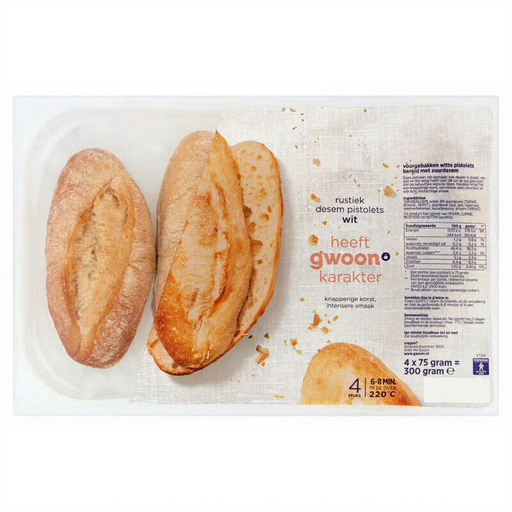 Image unavailable
g'woon White Rustic Pistolet, 4 rolls
Four rolls could work well for several planned snack breaks. The product description lists wheat and gluten; before packing one, check the label for other allergens and bear the school’s rules in mind. If you’re planning to have the rolls after school, read the preparation instructions on the packaging too.
View on Joybuy
Frequently asked questions
Can my child take a standard roll to school if there’s a child with an allergy in their class?
It depends on the specific school rules and the allergens that need to be considered. The standard rolls we looked at contain wheat and gluten, and may carry warnings about other allergens. If the allergy is relevant, speak to the school in advance about which snacks are allowed.
How can I tell if a roll contains grains with gluten?
Read the ingredients list and look for the grains listed, such as wheat, rye, barley or spelt. The Netherlands Food and Consumer Product Safety Authority states that allergens which must be declared should be clearly identifiable on the label. Check for any warnings about possible traces too.
Are multigrain rolls gluten-free?
You can’t tell from the name ‘multigrain’: the PLUS multigrain rolls we looked at contain wheat, rye and spelt, among other ingredients. If you need a gluten-free option, choose only a product explicitly labelled gluten-free and check its current label too.
How can I avoid having frozen rolls left unused?
Defrost only the amount you can use in time according to the packaging. The frozen rolls from Jumbo that we looked at must not be refrozen after defrosting and need to be prepared and eaten within 24 hours.


