
Parents who want to keep an eye on fibre
You’re looking for a roll for after school and want to compare the wholemeal flour content and fibre per 100 g, without the filling affecting the comparison.


Choose a roll for an after-school snack based on its shape, how much fibre you’re looking for and the preparation method that fits your schedule; ‘thick cut’ doesn’t refer to a standard size for rolls that are easy to fill. If you want to compare fibre content, check the nutritional information per 100 g and the ingredients list. If the roll is going to school or childcare, also check the allergen information and the setting’s food policy.
You’re looking for a roll for after school and want to compare the wholemeal flour content and fibre per 100 g, without the filling affecting the comparison.
You want to bake the rolls just before snack time and take your available oven or air fryer, storage instructions and any defrosting guidance into account when choosing.
Before packing a roll, check the allergens on the current packaging and the school or childcare setting’s rules on food and sharing.
First decide whether a shape that’s easy to fill, fibre content, allergen checks or convenient storage and baking matters most to you. Then compare the details of the specific roll: white, brown and multigrain don’t, on their own, tell you how large or sturdy it is.
| What to consider | What to check when buying | Who it matters to |
|---|---|---|
| Easy to fill | Look at the shape and, if listed, the weight of each roll. Judge the size for yourself rather than relying on ‘thick cut’. | If I want to fill a roll generously, its shape needs to suit my snack. For around 25% of consumers, ease of filling may be the top priority. |
| Fibre and ingredients | Compare fibre per 100 g and check how much wholemeal flour is listed in the ingredients; ‘multigrain’ doesn’t automatically mean wholemeal. | I want to be able to compare the fibre content of different rolls. For around 31% of consumers, this comparison may come first. |
| Allergens and school | Check the current ‘contains’ and ‘may contain’ statements, and ask about the school or childcare setting’s policy if needed. | If the roll is going to school, I want to know which allergens are listed and what rules apply there. For around 25% of consumers, this may be the most important requirement. |
| Preparation and storage | Check whether you can prepare the rolls in an oven or air fryer, and what instructions to follow after defrosting. | After school, I want to be able to prepare a roll from my stock without overlooking the storage instructions. Around 19% of consumers may make their choice mainly on this basis. |
A multigrain roll may contain ordinary flour as well as wholemeal flour. For example, PLUS lists 34% wholemeal wheat flour and 21% wheat flour in its multigrain sourdough rolls.
Read the ingredients list and compare fibre per 100 g if that matters to your choice.
The white and brown rolls reviewed contain wheat or other gluten-containing cereals. The colour and size of a roll don’t change its allergen information.
Check both ‘contains’ and ‘may contain’ on the packaging, and follow the school or childcare setting’s policy when packing food.
According to Jumbo’s product information, its white frozen rolls must be prepared and eaten within 24 hours of defrosting; this variety must not be refrozen.
Defrost only the portion you need and follow the instructions on the packaging you’ve chosen.
If you defrost more rolls than you can use within the stated time, you may have to throw them away.
Rolls aren’t pre-sliced loaves. So, without a stated measurement, the term doesn’t tell you how much space or sturdiness you’ll have for the filling.
Look at the shape and size of the roll itself; use the ingredients, nutritional information and preparation instructions to compare details that are actually shown on the packaging.
The brown multigrain sourdough roll reviewed is an example for anyone who wants to compare a roll individually, with its ingredients listed.
The white and brown frozen rolls reviewed are worth considering if you want to store rolls and prepare them later.
The bake-at-home rolls reviewed include white and multigrain varieties. Check the preparation instructions on each pack to see what suits your oven or air fryer.
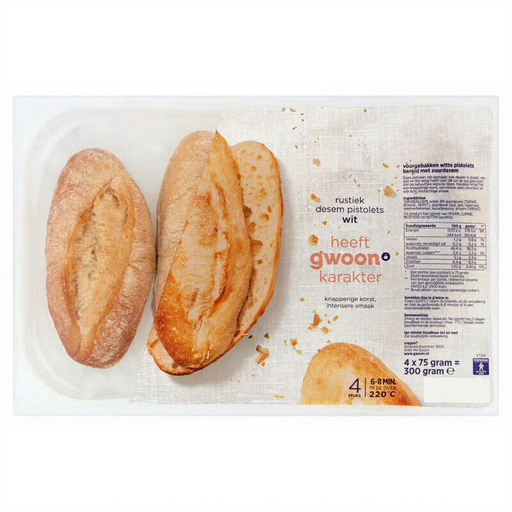
This white roll is an option if you’re looking for a base for an after-school snack. Compare its shape, nutritional information and allergens on the packaging if ease of filling or taking it with you is important.
 No image available
A white roll to use as the base for an after-school snack, supplied in a pack of 4.
If you want to compare fibre, check the current packaging to see whether the nutritional information is given per 100 g or per portion. If the roll is going to school, also check how gluten-containing cereals and other allergens are listed on the label.
If you mainly want to compare fibre content, the brown and multigrain varieties reviewed are worth a look: Jumbo, PLUS and Albert Heijn list 5.1 to 7 g of fibre per 100 g for these, compared with 2.5 to 2.7 g for the white examples reviewed. Check the label on the specific roll, as ‘multigrain’ doesn’t automatically mean wholemeal.
Don’t assume it is: the regular rolls reviewed contain wheat or other gluten-containing cereals. If you’re looking for a gluten-free product, check that the packaging explicitly describes your chosen product as gluten-free, and read the rest of the allergen information too.
Follow the preparation and storage instructions for the exact variety. PLUS recommends preparing the bake-at-home rolls reviewed in an oven or air fryer; according to Jumbo, the white frozen rolls reviewed must be prepared and eaten within 24 hours of defrosting and must not be refrozen.