What should you look for when buying?
Unsalted peanuts
A good fit if: you’re looking for a peanut snack and it fits within the agreed allergen rules.
Bear in mind: peanuts are a separate allergen; general nutritional values don’t necessarily apply to every brand.
Unsalted mixed nuts
A good fit if: variety between different types of nuts is your priority.
Bear in mind: ingredients and nutritional values depend on the mix.
A setting where nuts aren’t allowed
A good fit if: the current school or childcare policy excludes peanuts and nuts.
Bear in mind: another type of nut or peanut butter won’t necessarily be allowed either; choose a snack that meets the agreed requirements.
First check that the snack is suitable for the place where it will be eaten and complies with any allergen requirements. Then compare the nutritional values for the portion you give your child.
| What to consider |
What to look for |
Most relevant for |
| Protein per serving |
Compare the protein per 100 g on the label of the exact product and calculate it for the portion weight; also check the energy content for the same portion. |
If you mainly want to know how much protein the snack actually provides around sports, look at the portion eaten rather than the value per 100 g alone. Around 31% of consumers prioritise protein content. |
| Allergens and setting |
Check the label for peanuts and types of nuts, and ask about the school or childcare setting’s policy. |
If you need to consider an allergy, a young child or the setting’s rules, the snack must be suitable both for the person and the place where it will be eaten. Around 31% of consumers prioritise safety and suitability for the setting. |
| Portion and variety |
Compare protein and energy for the same portion size, and check which nuts are in the mix. |
If you’re looking for a regular snack at home with some variety, you’ll want to keep track of the portion and know what the mix contains. Around 23% of consumers focus mainly on portion size and variety. |
| Packaging and storage |
Check the net weight and storage instructions on the exact pack. |
If you use the snack regularly, the pack is practical when its size suits your needs and you can store the contents according to the label. Around 15% of consumers pay the most attention to packaging and practicality. |
Nut products at Joybuy
This selection includes unsalted peanuts, almonds and mixed nuts. For children under 4, the Voedingscentrum recommends nut butter with no added sugar or salt instead of whole nuts because of the risk of choking; older children can choke too. Amsterdam UMC advises children to eat slowly at the table and to have an adult stay with them when they eat whole nuts.
 No image available
g'woon unsalted peanuts 250 g
A peanut snack to compare by protein content per serving.
The product information lists 27 g of protein per 100 g and gives the ingredients as 99% peanuts and sunflower oil.
View at Joybuy
 No image available
g'woon raw unsalted almonds 200 g
An unsalted almond snack made with one type of nut.
The product information lists 24 g of protein per 100 g.
View at Joybuy
 No image available
g'woon unsalted mixed nuts 200 g
A mixed nut snack for anyone who likes variety.
The product information lists peanuts, almonds, cashews, Brazil nuts and hazelnuts, 20.1 g of protein per 100 g and 0 g of salt per 100 g.
View at Joybuy
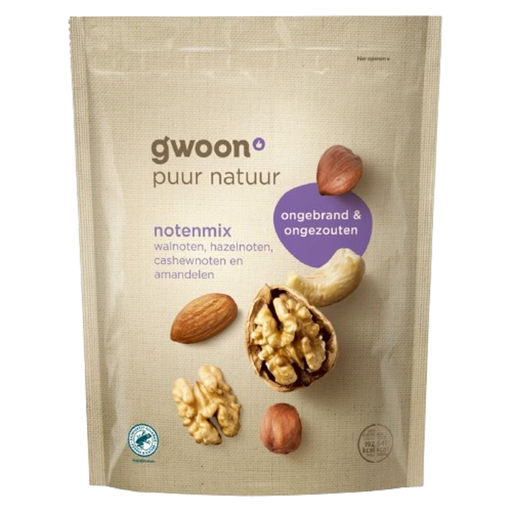 No image available
g'woon raw unsalted mixed nuts 200 g
A raw, unsalted mix if you’re looking for variety between types of nuts.
The product information lists hazelnuts, walnuts, almonds and cashews, with 19.1 g of protein per 100 g. It also mentions possible traces of peanuts.
View at Joybuy
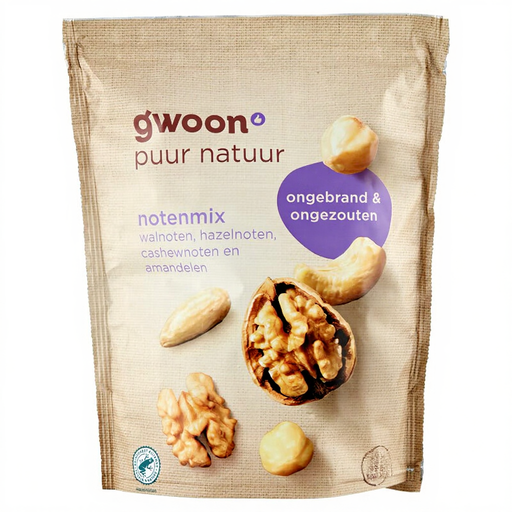 No image available
g'woon unroasted mixed nuts 500 g
A larger pack of mixed nuts to compare if you use several portions from one pack.
The product information lists hazelnuts, walnuts, almonds and cashews, possible traces of peanuts and other nuts, 16.9 g of protein per 100 g and 0 g of salt per 100 g.
View at Joybuy
Frequently asked questions
Does your child need extra protein after every training session?
Not necessarily. According to the Voedingscentrum, most athletes don’t need special protein shakes or bars if they eat a healthy, varied diet. This general advice doesn’t determine an individual child’s protein needs or prove that a nut product aids recovery.
How do you calculate the protein content per serving?
Multiply the protein value per 100 g by the portion weight, then divide by 100. For the 235 g Duyvis product, Flink lists 27 g of protein per 100 g; a sample 25 g portion therefore contains 6.75 g of protein. This sample portion isn’t daily guidance for children.
Can you give whole nuts to a young child?
For children under 4, the Voedingscentrum recommends nut butter with no added sugar or salt instead of whole nuts because of the risk of choking. Amsterdam UMC warns that older children can choke too, and advises children to eat slowly at the table with an adult staying with them.
Are peanuts an option if the school doesn’t allow nuts?
It depends on the policy at that particular setting. Peanuts and tree nuts are separate allergens, but a school may exclude both; OBS De Venen states that this applies across the whole school. So check the current rules at your child’s school or childcare setting.
Where can you check allergen information on a pre-packed snack?
Check the label on the exact pack. The Netherlands Food and Consumer Product Safety Authority states that allergen information must appear on the label of pre-packed products; peanuts and tree nuts are listed separately.


