
Parents looking for small snack portions
You’re looking for something sweet after school and want to compare the energy in the amount your child actually eats, without mistaking a small portion for a low-calorie product.


Of the three apricot products compared, AH Soaked Dried Apricots provide the least energy per 20 g portion: 36.4 kcal, compared with 47.4 kcal for Jumbo and 50.8 kcal for PLUS. This is a comparison by portion, not proof that the product is low in calories: according to the European Commission, solid foods must contain no more than 40 kcal per 100 g to make that claim, and all three products exceed this limit. Also compare ingredients, allergens and storage instructions. For children aged 4 to 12, the Dutch Nutrition Centre’s Wheel of Five remains the basis for a varied diet.
You’re looking for something sweet after school and want to compare the energy in the amount your child actually eats, without mistaking a small portion for a low-calorie product.
You check for added sugars and, if it’s relevant to your child, sulphites or other allergens. You check the label of the exact product, not just the type of fruit or the supermarket name.
You want to fit larger packs into your everyday shopping routine and consider portioning, storage and how to use the product after opening.
| What to consider | What to look for when buying | Who is this most relevant to? |
|---|---|---|
| Energy per portion | Compare kcal per 100 g and work out the amount for the portion you plan to serve. | I want to know how much energy is in the portion my child actually gets, not just in 100 g. Around 36% of consumers put energy per portion first. |
| Ingredients and allergens | Check the ingredients, total sugars and current allergen information on the pack. | If ingredients or allergens are relevant to my child, I check the label on that exact pack. This is the top priority for around 29% of consumers. |
| Convenience and storage | Check the storage instructions for after opening and consider whether you’ll need to portion it yourself. | For a snack I prepare in advance, portioning and storage need to fit into my routine. Everyday convenience is the top priority for around 21% of consumers. |
| Stocking up and packaging | Check the net weight and how much you’ll use before the quality starts to deteriorate. | With a larger bag, I want to be able to portion it out and use it in time. Getting good value when stocking up is the top priority for around 14% of consumers. |
The European Commission assesses the nutrition claim for solid foods per 100 g, not per snack portion you choose yourself. A smaller portion does not change the energy per 100 g.
Compare like-for-like portions if you want to assess the energy in each portion. Only use the low-calorie claim when the product meets the applicable limit.
PLUS Sultana Raisins state 0 g of added sugars, but the product label lists 68.2 g of total sugars per 100 g.
Check total sugars and energy alongside the ingredients list. The statement about added sugars doesn’t tell you how much total sugar the product contains.
The AH product compared contains water and has different energy and storage information from the regular apricots compared from Jumbo and PLUS.
Compare the same weights, specify which type you mean and check the storage instructions on the exact pack.
A retailer’s product description doesn’t prove that a product is low in calories or that a child will prefer its taste.
Use the description to understand how the product is presented, but base nutritional comparisons on the label of the exact product.
The product compared is AH Soaked Dried Apricots 250 g.
The product compared is Jumbo Dried Apricots, Pitted 250 g.
Alesto is relevant for its specifically named dried mango strips.
The Dutch product pages list Trader Joe’s raisins and sun-dried apricots.
The larger packs compared are PLUS Dried Apricots 375 g and PLUS Sultana Raisins 375 g.
Dirk lists 1 de Beste Apricots in a 375 g pack.
These dried apricots from Joybuy are ready-to-eat snack options. Compare the energy per 100 g and the ingredients: both products exceed the EU limit for the low-calorie claim.
 Image unavailable
An option if you’re looking for dried apricots that can be eaten straight from the pack.
Joybuy product information lists 311 kcal per 100 g, white sugar, maltose syrup and sulphites. Consume immediately after opening.
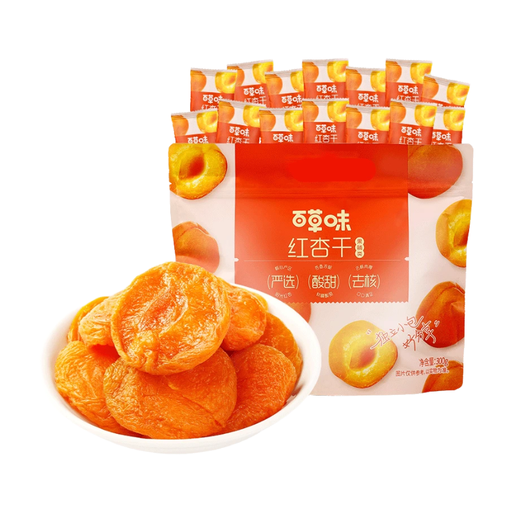 Image unavailable
The product description presents these as ready-to-eat apricots for a snack.
Joybuy product information lists 327 kcal per 100 g, sugar, maltose syrup and sulphites. The ingredients list states apricot (≥60%).
No. The Dutch Nutrition Centre recommends a maximum of 20 g of dried fruit per day as general guidance; this is not a legally prescribed portion for a single snack. The 20 g used in this comparison is a consistent basis for calculation, not individual dietary advice.
No. According to the European Commission, solid foods must contain no more than 40 kcal (170 kJ) per 100 g to make the low-calorie claim. The AH, Jumbo and PLUS apricots compared here all exceed that limit, whatever the portion size.
No. PLUS Sultana Raisins state 0 g of added sugars, but the label also lists 68.2 g of total sugars per 100 g. Check both figures and the ingredients list.
Not according to the instructions for AH Soaked Dried Apricots: Albert Heijn says to refrigerate them at a maximum of 7°C after opening and notes that they have a limited shelf life. Follow the instructions for the exact product.
Check the current ingredients and allergen warnings on the pack of the exact product. The Jumbo apricots compared contain sulphites and may contain nuts, peanuts and sesame; this warning does not automatically apply to other dried fruits.