
Viewers who care about dark scenes
You mainly watch films in a darkened room and want to make out shadows and bright details at the same time. RTINGS.com explains why contrast matters in a dark viewing environment.


Start by measuring the distance between the lens and the screen, and deciding how wide you want the image to be. Then choose a projector with a throw ratio and placement options that suit your setup. For adventure films in a dark room, performance in dark scenes matters too: RTINGS.com explains that contrast affects how clearly dark backgrounds and bright details remain visible side by side. A quoted brightness or contrast figure alone won’t tell you how shadow detail will look in your films.
You mainly watch films in a darkened room and want to make out shadows and bright details at the same time. RTINGS.com explains why contrast matters in a dark viewing environment.
You want the image to fall on a particular wall or screen, so you need to match the lens distance to the projector’s position. Epson and Nebula list optical placement options or a specified throw ratio for certain models.
You regularly rearrange your viewing space and may be looking for features such as automatic focus, streaming or built-in sound. XGIMI and Nebula list these features for certain models.
First, measure the lens distance and the image width you want. Then compare performance in dark scenes, the connections you need and the maintenance required for your chosen light source.
| What to consider | What should you check? | Who is this important for? |
|---|---|---|
| Shadow detail and contrast | Compare contrast measurements and the picture mode used; don’t rely on a dynamic contrast figure alone. | I want to make out both shadows and bright elements in dark scenes. Around 31% of consumers prioritise shadow detail. |
| Throw distance and image size | Measure the lens distance and image width, then check the throw ratio. Also look at the available zoom and lens-shift options. | I want to know in advance whether I can achieve the image width I want from my fixed position. Around 25% of consumers prioritise placement. |
| Sharpness and motion | Check the resolution the model displays and the motion processing available. | I’m most interested in landscape detail and fast-moving scenes on a large image. Around 19% of consumers give picture sharpness and motion top priority. |
| Streaming and sound | Check that the exact model has the apps, HDMI connections and audio connections you need. | I want to play my films using the devices and sound system I already have. Around 13% of consumers prioritise playback and sound. |
| Running costs and maintenance | Check the stated light-source life for the specified operating mode and make sure compatible replacement parts are available. | I want to know what maintenance and model-specific parts I might need in future. Around 12% of consumers prioritise running costs. |
How dark scenes look also depends on the content and the measurement method. A figure on the packaging won’t, by itself, tell you how dark areas in a film will appear.
Look at independent contrast measurements and check which picture mode was used, especially for scenes with both dark and bright areas.
A model may not be able to produce the image size you want from your intended position. The distance from the lens to the screen, divided by the desired image width, must fall within the model’s throw ratio.
Measure your room, then check the throw ratio and the practical space available for zoom or lens shift.
The stated life applies under the manufacturer’s specified conditions and doesn’t mean that all models need the same maintenance.
Check which operating mode the figure is based on. For lamp models, find the correct replacement part.
A lamp model may need a model-specific replacement lamp later on. Check in advance which part is compatible with the exact model.
The EH-TW7000 is worth considering if you’re looking for a fixed home cinema setup with optical placement options.
The W2720i is worth comparing if picture modes and connection to a separate sound system are important to you.
The HORIZON Ultra is a smart projector worth comparing if automatic setup and built-in sound are important to you.
The UHZ66 is a laser model worth comparing if stated light output, zoom and light-source maintenance matter to you.
The Cosmos 4K SE is worth comparing if you want to combine Google TV with a flexible viewing space.
These Joybuy products are portable projectors for a flexible viewing space. Don’t treat their stated resolution and light-source figures as proof of picture performance in dark scenes. Also check the throw ratio and connections for your setup.
 No image available
A good fit if you’re looking for a portable projector with built-in streaming; the product title lists Google TV and a built-in battery.
Full HD 1080p; 800 ANSI lumen; HDMI 2.1 and USB-C; stated battery life: 2H.
 No image available
A good fit if you’re looking for a flexible viewing setup with a projector screen and stand included.
Full HD 1080p; 250 ISO lumen; Google TV; JBL audio; built-in battery.
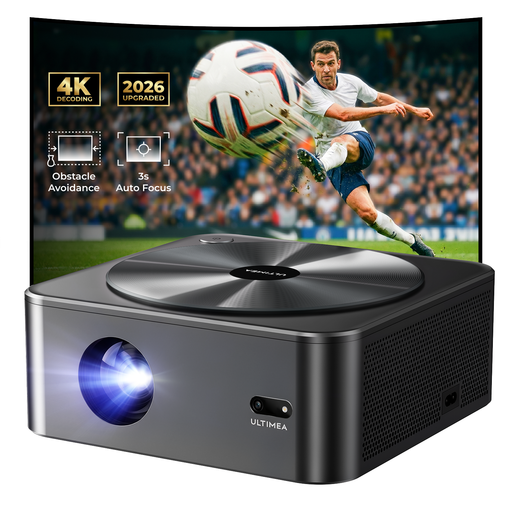 No image available
A good fit if you want to include automatic focus in your choice of a home projector.
1080p; HDR10; 700 ANSI lumen; automatic focus; Wi-Fi and Bluetooth.
 No image available
A good fit if you want to combine Google TV with flexible placement; the title mentions compatibility with a rotating ceiling mount.
Native 1080p Full HD; 520 ISO lumen; built-in Google TV; two 5 W speakers.
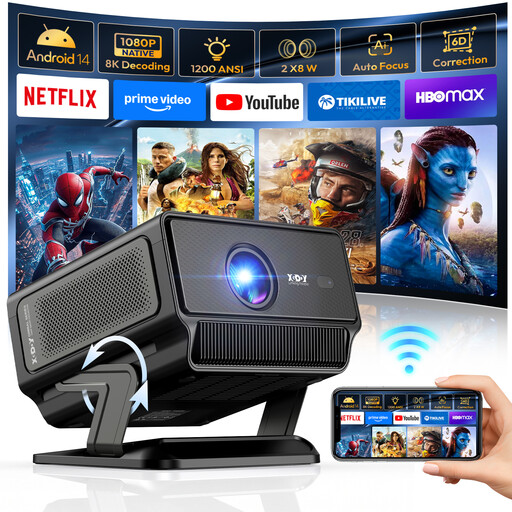 No image available
A good fit if you want to reposition your projector and value automatic focus and keystone correction.
Native 1080p; 1.200 ANSI lumen; Android 14.0; automatic focus and keystone correction; 2 GB RAM and 16 GB ROM.
Measure the distance from the lens position to the screen and the image width you want. Divide the distance by the image width and check that the result falls within the throw ratio of the exact model. Then check whether optical zoom or lens shift suits your fixed setup.
No. Check separately which resolution the model displays and which signals it processes through its connections. Epson uses the product name 4K PRO-UHD for the EH-TW7000; assess the performance of the specific model rather than relying solely on a supported-signal claim.
Check the manual to find out which lamp and any filters are compatible with the model. Epson states a lamp life of 5.000 hours in Eco mode for the EH-TW7000 and lists the ELPLP85 as a compatible replacement lamp; this figure isn’t a fixed replacement date.
When you buy from a business online, you usually have a 14-day cooling-off period, as explained by the Dutch government (Rijksoverheid). The Netherlands also has a statutory guarantee: if, under normal use, the product doesn’t do what you could reasonably expect, the seller is responsible for providing an appropriate solution. This doesn’t mean every projector has a fixed statutory guarantee period of two years; ACM ConsuWijzer explains the seller’s responsibility when a product breaks too soon.
Electrical and electronic products covered by EU rules that require CE marking must comply with those rules and carry the mark. The European Union’s Your Europe website explains CE marking requirements. Check the mark and product documentation for the specific model, as a brand name alone doesn’t demonstrate compliance.