
Vandaag of morgen in huis

Kwaliteit gegarandeerd

Welkomstaanbiedingen ontgrendelen: GRATIS bezorging | Tot 80% korting | Gratis 30 dagen JoyPlus-proefperiode
Download de app
Setting up a serious home gym often starts with one central piece of equipment: an adjustable weight bench with a squat rack. It's the cornerstone of your strength training. However, the market is flooded with models that look good at first glance but disappoint in practice. Many home athletes fall into the same traps: a wobbly construction, misleading specifications, or limited functionality.
As a Joybuy Product Recommendation Officer, I see it as my job to help you avoid these mistakes. We won't look at flashy ads, but at the specifications that truly matter. Let's break down the three most common pitfalls so you can make a purchase that will last for years.
To bypass the pitfalls, you need to shift your focus to a few concrete, verifiable specifications. These are the factors that determine the quality, safety, and versatility of your strength training bench.
Look past the marketing claims and search for the dynamic load capacity. For a serious home athlete looking to make progress, a dynamic capacity of at least 180 kg (user + weights) is a good starting point. This number is a direct indicator of the frame's robustness. A frame made of high-grade alloy steel with a solid powder coating not only provides the necessary sturdiness but is also more resistant to corrosion.
A versatile adjustable weight bench with multiple positions is essential for a complete workout. Check the number of backrest positions (minimum 4-5, including flat, incline, and decline) and the seat adjustments. For a squat rack with a bench, it's crucial that the uprights and safety hooks are adjustable to various heights to suit your body and the exercises you want to perform. Also, measure the total dimensions of the unit and compare them with the available space in your home gym. For smaller spaces, a foldable weight bench can be a smart choice.
Not everyone has the same needs. That's why we've highlighted a few options that fit different training profiles, based on their objective specifications.
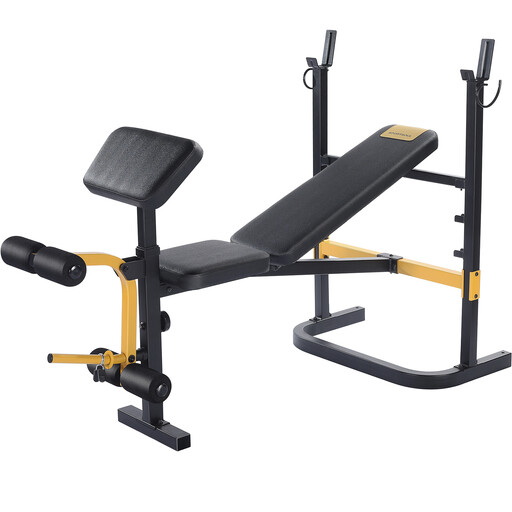
Why This Fits Their Persona: This user is looking for a complete and space-saving solution for heavy compound exercises like bench presses, squats, and leg extensions, without needing to buy separate pieces of equipment.
This model specifies a dynamic load capacity of 186 kg, providing clarity on its true capability. The alloy steel construction addresses the pitfall of instability.
Combines a squat rack, adjustable bench, and leg developer into one unit. The backrest has 4 adjustment positions, and the preacher curl pad is removable for maximum versatility.

Why This Fits Their Persona: This athlete wants a combination of weight training and bodyweight exercises like pull-ups and dips. Versatility and a wide range of exercises are more important than maximum weight capacity.
The heavy-duty steel frame is designed for the combined load of bodyweight and free weights, tackling the instability pitfall common in multi-function machines.
Integrates a power tower (pull-up/dip station) with a weight bench. This offers an exceptionally wide range of full-body exercises in a relatively small footprint.
We've compiled a complete, up-to-date list of products that fully meet these strict selection criteria and safety standards.
The static load capacity is the maximum weight a unit can support while stationary. The dynamic load capacity is the maximum weight (user + barbell) the unit can safely support during an exercise. For strength training, the dynamic load capacity is the only specification that matters for your safety.
Although a good squat rack with a bench is equipped with safety hooks that can catch the bar, it is always recommended to train with a spotter when lifting heavy weights or training to muscle failure. The safety hooks are an emergency measure, not a substitute for an attentive training partner.
Plan for a minimum floor area of about 2.5 by 2.5 meters. This gives you enough room to safely handle the barbell (usually 2.20 meters) and to move around the equipment. Always measure the dimensions of the specific product and account for extra clearance for movement.
