If you don’t have a suitable amplifier, an active stereo pair is the simpler choice for listening to brass band music in your home office. If you already have a suitable amplifier and enough space, passive bookshelf speakers are another option. The specifications available won’t tell you which model sounds best to you, so, if possible, listen to familiar recordings and check that the pair suits your desk and music source.
Who is this buying guide for?
Listener with a small desk
You want to fit two speakers without them taking over your work surface. Start by checking the space available and the dimensions of the exact model. Genelec lists the dimensions of the 8010A, while Audioengine describes the A2+ Gen 3 as a compact desktop system.
Listener without an amplifier
You want to play music from a computer or phone without buying a separate amplifier. Active models such as the Edifier R1700BT and Audioengine A2+ Gen 3 are worth comparing; check that their inputs suit your source.
Listener with a hi-fi amplifier
You already have a suitable amplifier or deliberately want a separate hi-fi set-up. Passive models such as the KEF Q1 Meta and Wharfedale DIAMOND 12.2i are options to explore; remember to allow for cables and space for the speakers too.
What should you look for when buying?
First, decide whether you already have a suitable amplifier. Then compare the connection to your music source and the space available for two speakers. Use familiar brass band recordings to assess the sound: specifications alone can’t tell you how the music will sound in your room.
| What to consider |
What to look for |
Who is this important for? |
| Listening experience |
Listen to familiar recordings from your usual listening position; don’t treat a single specification as an assessment of sound quality. |
If I want to know how my brass band recordings sound, I want to listen to them in my own set-up. Around 33% of consumers put the listening experience first. |
| Placement |
Measure the space for both speakers and consider where you’ll be listening. |
If I have limited space on or around my desk, a stereo pair needs to fit practically in that space. Around 25% of consumers say placement is their main consideration. |
| Connection |
Check the output on your computer or other source and the input on the exact model. |
If I want to connect my existing computer or phone without unnecessary extra steps, the connection needs to match my source. Around 25% of consumers prioritise the connection to their music source. |
| Amplifier and system |
Check whether the pair is active or passive and what equipment you already have. |
If I don’t yet have a suitable amplifier, I want to know in advance what components I’ll need for a working set-up. Around 17% of consumers focus mainly on the amplifier and overall system set-up. |
Things to watch out for when buying
-
Treating a passive pair as a complete computer speaker system
Passive speakers need a suitable separate amplifier. Without one, the pair won’t provide a complete connection to your computer on its own.
Before choosing, check which amplifier and cables you already have and what else you’ll need.
A passive set-up may also require a suitable amplifier and cables.
-
Choosing a model based only on its power rating or the manufacturer’s claims
A specification or manufacturer’s claim isn’t a comparative listening test using your brass band recordings in your room.
Use the specifications to check the size and connections. Assess the sound separately using familiar music.
-
Confusing model generations or the number of speakers included
Different versions of a model may have different connections, and an offer may be described as either a single speaker or a pair.
Check the full model name, generation, quantity included and connections for the version you’ve chosen.
Brands to consider
Edifier
Active bookshelf speakers such as the R1700BT may suit you if you want to listen via Bluetooth without a separate amplifier.
- Edifier lists Bluetooth and built-in amplification for the R1700BT.
- Check that the connections on the exact version suit your computer; the specifications aren’t a listening comparison for brass band music.
Audioengine
The A2+ Gen 3 is a compact active system to consider for playing music from a computer.
- Audioengine lists USB-C, Bluetooth and an analogue connection for the A2+ Gen 3.
- Check the full generation name and make sure the connections suit your source.
KEF
The Q1 Meta is a passive bookshelf model for a set-up with a separate amplifier.
- KEF presents the Q1 Meta as part of a hi-fi system.
- Factor the amplifier and placement into your choice; the manufacturer’s description isn’t an independent listening comparison.
Wharfedale
The DIAMOND 12.2i is a passive bookshelf model for anyone considering a separate hi-fi set-up.
- The DIAMOND 12.2i is a distinct model.
- Don’t confuse this model with the 12.2 or 12.1i. Allow for an amplifier and the space available.
Genelec
The active 8010A is a compact studio monitor for a listening space with suitable analogue connection equipment.
- Genelec lists an XLR input and dimensions of 195 × 121 × 115 mm with Iso-Pod for the 8010A.
- Check your source, cables and how many speakers you need; these specifications aren’t a listening test for brass band music.
Joybuy products
These are passive bookshelf speaker pairs for a set-up with a separate amplifier. Before buying, check that the version you’ve chosen is suitable for your amplifier and connections, and that you have enough space.
 No image available
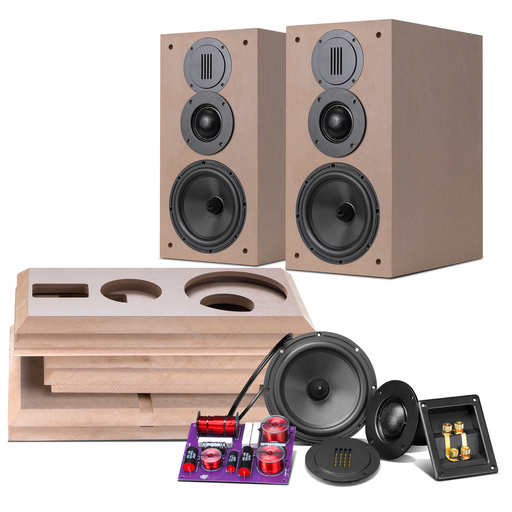
HiVi-Swans DIY3.1 passive bookshelf speakers, 6.5 inches, one pair
A passive pair for stereo listening with a separate amplifier.
Passive 2-way bass reflex design; 6.5-inch and 28 mm drivers. A suitable amplifier is required.
Joybuy
 No image available
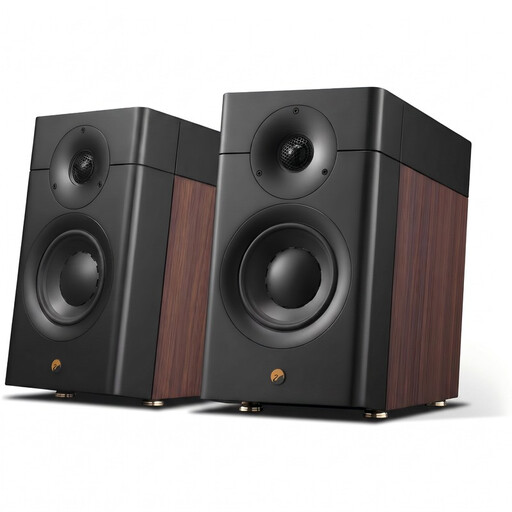
HiVi-Swans D3.1MKII passive bookshelf speakers, 6.5 inches, one pair
A passive stereo pair for a listening space where you use a separate amplifier.
The product information lists a 6.5-inch bass-midrange driver and a 28 mm soft dome tweeter. A separate amplifier is required.
Joybuy
Frequently asked questions
Can I connect passive bookshelf speakers directly to my computer?
Not as a complete working system: a passive model needs a suitable separate amplifier. Choose an active model if you don’t want to add that component, then check that its input suits your computer.
How should I start arranging two speakers in my home office?
First, set aside space for both speakers and assess the arrangement from your usual listening position. Also check the placement guidance for the exact model.
Who should I contact if a speaker I bought online is faulty?
According to the Netherlands Government, if there’s a problem with a product, the seller—not the manufacturer—must provide a solution. In many cases, distance purchases also come with a 14-day cooling-off period; the terms that apply depend on the specific purchase.
Which Dutch product rules apply to active speakers with Bluetooth?
Business.gov.nl lists the Radio Equipment Directive for equipment with Bluetooth; the applicable CE rules vary by product group. Check the documentation for the exact version, as a product listing alone doesn’t confirm that a specific item meets all applicable requirements.


