
Vandaag of morgen in huis

Kwaliteit gegarandeerd

Welkomstaanbiedingen ontgrendelen: GRATIS bezorging | Tot 80% korting | Gratis 30 dagen JoyPlus-proefperiode
Download de app
An acrylic marker set may seem straightforward: choose a few colours, press down the nib and start drawing. In practice, acrylic markers vary considerably in coverage, nib size, compatible surfaces and durability. As a result, an inexpensive set may be less suitable for glass, ceramic or wood than the packaging suggests.
For creative adults, hobbyists, artists, crafters and children aged 7 and over, three pitfalls are particularly important:
With the right specifications, you can find acrylic markers that suit your project more quickly, without relying solely on marketing claims.
Acrylic markers contain paint ink rather than standard writing ink. For a clear mark on dark paper, wood or ceramic, opaque, highly pigmented ink is a practical choice. According to Faber-Castell’s product information, the sets mentioned contain highly pigmented, opaque water-based acrylic ink.
This says something about the formulation and intended use, but not automatically about the final durability on every surface. Always test the marker first on an inconspicuous area of the material. Adhesion, drying time and resistance to wear can vary particularly on glass, plastic and textiles.
Also consider the colour selection. A basic set containing white, yellow, red, green, blue and black is suitable for general DIY projects. Metallic acrylic markers are more interesting for accents, gift packaging, decorative cards and dark surfaces.
A set with multiple nib sizes gives you greater control:
According to the product information, the Faber-Castell sets in this selection feature two nib sizes: 1 mm and 3 mm. This combination is useful when you do not want to buy several individual markers straight away.
Many acrylic markers use a shake-and-pump system. The pigments need to be mixed before use. According to the product information, the recommended method for the Faber-Castell Acrylic Marker Sets is:
Store the marker tightly capped afterwards. A loose cap can cause the nib to dry out. For intensive use, an ink level indicator is useful, as it gives you a better idea of when a marker is nearly empty.
Acrylic markers can be used on a range of materials, but preparing the surface remains important.
Use black acrylic markers for outlines and contrast. White markers are useful for highlights, dark surfaces and hand lettering. Paint markers in metallic colours add decorative details, but visibility may vary depending on the material.
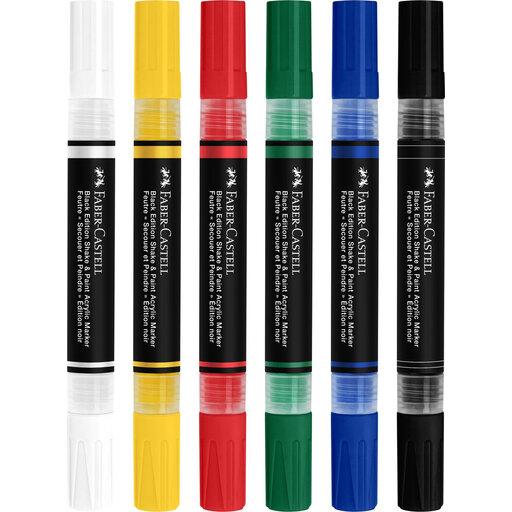
Why it’s a good fit: A well-organised foundation for cards, canvas, wood and other creative projects at home.
The set specifies the six individual colours and two nib sizes, so you know exactly what you are receiving.
White, yellow, red, green, blue and black; 1 mm and 3 mm nibs; ink level indicator and shake-and-pump function.
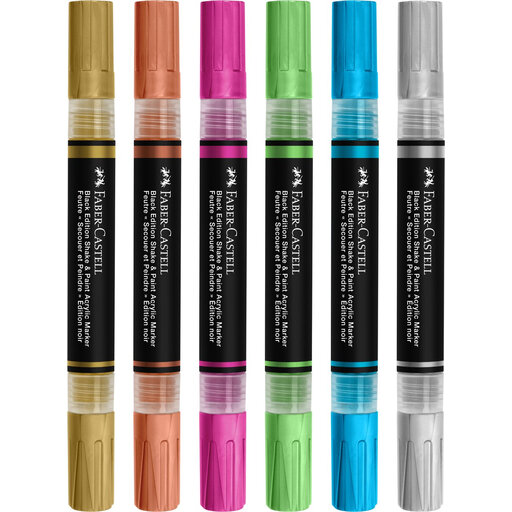
Why it’s a good fit: Designed for decorative projects where gold, silver, bronze and other metallic shades take centre stage.
The colour category is clearly defined as six metallic colours rather than a vague claim about special effects.
Gold, bronze, pink, blue, green and silver; 1 mm and 3 mm nibs; water-based acrylic ink and ink level indicator.
Why it’s a good fit: A practical choice for users who switch between paper, wood, glass, ceramic, metal, plastic, textiles, stone and canvas.
The product information names the specific materials. Still, test each surface and check the required level of wear resistance before use.
Opaque water-based acrylic ink, two nib sizes and an activation method that you can repeat whenever the ink does not flow evenly.

Why it’s a good fit: This is not a marker, but an additional storage solution for keeping acrylic markers visible, organised and within easy reach.
A dedicated place helps prevent markers from being left uncapped or stored horizontally among other materials.
Desktop storage for creative materials; check the dimensions before ordering.
Browse a current selection of acrylic products for creative projects, decoration and DIY applications.
Work on a protected table wherever possible and use scrap paper to get the ink flowing before you begin. Shake the marker with the cap on to reduce splattering. Keep colours separate and recap each marker immediately after use.
Supervision is advisable for children aged 7 and over, especially when working on projects involving glass, ceramic or small parts. Also check the age information and warnings on the packaging. According to the product details, the metallic set states a recommended minimum age of 7.
According to the product information provided, a statutory minimum two-year guarantee applies to the Faber-Castell sets within the EU. This is separate from the question of how long a mark will remain visible on a particular surface.
Not automatically. The Faber-Castell sets are described as markers containing water-based acrylic ink. This describes the ink base, but does not provide a general guarantee of water resistance once dry. If you plan to wipe down an item or use it outdoors, test adhesion first and look for specific information about sealing or protection.
Its lifespan depends on the number of lines drawn, pressure applied to the nib, the surface and how the marker is stored. A broad nib uses ink more quickly on large areas than a fine nib. Keeping the cap securely closed and activating the marker according to the instructions reduces the risk of uneven ink flow.
According to the product information for the Faber-Castell markers mentioned, they can be used on multiple surfaces. Results may vary from one surface to another. Clean smooth materials, allow them to dry and test a small area first. For textiles and objects that are washed or handled frequently, check the care information particularly carefully.
