
Microphone user checking compatibility
You’re not sure whether your transmitter supports NiMH AAs and want to avoid buying batteries that aren’t suitable. Sennheiser advises against using NiMH AAs in its EW-D and EW-DX transmitters.


First, check the manual for your exact microphone to see whether rechargeable AA batteries and the relevant battery chemistry are supported. If NiMH AAs are suitable, a charger with independent charging channels can be useful for charging individual batteries; a starter set is a better choice if you still need batteries and can charge them in advance. A fast charger is only helpful if its charging time suits the number and type of batteries you use.
You’re not sure whether your transmitter supports NiMH AAs and want to avoid buying batteries that aren’t suitable. Sennheiser advises against using NiMH AAs in its EW-D and EW-DX transmitters.
You swap batteries around calls or recordings and want to charge individual batteries and check their charge status. Panasonic describes the BQ-CC55 as a charger for one to four AA or AAA batteries, charged individually.
You don’t have any rechargeable AAs yet and are looking for a charger with a suitable first set, without paying for features you don’t need. Energizer describes its Dutch Pro Charger as coming with four AA NiMH batteries.
Choose this if: the manual allows NiMH AAs and you want to charge individual batteries too.
Bear in mind: Panasonic describes the BQ-CC55 as suitable for one to four AA or AAA batteries; check the charging time for your batteries.
Choose this if: your microphone supports NiMH AAs and you still need batteries.
Bear in mind: the Energizer Pro Charger is described as coming with four AA batteries and charging two or four batteries; it can’t charge just one battery.
Choose this option if: the manual advises against NiMH AAs or specifies a proprietary battery pack.
Bear in mind: Sennheiser’s advice for EW-D and EW-DX transmitters doesn’t automatically apply to other microphones; check the exact model.
| Consideration | What to look for | Who is this important to? |
|---|---|---|
| Compatibility | Check the requirements for your exact transmitter model and make sure the battery chemistry is supported. | If I’m not sure which transmitter model I have, I want to avoid finding out that the AA size is right but the battery chemistry is wrong. Around 36% of consumers put microphone compatibility first. |
| Charging channels | Check whether you can charge one to four batteries individually and see the charge status of each one. | For a spare pair or individual batteries, I want to know which one is ready without having to charge a complete pair each time. Around 29% of consumers prioritise flexible charging and visibility of charge status. |
| Charging time | Compare times for the same number of AA batteries, taking the battery and its capacity into account. | If I need to top up the charge shortly before a call or recording, the time it takes to charge my own number of batteries matters. Around 21% of consumers prioritise preparation time. |
| Complete set | Check how many batteries are included and whether their chemistry is suitable for your microphone. | If I don’t have any rechargeable AAs yet, I want to check whether the charger and batteries together meet my needs. Around 14% of consumers put buying a complete charger and battery set at the top of their list. |
The size alone doesn’t tell you which battery chemistry your transmitter supports. For example, Sennheiser advises against NiMH AAs in its EW-D and EW-DX transmitters.
Check the battery requirements for your exact microphone model before choosing a charger and batteries.
Charging time can vary depending on the charger, batteries and number of cells. A time quoted for a small number of batteries won’t necessarily apply to a full set.
Compare the stated times for the number of batteries you use and allow enough time before a call or recording.
A set may include batteries, whereas you might need to buy them separately with a standalone charger.
Check everything included in the package and make sure the supplied or separately chosen battery chemistry is suitable for your microphone.
If you buy a standalone charger, you may still need to buy suitable AA batteries separately.
The eneloop BQ-CC55 is a NiMH charger that can charge one to four AA or AAA batteries individually.
The Dutch Recharge Pro Charger is designed for two or four NiMH AA or AAA batteries and is described as coming with four AA batteries.
The LCD Charger+ range includes several NiMH chargers; the number of charging slots varies by model.
These Joybuy product options are chargers or sets for rechargeable AA batteries. Check your microphone’s battery chemistry before choosing.
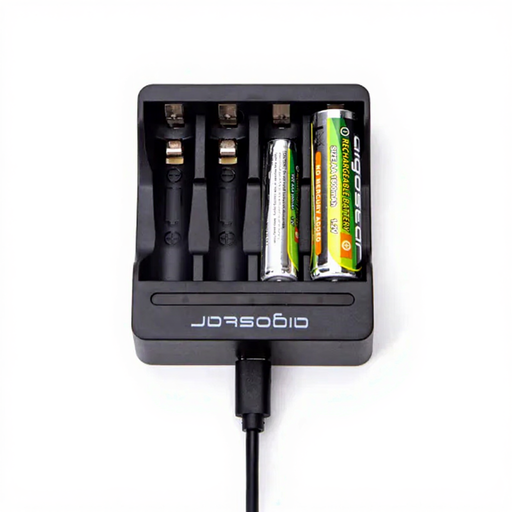 No image available
An option if your microphone’s manual allows NiMH AAs and you want to be able to charge individual batteries.
The product name describes a charger for 4 AA/AAA batteries.
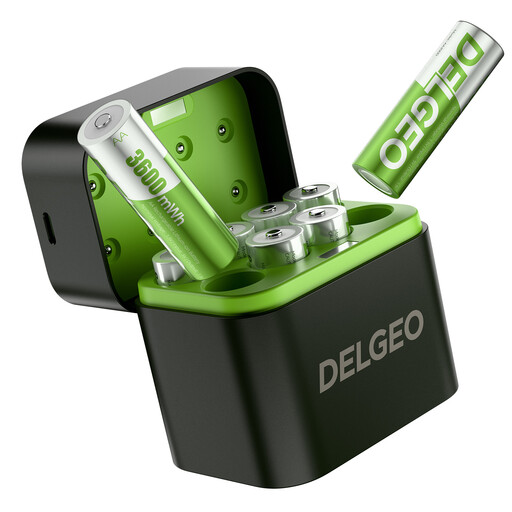 No image available
Only consider this set if the manual for your exact microphone allows rechargeable lithium AA batteries.
The product name lists eight batteries, 1,5 V constant output, 3.600 mWh and a charger with a stated charging time of 2,5 hours.
No, follow the manual for your exact transmitter model. Sennheiser specifically advises against NiMH AAs in EW-D and EW-DX transmitters; this advice doesn’t automatically tell you what’s suitable for other microphones.
No, it depends on the model. Panasonic describes the BQ-CC55 as suitable for charging one to four batteries individually; Energizer describes the Dutch Pro Charger as suitable for two or four batteries. Follow the plus and minus markings on the charger.
Don’t put used household batteries in your general rubbish. The Dutch government advises taking them to a collection point.
No, the Netherlands has no fixed statutory warranty period. The Dutch government says what you can expect from a product depends on factors including the product itself and the sales information; report a faulty product to the seller.
No, the European Commission gives 14 December 2028 as the date when the new requirements described will take effect. For chargers for loose AA or AAA batteries, the Commission describes a scope covering models that don’t plug directly into a mains socket; this doesn’t tell you whether a specific model complies with the rules.