
Microphone users with few spare sockets
You want to prepare AA batteries using an available USB power source, without needing a separate mains plug for the charger. Panasonic Energy and GP Batteries Nederland describe USB-powered charging options.


First, check your transmitter’s manual to see whether rechargeable AA batteries are allowed; a compatible charger cannot make incompatible batteries suitable. If you already have a suitable USB power source, compare how many cells it can charge at once, whether it monitors each cell individually and how long charging takes. A mains charger is still an option if you can free up a socket while charging.
You want to prepare AA batteries using an available USB power source, without needing a separate mains plug for the charger. Panasonic Energy and GP Batteries Nederland describe USB-powered charging options.
You want to prepare several cells and see how charging is progressing. Panasonic Energy and GP Batteries Nederland describe chargers with different charging configurations.
You want to check which cells and cables are included, and whether the chosen battery chemistry is suitable for your microphone transmitter. Check this before choosing a charger or starter set.
Start with a practical power source and the battery chemistry permitted by your transmitter. Then compare the charging channels, capacity and contents of any starter set.
| What to consider | What should you check? | Who will find this most important? |
|---|---|---|
| Power when sockets are limited | Check the USB connection, the power supply required, and whether a cable and adapter are included. | If there’s no spare socket, I want to be able to charge using a suitable USB source. Around 36% of consumers in this situation give USB power top priority. |
| Compatibility with the transmitter and batteries | Check the transmitter manual for the permitted battery chemistry and compare it with the cells supported by the charger. | I don’t want to buy batteries that my transmitter doesn’t allow, or that make the battery indicator behave differently than expected. Around 29% of consumers give compatibility top priority. |
| Charging slots and monitoring | Compare the number of slots with the number of independent charging channels, and check the charging status and stated charging time. | When I rotate between several sets during sessions, I want to be able to charge enough cells at once and monitor their progress. Around 21% of consumers prioritise charging capacity and monitoring. |
| What’s included in a starter set | Check how many AA cells are included, and whether a cable or power source is supplied. | If I’m putting together my first set, I want to know which parts I’ll still need and whether the included cells are compatible with my transmitter. Around 14% of consumers give a complete starter set top priority. |
The number of slots doesn’t automatically tell you how many cells are managed individually. GP Batteries lists four slots and two channels for the B421; Panasonic describes individual cell monitoring for the BQ-CC87.
Compare the channel configuration, not just the number of visible slots.
A USB connection doesn’t automatically mean that a mains adapter comes with the charger. Panasonic states that the adapter for the BQ-CC87 is not included.
Check what’s in the box and decide in advance which suitable USB power source you’ll use.
If you don’t have a suitable USB power source, you may need an adapter or another power source.
Your transmitter must also support the battery chemistry. Shure allows NiMH AAs in QLX-D transmitters, but warns that the battery meter may be inaccurate; this does not automatically apply to other models.
Consult the manual for your own transmitter and test a fully charged set in advance.
A charger that plugs directly into a socket won’t solve a shortage of spare sockets.
First choose a power option that will be available while you prepare, then compare the charging features.
The BQ-CC87 is a USB-powered charger for compatible eneloop cells.
The ReCyko B421 is a USB charger sold as a set with four NiMH AA cells.
The Basic IV + 4× AA 1300mAh is a USB starter set with rechargeable cells.
The VC4SL is a USB-C charger with extra features for users with several supported battery types.
These product options include USB-powered AA charging solutions. Before buying, check that the supported battery chemistry is compatible with your microphone transmitter’s manual.
 No image available
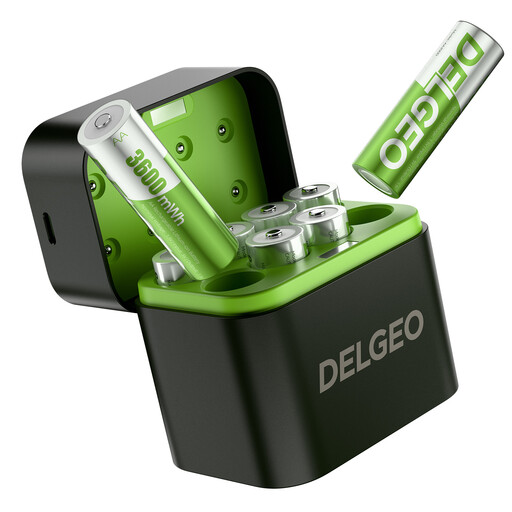
The product listing describes a USB-C charger for eight AA batteries; check whether lithium AAs are permitted in your microphone transmitter.
The title states a 2.5-hour charging time, 3600mWh, 1.5V constant output and 2000 cycles. Check how these specifications apply to your equipment and what they mean.
 No image available
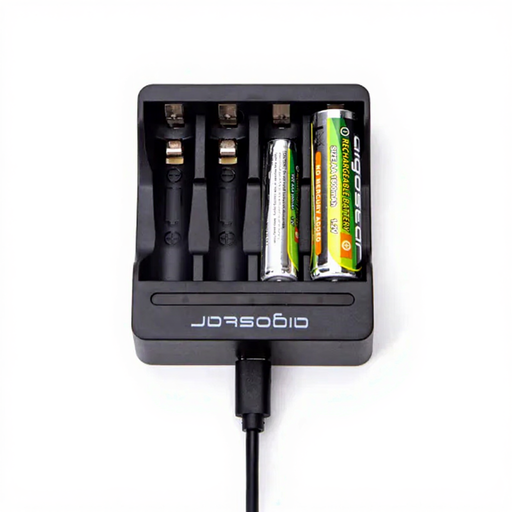
This USB-powered charger may suit anyone preparing compatible NiMH or NiCd AA cells; first check which battery chemistry your transmitter allows.
The product description lists four independent channels for AA/AAA cells and an included USB cable.
No. Check your transmitter’s manual. Shure allows NiMH AAs in QLX-D transmitters, but warns that the battery meter may be inaccurate; this does not confirm that other models support these cells.
Only if you already have a suitable USB power source. Panasonic Energy specifies a USB power supply for the BQ-CC87 and states that the mains adapter is not included.
Not in the Panasonic BQ-CC87: Panasonic explicitly warns against charging dry batteries in it. Check which battery chemistries each charger supports and follow the instructions for use.
According to the Dutch government, used batteries must not go in general waste. You can take them to shops that sell batteries, among other collection points. For an old charger, the Dutch government describes a ‘new for old’ scheme when you buy a new, similar appliance; there are other collection points too.
Check whether the set includes batteries, a cable and a suitable USB power source. GP Batteries lists four AA cells with the B421 set, ANSMANN lists four AA cells and a cable with the Basic IV set, and Panasonic Energy states that the adapter is not included with the BQ-CC87.