
Technician using an AA transmitter
Wants to check first that the cell chemistry and charging method are suitable for their transmitter. Shure says that NiMH cells can be used with the QLX-D series, but the battery meter may be inaccurate.


Start by checking your microphone transmitter’s manual: only use a battery chemistry approved for the transmitter. Then choose a charger based on the USB or mains power available, the charging status you want for each cell and how much preparation time you have. Manufacturers’ charging times apply only under the stated test conditions. Before buying, also check that the version on offer carries the required CE marking.
Wants to check first that the cell chemistry and charging method are suitable for their transmitter. Shure says that NiMH cells can be used with the QLX-D series, but the battery meter may be inaccurate.
Needs cells ready for a performance or presentation, so checks charging times alongside their conditions rather than relying on a short time claim alone.
Wants to pack the charger and cells compactly, and know in advance which USB power supply or adapter is needed.
| What to consider | What to look for | Who should prioritise this? |
|---|---|---|
| Compatibility | Check the transmitter’s manual to see which cell chemistries are approved. Shure provides this information for the QLX-D series; it does not automatically apply to other transmitters. | If I’m taking an AA transmitter, I want to make sure it accepts my chosen rechargeable chemistry first. Around 33% of consumers put compatibility first. |
| Charging time | VARTA gives a charging time of an hour and a half for type 57684, based on two 1600 mAh AA cells and a suitable PD power supply. Duracell says the CEF27 takes around 45 minutes to reach approximately 85% charge when used with 1300 mAh Duracell AA NiMH cells. These figures are based on different conditions and do not guarantee a full set will be charged. | When I have little time before a performance, I want to know how many cells will be ready under the stated conditions. Around 27% of consumers prioritise preparation time. |
| Power supply and portability | Check the required input and whether an adapter is included. GP specifies a 5 V/1 A USB power supply for the B421; VARTA says the PD adapter required for type 57684 is not included. | If I have limited space in a hotel room, I want to charge using the power supply available and pack the set compactly. Around 20% of consumers prioritise power supply and portability. |
| Charging status for each cell | Panasonic specifies individual control for compatible cells in the BQ-CC87. According to GP, the B421 has four slots and two charging channels, so four slots do not mean four independent channels. | When I have several microphone cells, I want to keep track of their charge status and repeated use. Around 20% of consumers prioritise cell management and ongoing costs. |
Manufacturers base charging times on specific cell capacities and quantities, and sometimes on a partial charge. The stated time may therefore not apply to your entire set.
Compare the number of cells, their capacity and the power supply required with the manufacturer’s test conditions.
According to GP, the GP B421 has four slots but only two charging channels, while Panasonic specifies individual control for the BQ-CC87.
Check the specifications to see how many charging channels there are and how each cell is charged.
Panasonic warns against charging ordinary dry batteries in the BQ-CC87 and advises against mixing battery types in a device. Using batteries incorrectly can damage the cells or equipment.
Keep rechargeable cells clearly separated and follow the manuals for the transmitter, batteries and charger.
The BQ-CC87 we looked at uses USB power, while the BQ-CC55 runs on mains power. Panasonic describes individual control for compatible cells in both models.
The ReCyko B421 we looked at is a USB NiMH charger with four slots and a case that GP says can also be used to store batteries.
According to VARTA, the LCD Smart Charger+ type 57684 is designed for AA and AAA NiMH cells and has individual slots, a display and a USB-C PD input.
According to Duracell, the Hi-Speed Advanced Charger CEF27 is designed for AA and AAA cells and can charge two or four at a time.
This Joybuy pick is a compact USB charger for AA and AAA cells with individual charging channels. First check that your transmitter supports your chosen cell chemistry and that the version on offer carries the required CE marking.
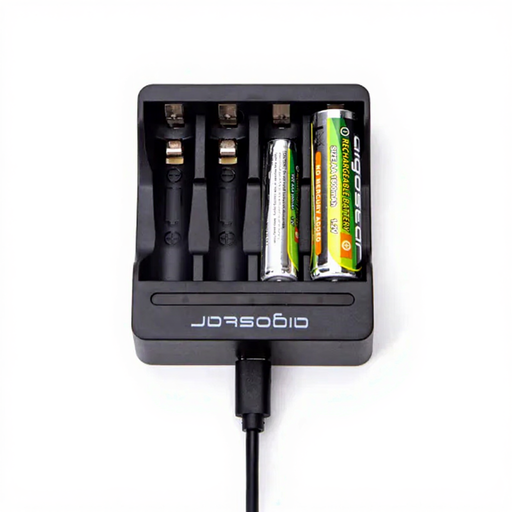 Image unavailable
For hotel use with USB power, this charger could be a good fit if your transmitter supports the NiMH or NiCd cells you’ve chosen.
The product description specifies individual charging channels, LED charging status indicators and automatic shut-off once charging is complete. The USB input is DC 5 V/1 A and a USB cable is included. Its dimensions are 75 × 66 × 25.2 mm.
Before considering this as a buying option, check that the version on offer carries the required CE marking.
No. The AA size alone does not mean a battery is suitable. Check the manual for your specific transmitter to find out which cell types are approved. Shure says NiMH cells can be used with QLX-D, but the battery meter may be inaccurate; this does not automatically apply to other transmitters.
That depends on the charger. Panasonic says the BQ-CC87 can charge one to four compatible cells individually; GP specifies four slots and two charging channels for the B421. Also check how many cells your transmitter uses.
Not necessarily. Panasonic says the BQ-CC87 does not come with a USB power adapter; VARTA also says the PD adapter required for type 57684 is not included. Check what’s in the box and the input requirements for the version you’re considering.
In the Netherlands, your statutory guarantee is separate from any manufacturer’s warranty. ACM ConsuWijzer says that, subject to the applicable conditions, the seller must put a faulty product right free of charge, for example by repairing or replacing it.
According to the Netherlands Food and Consumer Product Safety Authority, CE marking is compulsory for electrical products; this does not confirm that a specific version meets all applicable requirements. The Dutch government says used batteries must be taken to a collection point and must not be put in the bin.