First, check your microphone’s manual to see whether it accepts rechargeable AA cells of the type you’re considering: AA describes the size, not whether a cell is suitable. Shure lists different cell voltages for alkaline and Ni-Cd batteries, while IKEA specifies that the STENKOL charger is for rechargeable NiMH cells only. Then choose a charger with the right chemistry and enough charging channels for your spare set. Compare charging times only when the number and capacity of the cells are the same. Use the charger indoors in a dry place, as IKEA specifies for the STENKOL.
Who is this buying guide for?
Microphone users with spare sets
You want to have charged AA batteries ready, so a flat set doesn’t catch you out while you’re using your microphone. First, check which type of battery your microphone accepts; the AA size alone doesn’t tell you enough.
Users short on preparation time
You’re charging shortly before a recording or event and want to compare charging times for the same number and capacity of cells.
Home users with limited charging space
You’re looking for a tidy charging spot on a dry part of your kitchen worktop and want to know in advance which power supply and batteries you’ll need.
What should you look for when buying?
First, check that your microphone, batteries and charger are compatible. Then consider charging speed, where you’ll use it and what else you might need to buy.
| What to consider |
What should you check? |
Who should pay particular attention? |
| Compatibility |
Check your microphone’s manual for the permitted battery chemistry, then compare it with the batteries and charger. IKEA specifies that the STENKOL is for NiMH batteries only and must not be used to charge non-rechargeable batteries. |
If I want to make sure an AA battery works with my microphone and charger, I check all three first. Around 36% of consumers put compatibility first. |
| Charging time |
Compare the stated time for the same number and capacity of cells. A charging time for two AA cells won’t necessarily apply to four. |
If I have a recording coming up soon, I want to know whether my whole spare set will be ready in time. An estimated 29% of consumers prioritise having their batteries ready before use. |
| Worktop space |
Check the power connection and what the charging lights mean. Use the charger indoors in a dry place and follow the instructions. |
On my kitchen worktop, I want to charge the batteries without placing the charger near water and be able to see their status. Around 21% of consumers prioritise simple, tidy charging. |
| What you’ll need |
Check whether suitable AA batteries and the required power supply are included; some chargers need a compatible adapter. |
When I buy a charger, I want to factor in the batteries or power supply I might still need. An estimated 14% of consumers first look at the total cost of the complete set. |
How to avoid common buying mistakes
-
Choosing a charger before checking the battery type
AA describes the size; it doesn’t tell you which battery chemistry your microphone accepts. The wrong combination could mean the battery isn’t suitable for your transmitter model.
Read your microphone’s manual first, then choose batteries and a charger that meet its requirements.
-
Assuming a fast charging time applies to every spare set
Stated charging times apply to a particular number of cells and sometimes a particular capacity. Four cells may take longer to charge than two.
Check the conditions given for the stated charging time and plan around the number of cells you actually want to charge.
-
Comparing the charger on its own
You may need to buy suitable AA batteries or a compatible power supply separately. For example, VARTA states that the required USB-C PD adapter is not included with the LCD Smart Charger+ type 57684.
Check what’s in the box and the power requirements for the exact model before ordering.
Brands to compare
IKEA
The STENKOL is designed for rechargeable AA and AAA NiMH cells and has separate charging channels.
- IKEA Netherlands lists 1–4 charging channels. For the STENKOL, IKEA gives charging times of 3–4 hours for 1–2 AA cells and 6–8 hours for four AA cells; the actual time may depend on the batteries.
- The manual specifies NiMH batteries, with a minimum capacity of 1000 mAh for AA cells. The charger is intended for indoor use.
Panasonic
Panasonic says the eneloop BQ-CC55 is designed to charge compatible eneloop AA and AAA cells, with a separate charging status for each cell.
- Panasonic gives an approximate charging time of 90 minutes for two AA eneloop cells.
- The manufacturer says charging time varies with temperature and battery condition. Also check that the plug type is suitable for the Netherlands.
VARTA
VARTA describes the LCD Smart Charger+ type 57684 as a charger with four separate charging bays for AA and AAA NiMH cells, and an LCD.
- VARTA lists charging and refresh modes. The manufacturer gives a charging time of 1.5 hours for two 1600 mAh AA cells.
- A compatible USB-C PD adapter is required for power; VARTA states that it is not included.
XTAR
According to XTAR, the VC4SL is aimed at users who want extra information about their spare sets as well as charging.
- XTAR lists support for 1.2 V NiMH cells and a capacity test.
- XTAR recommends a suitable adapter for the fastest charging. Check in advance that the power supply and your AA cells are compatible with the model.
A charger for your microphone batteries
This product selection focuses on charging rechargeable AA NiMH cells indoors, with a USB connection and separate charging channels. First, make sure your microphone accepts NiMH batteries.
 No image available
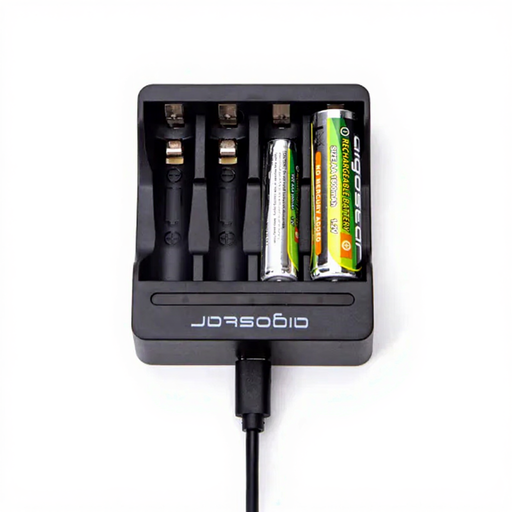
Aigostar Quick battery charger for 4 AA or AAA batteries, black
Could suit anyone looking to charge rechargeable NiMH AA cells, provided their microphone’s manual says this battery type is suitable.
The product information lists four separate charging channels, a USB input, LED status indicators and automatic shut-off. Designed for indoor use.
Joybuy
Frequently asked questions
Can I recharge the AA batteries in my microphone?
Not based on the AA size alone. Check that the batteries are rechargeable and that both your microphone and charger support the relevant chemistry. The STENKOL manual says not to charge non-rechargeable batteries in this charger.
Do NiMH batteries need to be completely flat before charging?
No. Milieu Centraal recommends recharging current NiMH batteries before they are completely flat.
How can I use a battery charger safely on my kitchen worktop?
Place the charger indoors in a dry spot, follow the polarity markings and keep it away from water. For the STENKOL, IKEA says not to immerse the charger and to unplug it before cleaning.
What should I do if my battery charger turns out to be faulty?
For a faulty consumer product, the Dutch government says the retailer should be your first point of contact to arrange a solution, such as a repair or replacement. What’s appropriate in a particular case depends on the circumstances.
Where can I recycle worn-out batteries and an old charger in the Netherlands?
The Dutch government says used batteries should not go in the bin. Take them to a collection point, such as a shop that sells batteries. For private consumers buying a new, similar electrical appliance, the take-back scheme applies to the old charger.


