First, check whether your weather sensor’s manual allows rechargeable NiMH cells: AA refers only to the size and says nothing about the permitted battery chemistry. If NiMH cells are allowed, choose a charger based on how many cells you want to prepare at once and whether you want to charge individual cells separately. If you’re sharing a desk, also consider the required power supply and leaving enough clear space around the charger.
Who is this relevant to?
Sensor owner checking battery compatibility
You want to find out first whether your weather sensor’s manual allows rechargeable AA cells. For example, AcuRite rules out rechargeable batteries for its 3-in-1 sensor; that instruction does not automatically apply to other models.
Colleague preparing individual AA cells
You share a desk and may want to charge a single cell or an incomplete set, while being able to see how charging is progressing. Panasonic says the BQ-CC55 charges cells individually; VARTA lists an LCD for its LCD Multi Charger+.
Manager of several sensor sets
You want to prepare several compatible NiMH cells at once and work out how many charging slots and how much desk space you’ll need. VARTA specifies eight individual AA/AAA slots for the LCD Multi Charger+ type 57681.
What should you look for when choosing?
Compact charger with individual slots
Choose this if: you want to charge one to four compatible AA NiMH cells, even if you don’t have a complete set. Panasonic lists the BQ-CC55 as an example.
Trade-off: four charging slots offer less room for charging several sets at once than a charger with more slots.
Charger for multiple sets
Choose this if: you want to prepare several compatible sets at once. VARTA specifies eight individual slots for the LCD Multi Charger+ type 57681.
Trade-off: this model takes up more desk space and, according to VARTA, requires a suitable USB-C PD power supply, which is not included.
Charger for fixed-size sets
Choose this if: you always charge two or four compatible AA NiMH cells at once. Duracell describes the Hi-Speed Value Charger CEF14 as suitable for sets of two or four.
Trade-off: this charger is not designed to charge a single cell on its own.
No rechargeable cells in the sensor
Choose this if: your specific sensor’s manual rules out rechargeable cells or specifies a different cell type.
Trade-off: the charger may still be useful for other devices, but it won’t meet that sensor’s battery requirements.
Compare charging options only after checking your sensor’s manual; AA size alone does not confirm compatibility.
| What to consider |
What should you check? |
Who should consider this? |
| Sensor compatibility |
Check the exact sensor model’s manual for the size and permitted battery chemistry before choosing cells or a charger. |
I want to be sure my sensor allows NiMH cells first; around 33% of consumers put battery compatibility top of their list. |
| Clear charging status on a shared desk |
Check the model’s charging status indicator and power requirements. Place the charger in a clear space and don’t use a damaged cable, as advised by the Fire Service. |
I want to see which cells are still charging at a shared workspace and use the correct power supply; around 27% of consumers prioritise clear, safe charging. |
| Number of cells and charging slots |
Count how many compatible AA cells you want to charge at once, and check whether the model supports individual cells, fixed pairs or individual charging slots. |
I want to prepare enough cells for my sensor sets in one go; around 20% of consumers put charging capacity first. |
| Spare batteries and accessories |
Check which power supply is needed for the model you choose. For cells kept ready for a long time, also look for information about self-discharge. The Consumers’ Association compares self-discharge, including after 25 and 50 days. |
I don’t want to buy unnecessary accessories, and I want spare cells to remain usable while stored; around 20% of consumers prioritise spare batteries and the total purchase cost. |
Common buying mistakes
-
Assuming AA cells are automatically suitable for your weather sensor
AA refers to the size, not permission to use NiMH cells. Battery requirements vary by sensor model; AcuRite rules out rechargeable batteries for its 3-in-1 sensor.
Look up your exact sensor model and check its battery instructions before preparing rechargeable cells for it.
-
Overlooking the power supply or the set size you need
According to VARTA, the LCD Multi Charger+ type 57681 requires a suitable USB-C PD power supply, which is not included. Duracell says the CEF14 charges sets of two or four cells.
Check the power requirements and decide whether you usually want to charge individual cells, pairs or several complete sets at once.
-
Focusing only on the stated capacity of spare cells
The Consumers’ Association points out that the cell with the highest stated capacity isn’t always the best choice. Self-discharge can also matter if you’re keeping spare cells ready for a long time.
Compare independent information about self-discharge if you plan to keep cells in reserve for an extended period.
Brands and models compared
Panasonic eneloop
The BQ-CC55 is an option for charging compatible AA/AAA NiMH cells individually.
- Panasonic says the BQ-CC55 can charge one to four eneloop or eneloop pro cells individually and show charging progress for each slot.
- The plug type varies by sales region, so check that the version is suitable for your needs.
VARTA
The LCD Multi Charger+ type 57681 is designed to charge several NiMH sets at once.
- VARTA specifies eight individual AA/AAA charging slots and an LCD.
- A suitable USB-C PD power supply is required and, according to VARTA, is not included.
Duracell
The Hi-Speed Value Charger CEF14 is an option for fixed sets of two or four AA/AAA NiMH cells.
- Duracell lists automatic shut-off for this charger.
- According to Duracell, the CEF14 does not charge a single cell on its own. Any charging-time claims apply under the stated test conditions and to the Duracell cells specified.
GP ReCyko
The Pro Charger P461 is a compact USB charging option with a storage function.
- GP says the P461 charges up to four batteries, switches off automatically and also doubles as a battery case.
- Charging-time information on the brand’s website relates to the test cells listed there and is not an independent measurement.
XTAR
The VC4SL may be worth considering if you use other battery types supported by the model as well as compatible NiMH cells.
- XTAR lists four charging slots, USB-C, adjustable charging current and a capacity test.
- Before use, check that both the cell type and the power supply are suitable for the cells you want to charge.
Joybuy product selection
This Joybuy selection is a compact charger with individual charging channels for rechargeable AA/AAA cells. Check your weather sensor’s manual to make sure it allows the cell type you plan to use.
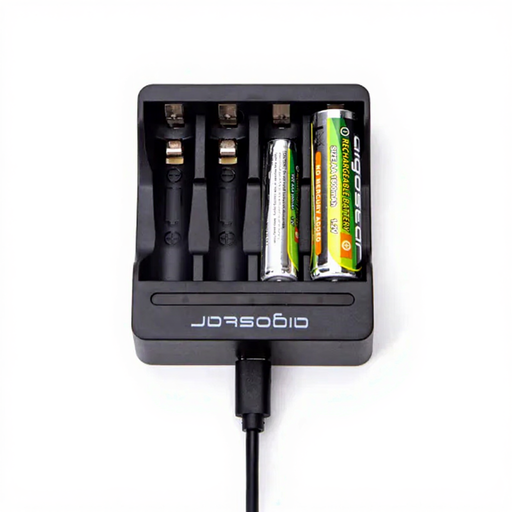 Image unavailable
Aigostar Quick Battery Charger with Smart IC, 4 AA/AAA, black
An option for preparing rechargeable AA/AAA cells individually if your weather sensor’s manual allows that cell type.
Four independent charging channels; charges AA/AAA cells individually.
USB input and LED charging status.
The product description says it switches off automatically when a cell is fully charged.
For rechargeable NiMH or NiCd AA/AAA cells only; not for non-rechargeable batteries.
View at Joybuy
Frequently asked questions
Can I use any rechargeable AA battery in my weather sensor?
No. Don’t assume it’s suitable just because it’s an AA cell. Check your sensor model’s manual: AcuRite explicitly rules out rechargeable batteries for its 3-in-1 sensor, but that isn’t a general rule for all weather sensors.
Can I charge a single AA cell at a shared desk?
That depends on the charger. Panasonic says the BQ-CC55 can charge individual cells, starting with just one; Duracell lists the CEF14 for sets of two or four. Also check that your sensor allows the cell type you’ve chosen.
Is the power adapter included with a battery charger?
Check what’s included with the specific version. VARTA says the LCD Multi Charger+ type 57681 requires a suitable USB-C PD power supply, but that it isn’t included.
Where should I put a battery charger while it’s charging?
Place the charger in a clear space so heat can escape, and don’t use a damaged cable. This is the Fire Service’s safety advice for chargers and batteries.
Where can I dispose of used AA batteries in the Netherlands?
According to the Dutch government, used batteries must not go in the bin. Take them to a collection point, such as a shop that sells batteries.


