
Wall clock users with a single battery
If you want to keep one suitable AA cell ready to use, choose a charger that can charge a single cell on its own. IKEA and Panasonic describe models with this feature.


First, check which battery type your wall clock’s manual specifies: a NiMH charger is not suitable if the clock requires a different type. If the clock accepts a rechargeable AA NiMH cell, choose a charger that can charge one cell on its own. For a clock that uses very little power, an alkaline battery may also be a sensible choice, according to Milieu Centraal.
If you want to keep one suitable AA cell ready to use, choose a charger that can charge a single cell on its own. IKEA and Panasonic describe models with this feature.
First check whether your clock accepts NiMH batteries and whether the cell is suitable for the charger. Milieu Centraal recommends using the battery type specified by the appliance manufacturer.
If you want to use the charger with other devices too, consider the number of charging bays and what’s included in the offer. IKEA and VARTA describe chargers for multiple cells.
Start with the battery type specified for your clock. Then check whether the charger can charge the number of cells you need individually, and whether you’ll use it with other devices too.
| Consideration | What to look for | Who is this important for? |
|---|---|---|
| Compatibility | Check the battery type specified for the clock and which battery chemistries the charger supports. Never charge a non-rechargeable battery in a NiMH charger. | If I want to switch to rechargeable batteries, I first need to be sure the clock and charger support the same battery chemistry. Around 36% of consumers put compatibility first. |
| Charging a single cell | Look for explicit support for charging a single cell and individual charge control; don’t assume this just from the number of slots. | If you use one battery in your wall clock, it’s important to be able to prepare that cell on its own. Around 29% of consumers prioritise individual charging. |
| Ease of use | Check the charging indicator, what’s included and, for a plug-in model, whether the plug is suitable for use in the Netherlands. | If I occasionally keep a spare battery ready, I want to be able to see what the charger is doing without unnecessary complications. Around 21% of consumers value easy preparation above all. |
| Whether it’s worthwhile for this clock | Consider whether you already have suitable batteries or a charger, and whether you’ll use the charger with other devices. Don’t assume it will pay for itself without relevant figures. | If you’re considering a charger just for a low-power clock, you may want to ask whether a separate purchase is necessary. Around 14% of consumers put the value of the purchase first. |
AA refers to the size, not whether a cell is rechargeable or suitable for your clock. A NiMH charger is only intended for suitable rechargeable NiMH cells; the STENKOL manual warns against charging non-rechargeable batteries.
Check the clock manual, the markings on the battery and the charger instructions before inserting a cell.
A charger with several slots won’t necessarily charge a single battery. IKEA says STENKOL can do this, as does Panasonic for the BQ-CC55; this capability has not been confirmed for the VARTA Mini Charger.
Look in the manual for the exact model for explicit support for charging one cell on its own.
If the charger requires two cells to be charged at the same time, you may need to use extra suitable cells or choose a different model.
A stated charging time applies to particular cells and conditions. Milieu Centraal notes that an alkaline battery can sometimes be a sensible choice for a device that uses very little power.
Decide whether you’ll use the charger with other devices too, and only compare charging times when the number and capacity of the cells are the same.
STENKOL is a NiMH charger for AA and AAA cells, with four independent charging channels. IKEA says it can charge one to four suitable cells.
Panasonic describes the eneloop BQ-CC55 as a charger for one to four eneloop or eneloop pro cells in AA or AAA sizes.
According to VARTA, the VARTA Mini Charger, type 57656, is designed for two AA or AAA NiMH cells.
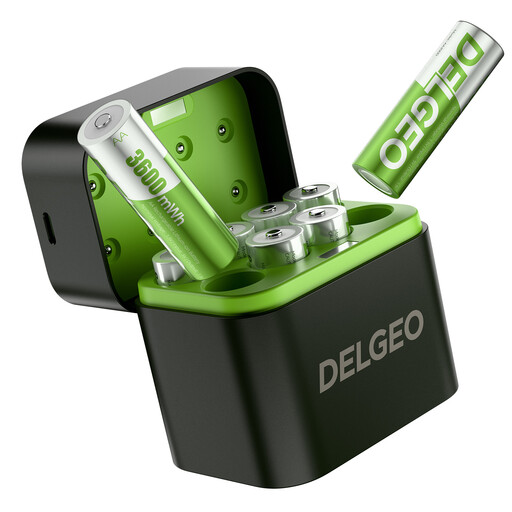
These options include a set of rechargeable AA lithium batteries with a charger and a separate charger for AA/AAA NiMH cells. Before buying, check which battery type your wall clock supports.
 No image available
Only consider this set if your clock manual allows rechargeable AA lithium cells; the AA size alone does not confirm compatibility.
The product information specifies a constant 1,5 V output and USB-C charging.
According to the product description, eight cells can be charged in 2,5 hours using a 5 V/3 A power source.
 No image available
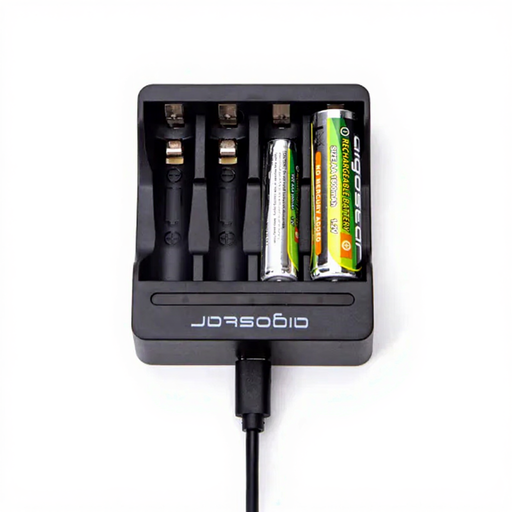
This charger is suitable for a clock that accepts compatible rechargeable AA NiMH cells and if you want to charge one cell on its own.
The product description lists four independent charging channels, support for charging individual cells and a charging status LED.
The charger is described as suitable for indoor use and comes with a USB cable.
No. First check which battery type the clock manufacturer specifies. The IKEA manual for STENKOL only allows suitable rechargeable NiMH cells and warns against charging non-rechargeable batteries.
According to IKEA, STENKOL can charge one to four suitable NiMH cells. Follow the indicated polarity. The manual specifies indoor use and says to unplug the charger before cleaning it or when it’s not in use.
Check whether the offer includes just the charger or suitable rechargeable cells as well. Ondernemersplein explains consumers’ statutory warranty rights; any additional manufacturer’s warranty does not replace those rights.
According to the Dutch government, used household batteries should not go in the bin; you can take them to places including shops that sell batteries. The Dutch government also outlines the relevant European safety requirements for electrical appliances placed on the market. A CE marking is not an independent performance test.