
Recordists with few spare sockets
If you want to prepare a spare set using a suitable USB power supply you already have, check the charger’s input requirements. GP and VARTA specify different USB power requirements for their chargers.


First, choose rechargeable AA cells that your voice recorder’s manual permits, and a charger designed for that battery chemistry. If you already have a suitable USB power supply, a USB charger can save you from needing an extra mains plug for the charger. Just check the required power supply and how many cells it can charge at once. A mains charger is a straightforward option if you can free up a socket before charging.
If you want to prepare a spare set using a suitable USB power supply you already have, check the charger’s input requirements. GP and VARTA specify different USB power requirements for their chargers.
If you sometimes charge one cell and sometimes a full set, it’s worth checking how many independent charging channels the charger has. IKEA specifies four independent channels for the STENKOL; GP says the U411 can charge two or four cells.
If you want to plan charging in advance or assess used NiMH cells, compare charging times and any test programmes. IKEA and ANSMANN describe these features; a capacity test won’t predict how long a cell will last in a recorder.
First, check whether your recorder supports the battery type you’ve chosen. Then compare the power requirements and the number of cells the charger can handle per charging session.
| What to consider | What should you check? | Who is this important for? |
|---|---|---|
| USB charging | Check the USB type, the power supply’s required output, and whether you need a cable or adapter. | If I’m short on sockets, I want to be able to charge my spare set with a suitable USB power supply, without needing an extra mains plug for the charger. Around 36% of consumers prioritise charging without an extra mains plug. |
| Recorder and battery compatibility | Check the battery chemistry allowed by your recorder’s manual and the type of cell the charger is designed for. | I want to make sure my recorder accepts rechargeable AA cells, so the charger and recorder are compatible. Compatibility is the top priority for around 29% of consumers. |
| Number of cells per charging session | Check whether the charger can charge a single cell and whether its slots have independent charging channels. | If my spare set varies, I want to be able to charge a single AA cell when needed. Flexible charging is the main reason to buy for around 21% of consumers. |
| Charging plans and cell checks | Compare the charging time for the number and capacity of your cells; consider whether a status indicator or test programme would be useful. | I want to know when my cells are ready or check the condition of cells I use frequently. Charging plans or cell checks are the top priority for around 14% of consumers. |
For type 57688, VARTA specifies particular requirements for a Power Delivery adapter. So, a USB-C connection alone doesn’t tell you whether a power supply is suitable.
Compare the required output with the specifications of a power supply you already have.
This charger requires a suitable Power Delivery adapter, which isn’t included.
The number of slots doesn’t necessarily tell you how many cells you can charge at once or individually. GP says the U411 can charge two or four cells; IKEA specifies four independent channels for the STENKOL.
Check whether you want to charge a single AA cell and what the charger’s manual allows.
Charging times can depend on the number of cells and their capacity. IKEA gives different times for the STENKOL depending on how many AA cells you’re charging; VARTA’s stated time is based on four 1600 mAh cells.
Plan charging using the information for your cells, and allow extra time before a recording.
AA describes the size, not whether a cell is rechargeable or supported by your recorder. The chargers listed are designed for specific rechargeable cell types.
Before charging cells, check the manuals for both your exact recorder model and the charger.
The GP U411 is a USB charger for two or four rechargeable NiMH AA or AAA cells.
Type 57688 combines USB-C power with individual slots for one to four NiMH AA cells.
The STENKOL is a mains charger for one to four rechargeable NiMH AA or AAA cells.
The Powerline 4.2 Pro is a mains-powered NiMH charger with charging and test programmes for AA and AAA cells.
These products are designed for preparing spare AA cells via USB; before use, check that the battery type is suitable for your recorder.
 No image available
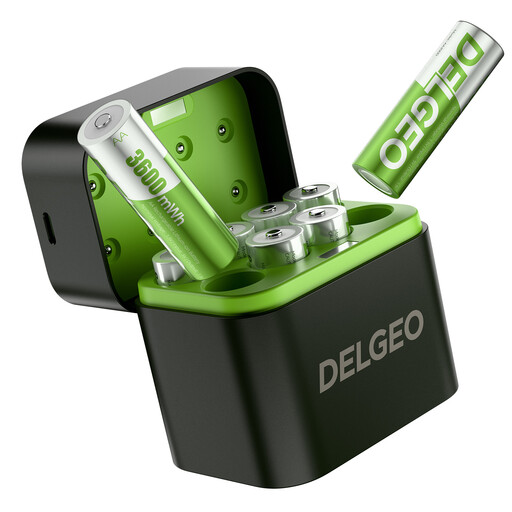
A set with a USB-C charger for anyone who wants to prepare rechargeable AA spare cells using a suitable USB power supply; only use the lithium cells if your recorder’s manual permits this type.
Stated capacity: 3600 mWh. Output: constant 1.5 V. The product information says eight cells take 2.5 hours to charge.
 No image available
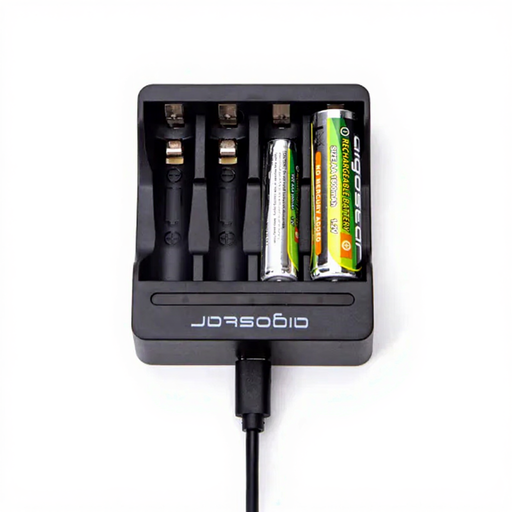
This USB charger may suit anyone who wants to charge individual cells and has a suitable USB power supply available; check that your recorder supports the chosen cell chemistry.
The product information specifies four independent charging channels, a DC 5 V/1 A input and support for rechargeable NiMH and NiCd cells.
No, only cells of a type the charger is designed for. GP and IKEA specify rechargeable NiMH cells for the chargers mentioned; the GP manual warns against using non-rechargeable batteries. Also check which battery types your recorder’s manual permits.
Not necessarily: for VARTA type 57688, the manufacturer specifies a Power Delivery adapter of at least 9 V/2 A or 12 V/1.25 A, which isn’t included. Check the adapter’s output before using this combination.
Follow the instructions for your charger model and observe the polarity markings. IKEA recommends unplugging the STENKOL before cleaning and wiping it dry; GP recommends removing the cells from the disconnected U411 after charging.
In the Netherlands, you’re covered by statutory consumer rights, but there’s no fixed statutory guarantee period. According to the Dutch government, what you can expect from a product depends, among other things, on the product, its price and the information provided. If a product is faulty, contact the seller and keep your proof of purchase.
According to the Dutch government, used batteries must not go in the bin. You can hand in an old household charger, among other places, when buying a similar new appliance through the take-back scheme.