
Voice recorder user recharging AA cells
You use a recorder that supports AA NiMH cells and are looking for a suitable charger before your next recording. The Tascam DR-05X manual is one example; always check the requirements for your own model.


First, check your voice recorder’s manual to see whether it supports AA batteries and rechargeable NiMH cells; some recorders use AAA batteries. Then choose a charger based on how many cells you want to charge at once, the number of charging channels, the power supply and the time available. Use it in a suitable, dry place and check the CE marking on the specific item before you buy. According to the Netherlands Food and Consumer Product Safety Authority, this marking is compulsory for electrical chargers, but it does not in itself prove that the product has undergone independent testing.
You use a recorder that supports AA NiMH cells and are looking for a suitable charger before your next recording. The Tascam DR-05X manual is one example; always check the requirements for your own model.
You want to know how many cells can be charged at once and how long this takes under the specified conditions. Manufacturers such as IKEA, Panasonic and GP describe different charging setups and requirements.
As well as a charger, you may need to buy AA NiMH cells and a suitable USB power supply. Check exactly what’s included in the offer you choose.
First, check the battery size and the permitted battery chemistry in your recorder’s manual. Then you can compare charging times, channel configuration and power supply.
| Concern | What should you check? | Who is this important for? |
|---|---|---|
| Compatibility with the recorder | Check the battery size and whether the recorder supports NiMH cells. Also make sure the charger is designed for AA NiMH cells. | If I want to avoid buying cells that don’t fit my recorder, I check the manual first. Compatibility is the top priority for around 36% of consumers. |
| Clear, dry charging setup | Check the number of independent charging channels, the charging and error indicators, and whether the required power supply will work in your chosen location. | If you want to set up the cells on the kitchen worktop, you’ll need a suitable dry place and a clear charging status indicator. A clear charging setup is the top concern for around 29% of consumers. |
| Ready in time for your recording | Only compare charging times for the same number and type of cells, and check the capacity used by the manufacturer for its figures. | If I can only charge shortly before a recording, I want to know how long my particular number of cells will take. Preparation time is the top priority for around 21% of consumers. |
| Complete charging setup | Check how many cells are included and whether a USB cable or suitable adapter is supplied. | If you want to start charging straight after buying, check that the right cells and the required power supply are both included. A complete purchase is the top concern for around 14% of consumers. |
Recorders can use different battery sizes. According to its manual, the Tascam DR-05X uses two AA cells, while the Zoom H1essential uses two AAA cells.
Read the manual for your own model before choosing a charger or set of cells.
According to GP, the GP ReCyko B421 has four slots but only two charging channels. IKEA describes the STENKOL as having four separate channels.
Compare the number of channels with the number of cells you want to be able to charge individually.
The stated time can depend on the number and capacity of the cells, as well as the model. For example, Panasonic’s figure of around 90 minutes is for two eneloop AA cells.
Only compare figures when the number and type of cells match.
One offer may include cells, while another may include only the charger. If you’re buying a USB charger, you’ll also need to make sure you have the required power supply.
Check the exact contents of the offer and its power requirements.
The STENKOL is a mains-powered charger for one to four AA or AAA NiMH cells.
The eneloop BQ-CC55 is designed to monitor AA and AAA eneloop cells individually while charging.
The ReCyko B421 is a compact USB charger, also available as a set with four AA NiMH cells.
The LCD Charger type 57070 is an AA/AAA NiMH charger with an LCD display.
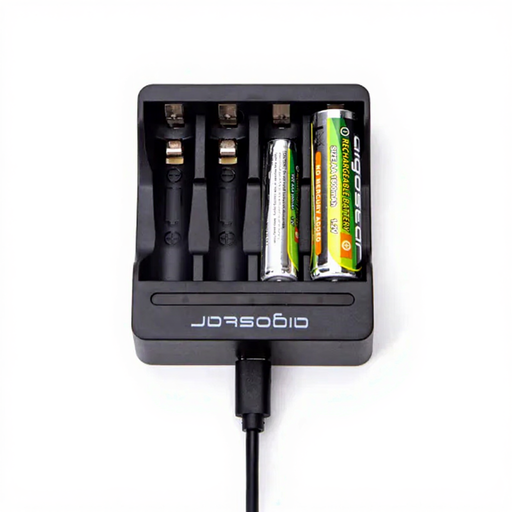
A USB charger for AA and AAA NiMH cells, for anyone who wants to be able to charge cells individually or in mixed combinations. Before buying, check the CE marking on the specific item and whether a suitable USB power supply is included.
 No image available
Suitable for a recorder that supports AA NiMH cells, and for charging cells individually or in mixed combinations. Check your recorder’s battery requirements.
The product description states that it is compatible with NiMH cells and has separate charging channels. USB input: DC 5 V/1 A. The LED indicators show when cells are charging, fully charged or inserted incorrectly.
Dimensions according to the product description: 75 × 66 × 25,2 mm. For indoor use. Before buying, check that the specific item carries the required CE marking. According to the Netherlands Food and Consumer Product Safety Authority, the marking does not in itself prove that the product has undergone independent testing.
No, it depends on the model. The Tascam DR-05X manual allows two AA cells, either alkaline or NiMH, while the Zoom H1essential uses two AAA cells. Check the size and permitted battery chemistry in your recorder’s manual.
No. The IKEA STENKOL manual warns that non-rechargeable and damaged batteries must not be charged. For other chargers, follow the manual for that model.
Place the charger in a suitable, dry spot and follow the manual for your chosen model. IKEA specifies indoor use for the STENKOL and warns against immersing it in water. The manual also says to unplug it before cleaning.
According to the Netherlands Food and Consumer Product Safety Authority, CE marking is compulsory for electrical chargers. A CE mark does not in itself prove that the product has undergone independent testing, so check the marking on the specific product.
The Government of the Netherlands says that used batteries must not go in the bin and can be handed in at shops and supermarkets that sell batteries. For old electrical appliances, the Government of the Netherlands also describes the old-for-new scheme: when you buy a new, similar appliance, you can hand in the old one at the shop where you buy the new one.