
Anyone who wants to check the cell type first
You want to avoid charging an unsuitable AA cell, so you check that the chemistry is supported by both the battery and the charger. IKEA’s STENKOL manual says to charge NiMH cells only.


First, check which AA cells the radio supports according to its manual, then choose a charger that matches the chemistry of your rechargeable cells. For a small set, individual charging slots can be useful. Choose between a plug-in and a USB charger based on the power supply available in your room. Only compare charging times when the number of cells, their capacity and the stated charge level match.
You want to avoid charging an unsuitable AA cell, so you check that the chemistry is supported by both the battery and the charger. IKEA’s STENKOL manual says to charge NiMH cells only.
You’re mainly concerned with the power supply available and how many cells you want to charge. Check whether there’s a suitable socket or USB power source, and whether the number of charging slots suits your set.
You want to know exactly what a stated charging time means for the number of cells and their capacity. Panasonic and Duracell each give charging times under specific conditions, so they aren’t necessarily directly comparable.
First, check that the battery, radio and charger are compatible. Then consider the power supply available, the charging time and what’s included in the box.
| What to consider | What to check before buying | Who should pay particular attention? |
|---|---|---|
| Cell type and safe charging | Check the cell type, which batteries are permitted according to the radio manual, and which chemistries the charger supports. | When I’m getting batteries ready for the radio, I want to be sure they’re rechargeable cells and that the charger is designed for them. Around 33% of consumers in this scenario prioritise compatibility and safe charging. |
| Power supply and charging slots | Check whether the charger needs a mains socket or USB power, and how many cells you can charge individually. | When I’m using a charger in a hotel room, I want to know in advance which connection is available and whether I can charge one or more cells. Around 27% of consumers in this scenario prioritise the power supply and ease of use at their destination. |
| Time until ready to use | Only compare the stated time when the number of cells, their capacity and the stated charge level are the same. | If the radio needs to be ready quickly, I want to know whether the claim applies to the number of cells I have and whether it refers to a full or partial charge. Around 20% of consumers in this scenario prioritise preparation time. |
| Charger and cells as a set | Check whether rechargeable AA cells are included and whether their type and capacity suit your needs. | If I don’t already have suitable cells, I want to know whether I’m buying just a charger or a complete set. Around 20% of consumers in this scenario prioritise the total cost of buying a charger and cells. |
AA refers to the size, not whether a battery can be recharged. IKEA’s STENKOL manual warns against charging non-rechargeable or damaged cells.
Check the markings on the battery and the manual for the exact charger model before charging.
Charging time claims may refer to a particular number of cells, a specific capacity or a partial charge. For example, Duracell states that its own 1300 mAh AA NiMH cells reach around 85% charge after 45 minutes.
Only compare charging times once the number of cells, their capacity and the charge level match what you need the batteries for.
A standalone charger and a set that includes cells are different purchases. A USB charger may also need a suitable USB power supply.
Check what’s in the box and what power supply is available before you choose.
The STENKOL is a plug-in charger for AA and AAA NiMH cells, with four individual charging slots. IKEA also offers a STENKOL/LADDA set.
Panasonic describes the BQ-CC55 as a charger for one to four AA or AAA eneloop and eneloop pro cells, which can be charged individually or in combination.
The VARTA LCD Charger type 57070 is an AA/AAA NiMH charger with a display. VARTA lists an input of 100–240 V.
According to Duracell, the Hi-Speed Advanced Charger CEF27 is designed for two or four AA or AAA cells.
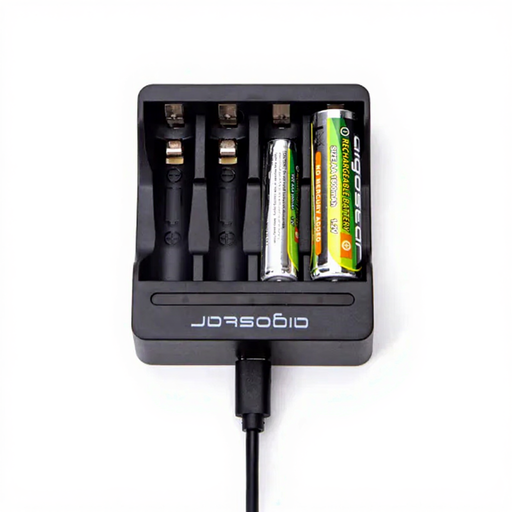
This selection focuses on a USB-powered charger for rechargeable AA cells. Check that you have a suitable USB power supply available where you’re staying.
 No image available
The USB connection could be a good fit if you have a suitable USB power supply available for charging AA cells for your radio.
According to the product description, the charger supports rechargeable AA NiMH and NiCd cells, with individual charging channels, an LED charging indicator and automatic shut-off. Not designed for standard, non-rechargeable batteries.
No. First check whether the cells are rechargeable and which cell type is permitted according to the radio manual. IKEA’s STENKOL manual allows only suitable NiMH cells and warns against charging non-rechargeable or damaged batteries.
Follow the manual for the model you’ve chosen and place the charger in an open area where heat can dissipate. The Netherlands Fire Service advises charging in a room with a working smoke alarm; this is not a legal requirement specific to hotels.
If a fault develops during normal use, contact the seller. ACM ConsuWijzer explains that the seller must fix a fault covered by the statutory guarantee free of charge; a manufacturer’s guarantee does not replace this right.
Don’t put flat batteries in your general rubbish. Take them to a collection point, such as a shop that sells batteries. For an unwanted electrical appliance, the Dutch government lists options including handing it in when buying a new, similar appliance or taking it to your local council recycling centre.
No. According to information from the Dutch government, the CE mark is not a quality mark; it indicates that the manufacturer declares the product meets the applicable EU requirements. Also check the manual and make sure the charger is suitable for your cells.