
Parents who want to check the train first
You want to know whether the train accepts rechargeable batteries before choosing a charger and cells. Check the AA size, battery chemistry and toy instructions separately.


First, check the battery compartment and the manual to see whether the train accepts rechargeable batteries and the relevant chemistry: an AA size alone doesn’t confirm this. If NiMH batteries are allowed, choose a charger based on the number of cells, the time available to get them ready and the power supply in your holiday cottage. Charging times always apply to specific batteries and quantities.
You want to know whether the train accepts rechargeable batteries before choosing a charger and cells. Check the AA size, battery chemistry and toy instructions separately.
You want the batteries ready before playtime. The number of cells and the batteries covered by the stated charging time determine which figure is relevant.
You want to charge several compatible AA cells and match the number of charging bays and the required power supply to the sets you’re actually taking with you.
Start with the train’s manual, then choose based on charging time, the number of charging bays and the power supply available.
| What to consider | What to look for when buying | Who is this important for? |
|---|---|---|
| Battery type and compatibility | Read the battery markings and train manual; check that the permitted chemistry and size are compatible with the charger. | I want to make sure the train accepts rechargeable cells of this type before anything else; around 36% of consumers want to establish battery compatibility first. |
| Getting the batteries charged in time | Compare charging times only for the same number of cells and the batteries used by the manufacturer to calculate the stated time. | If the batteries need to be ready before playtime, the charging time for the full set matters; around 29% of consumers prioritise preparation time. |
| Charging bays and power supply | Count how many cells you need to charge at once and check whether a mains socket or the required USB-C-PD power supply is available. | I want to prepare several cells or spare sets and check which power supply I can take with me; around 21% of consumers focus mainly on charging bays and power. |
| Total cost and aftercare | Check which batteries and adapters are included and what terms the seller provides. | For consumers who want to know in advance what they’ll need besides the charger and who to contact if there’s a problem, this is the main concern; they account for around 14%. |
AA describes the size, not whether a battery is rechargeable or supported by the toy train. A NiMH charger isn’t designed for non-rechargeable batteries.
Check the train’s manual and the battery markings first. Only then choose a charger designed for that chemistry.
Manufacturers give times for different batteries and charging loads. IKEA generally states 6–8 hours for four AA cells with STENKOL, while Panasonic gives around 90 minutes for two AA eneloop cells. These figures don’t automatically apply to a different set.
Compare times only when the charging load and relevant battery details match, then plan your preparation time accordingly.
VARTA states that the LCD Multi Charger+ type 57681 requires a USB-C-PD adapter, which isn’t included.
Before you leave, check what’s in the box and whether you already have the required power supply.
STENKOL is a mains-powered NiMH charger for one to four AA or AAA cells.
The BQ-CC55 is designed to charge supported eneloop AA and AAA cells individually.
The LCD Multi Charger+ type 57681 is designed to charge several NiMH cells individually via USB-C.
The Hi-Speed Value Charger CEF14 is designed to charge two or four AA or AAA cells.
This selection includes an AA/AAA charger and a set of AA lithium batteries with a charger. For both options, check that the chemistry is compatible with what the train’s manual allows.
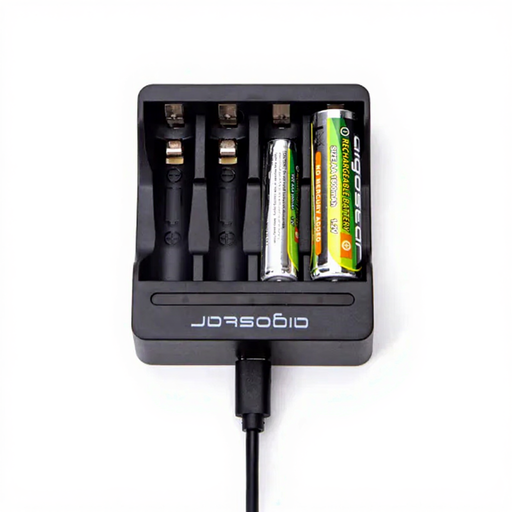 No image available
Worth considering if you want to charge AA cells and the train manual allows the supported chemistry.
For 4 AA or AAA cells; the stated USB power supply is DC 5 V, 1 A. Before use, check that the battery type is compatible with the train.
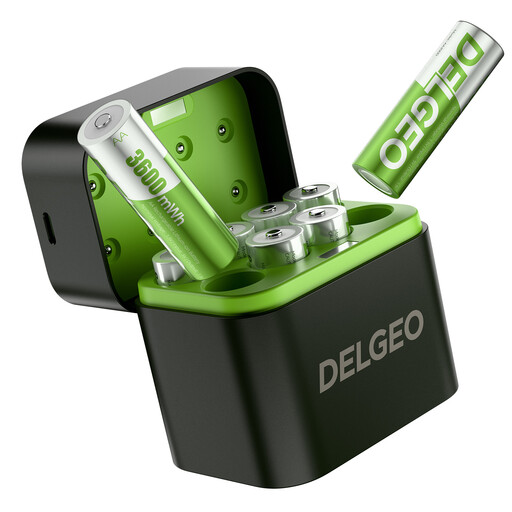 No image available
Only worth considering if the train manual allows this rechargeable lithium battery system; AA size alone doesn’t confirm compatibility.
According to the product name, the set includes eight AA lithium batteries and a USB-C charger. A 5 V/3 A power supply is specified for the stated charging setup.
Only if they’re rechargeable batteries and the train’s manual allows you to use them. Don’t use a NiMH charger for non-rechargeable batteries, and check the markings before putting cells in the charger.
Follow the instructions and place the charger somewhere clear so heat can escape. The fire service recommends keeping chargers unobstructed.
If there’s a problem with a charger you’ve bought, contact the seller about your statutory guarantee; a manufacturer’s warranty doesn’t replace it. The Dutch government advises against putting used batteries in general waste. Take them to a collection point instead.