
For households with sockets already in use
Wants to charge AA cells for the train using an available USB power source, without taking up another socket while charging. Check that the power source meets the charger’s requirements.


If you have a suitable USB power source, a USB charger can free up a socket. A plug-in charger is another option if you can spare a socket while charging. First check that the toy train accepts the AA cells you’ve chosen, then make sure the number of charging slots, the charging time for the number of cells you need and the required power source all suit your needs. The NVWA states that CE marking is mandatory for electrical products covered by this requirement. Check the marking on the specific charger, as the models mentioned are examples for comparison, not confirmed recommendations to buy.
Wants to charge AA cells for the train using an available USB power source, without taking up another socket while charging. Check that the power source meets the charger’s requirements.
Charges several cells before playtime and wants to check the stated charging time for the number of cells needed.
Wants to check whether the train accepts rechargeable cells and whether the charger, power source and any battery set are compatible.
| What to consider | What should you check? | Who is this important for? |
|---|---|---|
| Power without using another socket | Check the USB type, the required voltage and current, and whether a suitable adapter is included. A plug-in charger uses a socket while charging. | If my sockets are already in use, I want to know whether my available USB power source is suitable. Around 36% of consumers mainly need a suitable connection that doesn’t use another socket. |
| Cells ready in time | Count how many AA cells the train needs, then compare the charging time for that number and the relevant capacity. IKEA typically states 3–4 hours for one or two AA cells and 6–8 hours for four with STENKOL; VARTA bases the stated 1.5 hours for type 57684 on two 1600 mAh AA cells. | For playtime, I want to have enough cells ready on time, rather than rely on a charging time for a smaller load. Around 29% of consumers prioritise being prepared in time. |
| Cell type and safe use | Read the train instructions, the label on the cells and the charger manual. Only charge cell types permitted by both the train and the charger. Also check the CE marking on the specific charger. | If I’m not sure which cell type the train accepts, I want to check the combination first. Around 21% of consumers make choosing the right cell chemistry and using it correctly their main concern. |
| What’s included? | Check whether the set includes AA cells and whether the required cable and a suitable adapter are included. Panasonic and VARTA state that the mains adapter is not supplied with the USB chargers mentioned. | When buying for the first time, I want to know what else I’ll need to use the charger. Around 14% of consumers mainly look for a complete starter set. |
According to VARTA, the LCD Smart Charger+ type 57684 requires a USB-C PD power supply of at least 9 V/2 A or 12 V/1.25 A. The required adapter is not included.
Before buying, compare the charger’s voltage, current and PD requirements with the details on your available power supply.
The 1.5 hours VARTA quotes for type 57684 applies to two 1600 mAh AA cells. IKEA typically states 6–8 hours for four AA cells with STENKOL.
Plan around the charging time for the number of cells you actually need and the capacity used by the manufacturer for its figures.
AA tells you the size, not whether a battery is rechargeable or which chemistries a charger supports. Panasonic limits charging in the BQ-CC87 to eneloop and eneloop pro cells; IKEA specifies NiMH cells for STENKOL.
Check the cell type in the train manual and follow the charger instructions. Do not charge non-rechargeable or damaged batteries.
STENKOL is a plug-in charger for one to four AA or AAA NiMH cells.
The BQ-CC87 is a USB-powered charger for eneloop and eneloop pro cells in AA or AAA sizes.
The LCD Smart Charger+ type 57684 is designed to charge one to four AA or AAA NiMH cells via USB-C.
The VC4SL is a USB-C charger for AA NiMH cells, among other battery types supported by the manufacturer.
This selection includes a set of AA lithium batteries with a USB-C charger and a charger for AA or AAA cells. Before buying, check which cell type the train allows and what power source the charger you choose requires.
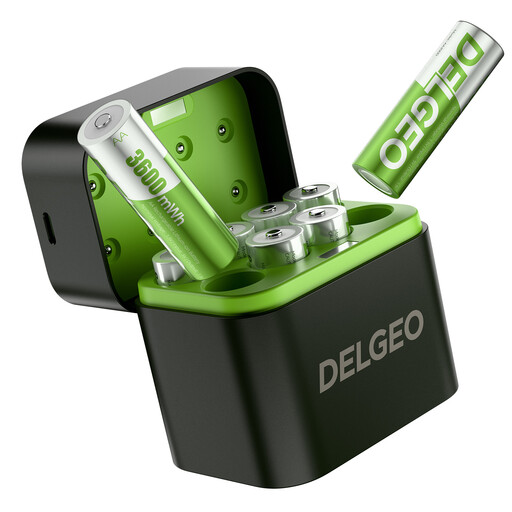 No image available
Check that the train accepts these AA lithium batteries and that the charger is suitable for these cells.
Set of eight AA lithium batteries and a USB-C charger.
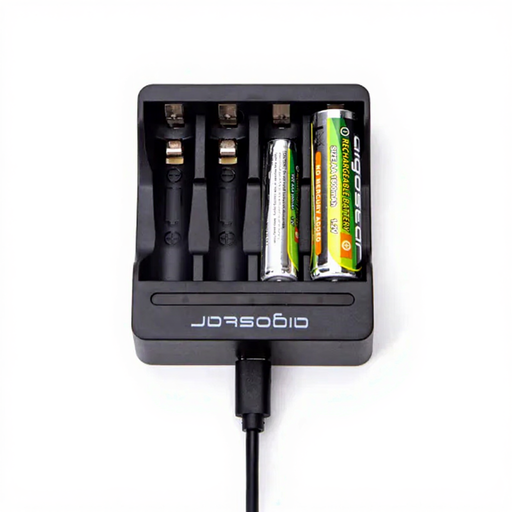 No image available
Check that the cell type allowed by the train matches the cells this charger is designed for.
The product name states that it supports four AA or AAA cells. Check the product instructions for the required power source and cell chemistry.
No. First check the train manual and the label on each cell. The IKEA STENKOL manual prohibits charging non-rechargeable or damaged batteries; Panasonic limits charging in the BQ-CC87 to eneloop and eneloop pro cells. Check the train instructions to find out whether rechargeable cells are allowed.
No. The adapter must meet the requirements of the specific charger model. Panasonic specifies a 5 V USB connection for the BQ-CC87; VARTA requires a USB-C PD adapter of at least 9 V/2 A or 12 V/1.25 A for the LCD Smart Charger+ type 57684. Check these values in the charger instructions and on the adapter.
Follow the plus and minus markings and the charger manual. IKEA advises unplugging STENKOL before cleaning it and not charging damaged or non-rechargeable cells.
The NVWA states that CE marking is mandatory for electrical products covered by this requirement. Check the marking on the specific charger you’re considering; a brand or model name alone doesn’t confirm which marking appears on that particular unit.