
Person responsible for shared torch batteries
You want to prevent colleagues from putting unsuitable or non-rechargeable cells in the charger, and need clear status and error indicators.


First, check whether the torch’s manual allows rechargeable NiMH AA cells, then choose a charger designed for this battery chemistry. If colleagues return individual cells at different times, independent charging channels and a status indicator for each cell are useful; for fixed sets, a simpler charger may be enough. Also check the required power supply, whether batteries are included and whether the charger suits use on your desk.
You want to prevent colleagues from putting unsuitable or non-rechargeable cells in the charger, and need clear status and error indicators.
You set aside one or a few AA cells at different times, so independent charging channels and a clear ready indicator are useful.
You want a tidy place to charge and store batteries, and check in advance that the available USB power supply is suitable for the charger.
Start by checking which battery chemistries the torch allows. Then consider whether you want to charge individual cells independently, what power supply is available and whether batteries are included with the model you choose.
| Key consideration | What should you check? | Who is it for? |
|---|---|---|
| Correct batteries and safe charging | Check which battery chemistries the torch and charger support, the error indicators and the condition of the cells. | I want to avoid charging the wrong or a damaged cell in a shared space. Around 33% of consumers with this need prioritise compatibility and safe charging. |
| Individual cells ready to use | Check whether a single cell can be charged independently and whether its status is shown individually or by pair. | I want to be able to put back an individual cell without waiting for a second one. Around 27% of consumers with this need want individual cells ready when needed. |
| Power supply and desk space | Compare the charger’s power input with the available adapter or USB port, and check what’s included in the packaging. | I want a permanent, tidy charging spot and to know in advance whether the available power supply is suitable. Around 20% of consumers with this need prioritise desk space and power supply. |
| Complete set and battery life | Check whether batteries are included; don’t judge them on their stated capacity alone. | I want to know what else I need and how the batteries perform with repeated use. Around 20% of consumers with this need prioritise a complete set and long-term use. |
A charger with four slots may still charge cells in pairs. GP lists four slots and two charging channels for the ReCyko B421, making it less flexible if colleagues return individual cells.
Compare the number of charging channels and the permitted number of cells, not just the number of slots.
A USB connection doesn’t tell you which power profile the charger needs. For the LCD Smart Charger+ type 57684, VARTA specifies USB-C PD 12 V / 1,25 A / 15 W.
Compare the charger’s input label with the power supply at your desk, and check what’s included with the model you choose.
Stated charging times are based on specific numbers and capacities of cells. The Consumentenbond also notes that a higher stated capacity isn’t always the best choice for long-term use.
Only compare charging times for the same number and type of cells, and assess the batteries separately from the charger.
The BQ-CC55 is designed for charging one to four NiMH AA or AAA cells independently.
The LCD Smart Charger+ type 57684 has separate slots for NiMH AA and AAA cells.
The ReCyko B421 combines USB charging with four AA cells and a case in the Dutch version.
The Pro Charger is a plug-in charger for fixed sets of two or four NiMH AA or AAA cells.
The Powerline 4.2 Pro is an option if you also want to test or refresh AA or AAA cells.
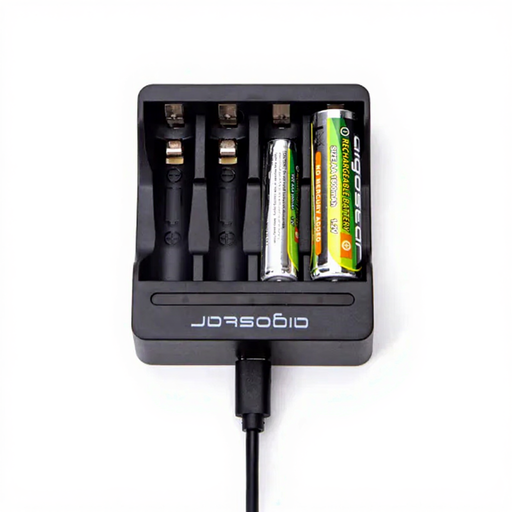
This selection is aimed at AA and AAA cells that are returned at different times, where independent charging channels and a visible charging status are useful.
 No image available
Its independent charging channels and status indicators make it a good fit for setting aside individual cells in a shared space.
For rechargeable NiMH or NiCd cells; USB input DC 5 V / 1 A. The description lists red charging and green ready indicators.
No. AA refers to the size, not the battery chemistry. The models discussed here are designed for NiMH cells. Check the markings on the cell and the charger’s manual, and don’t put a single-use alkaline AA battery in a NiMH charger.
Use the specified power supply, follow the polarity markings and don’t use damaged or damp cells. Brandweer Nederland lists incorrect charging, short circuits, damage and moisture as risks. Make it clear to colleagues which set is charged, and check whether the charger displays the status for each cell or pair.
That depends on which battery types the torch supports. Panasonic states that eneloop NiMH cells have a voltage of around 1,2 V, compared with about 1,5 V for alkaline cells. Check your torch’s manual, and don’t mix different battery types or cells with significantly different characteristics unless the manufacturer says you can.
Check whether the model you choose includes batteries and the required power supply. With rechargeable AA cells, the highest stated capacity isn’t automatically the best choice for long-term use; the Consumentenbond advises against using capacity as the only measure.