
Owner of a single table clock
You want to have a suitable battery ready without buying an unnecessarily large charger. First, check what the manual for your clock allows.


First, check the manual for your table clock: AA only tells you the battery size, and the manual for a specific Technoline clock model rules out rechargeable batteries. If the manual allows the type of battery you’ve chosen, pick a charger that’s compatible with its chemistry. Individual charging is useful when you want to prepare one cell at a time, while storage claims don’t guarantee how long a battery will last in your clock.
You want to have a suitable battery ready without buying an unnecessarily large charger. First, check what the manual for your clock allows.
You want to charge a few NiMH cells for your clock and other compatible devices at the same time. The number of charging slots and whether cells can be charged individually then become more important.
You often leave the holiday home unoccupied and want to have a spare ready before you leave. Check the storage information for your chosen cells, but don’t assume it guarantees how long they’ll last in your clock.
First, the clock manual will tell you whether rechargeable cells are suitable. Only then should you consider the charging format and number of slots.
| What to consider | What should you check? | Who is this important to? |
|---|---|---|
| Suitability for your clock | Check the exact clock model, the specified battery type and whether rechargeable cells are ruled out. | I want to know whether my table clock accepts rechargeable batteries before I buy a charger. Around 36% of consumers asking this question prioritise clock compatibility. |
| Charging one cell at a time | Compare the minimum and maximum number of cells the charger can charge at once. | If I usually replace one battery in my clock, I don’t want a charger that requires a second cell. Around 28% of consumers prefer to charge a small number at a time. |
| Keeping a spare | Check the storage information for the exact cell and the conditions it applies to. | I want to have a spare ready for a future stay, so I check what’s stated about storing the cells I’ve chosen. Around 22% of consumers prioritise keeping a spare for later. |
| Using several devices | Check what’s included in the set, how many cells the charger can handle and which battery types are permitted. | If I also use other devices with compatible rechargeable cells, one charger could be handy for different charging needs. Around 14% of consumers prioritise using a charger with several devices. |
The manual for a specific Technoline clock model advises against using rechargeable batteries. This doesn’t automatically apply to all table clocks, so check the guidance for your exact model.
Find your clock’s manual first, then choose the battery type and charger.
AA describes the size, not the battery chemistry. An Energizer manual for a NiMH charger warns that charging other battery types can cause leakage, rupture or an explosion.
Check the markings on the battery and charger, and only charge types permitted by the charger manual.
VARTA distinguishes between its LCD charger model numbers: according to the manufacturer, type 57676 charges one to four cells, while type 57070 charges two or four.
Check the full model number and the minimum number of cells that can be charged at once.
Claims about charging time or capacity retention during storage apply to the batteries and conditions specified. They don’t predict how long a battery will last in your table clock.
Only compare claims when the battery type and conditions match, and always follow your clock’s own manual.
The BQ-CC50 is a compact charger for one or two cells. According to Panasonic, the BQ-CC55 can charge one to four cells individually.
The STENKOL/LADDA version is a starter set with a charger and four AA batteries.
The LCD Charger range includes several models; the exact model number determines how many cells can be charged at once.
The Hi-Speed Value Charger is designed for compatible rechargeable AA and AAA cells.
These product picks cover AA cells and charging for a clock. For each product, check that the battery chemistry is compatible with both the charger and your table clock’s manual.
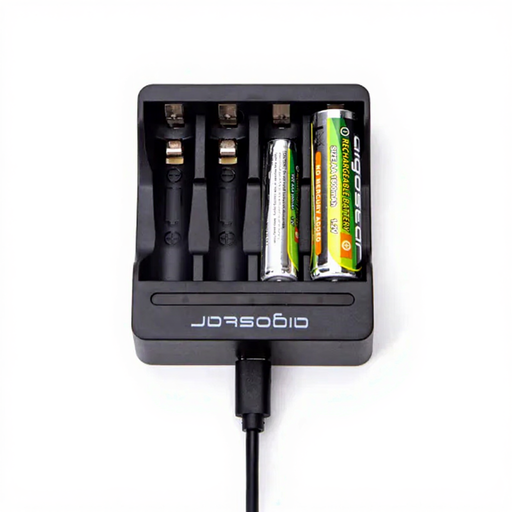 No image available
This charger could suit a small charging session, provided the battery chemistry is also permitted by your table clock.
The product information lists rechargeable NiMH or NiCd cells. Only charge types permitted by the charger manual.
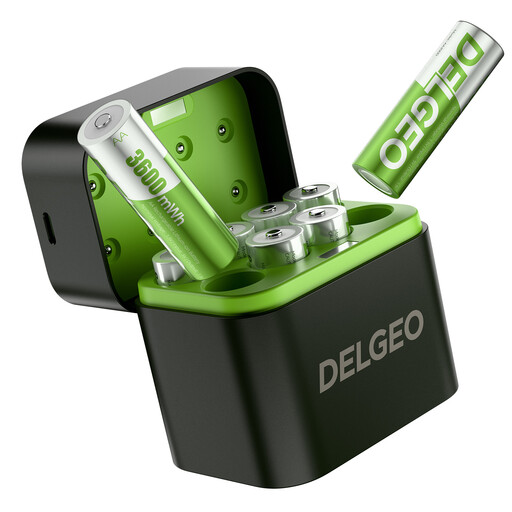 No image available
The product name describes a set of eight AA lithium batteries and a USB-C charger. Only use these batteries in your table clock if its manual permits this type.
The product name specifies a constant output of 1.5 V.
No. Follow the battery chemistry permitted in the manual for your exact charger. An Energizer manual for a NiMH charger warns that charging other battery types can cause leakage, rupture or an explosion. AA describes the size, not whether a battery is rechargeable.
Only charge battery types permitted by the charger manual, and follow its instructions. Check the storage information for the exact battery type and the conditions specified; a storage claim doesn’t tell you how long a battery will last in your clock.
Contact the seller. According to the Dutch government, if a product doesn’t work properly, you’re entitled to a product that does. A possible solution might be a repair or replacement.
According to the Dutch government, you can take used household batteries to places such as shops and supermarkets that sell batteries. A discarded charger can be taken to a collection point or your local council recycling centre. When you buy a new, similar appliance, the government also says you can return the old one through the shop or its online service.