First, check whether the wall clock’s manual allows rechargeable NiMH cells: AA size alone doesn’t tell you that. If charging is allowed, a charger with independent channels and a clear charging or error indicator is handy when colleagues are preparing one or a few cells. If you only use it occasionally for one clock, extra charging slots or fast charging aren’t automatically necessary.
Who is this buying guide for?
Person responsible for the shared wall clock
Wants to check the existing clock’s battery requirements first, then agree on a suitable replacement routine. Not every clock is suitable for rechargeable cells, so check the manual for the exact model. Panasonic Energy and TechnoTrade Import-Export GmbH provide examples of different battery voltages and requirements.
Colleague who charges individual AA batteries
Wants to prepare one or a few cells and check the charging status of each one, without waiting for a full pair to be ready. IKEA Nederland and Panasonic Energy describe chargers with independent charging channels.
Person responsible for a shared battery stock
Also prepares cells for other devices and weighs up extra charging slots and the power supply required against a simpler charger. VARTA AG describes a model with up to eight independent channels that requires a suitable adapter.
What should you look for when buying?
Start with the clock’s battery requirements. Only once rechargeable NiMH cells are permitted does it make sense to compare charging channels, status indicators and how many cells you need.
| Consideration |
What to look for |
Who is it important for? |
| Suitable for the wall clock |
Check the manual for the exact clock model to confirm the permitted battery type and voltage; don’t assume it’s suitable based on AA size alone. |
If I first want to know whether charging is even an option for this clock, compatibility comes first. Around 28% of consumers say this is their main concern. |
| Clear charging status |
Check how the model you’re considering indicates that a cell is charging, fully charged or inserted incorrectly, and which battery chemistry it accepts. |
At a shared desk, I want to see which cells are ready and which need attention. Around 22% of consumers prioritise a clear status and error indicator. |
| Charging individual cells |
Check the number of independent charging channels; the number of slots alone doesn’t tell you whether you can charge a single cell on its own. |
If only one battery needs replacing at a particular time, I don’t want to have to wait until a pair is available. Around 22% of consumers consider charging cells individually most important. |
| Keeping a spare ready |
Compare information about storage and self-discharge with how often the clock needs a replacement; keep charged and used cells clearly separate. |
I want to be able to grab a usable spare when the clock needs a new battery. Around 17% of consumers prioritise having a spare ready. |
| Complete set-up |
Check whether the version you choose includes AA cells and whether it needs a separate power adapter. |
For one clock, I don’t want to choose parts or charging slots I won’t need. Around 11% of consumers focus mainly on the complete set-up of charger, cells and power supply. |
Avoid common buying mistakes
-
Assuming any AA battery will work in the clock
AA refers to the battery size, but the clock’s requirements also determine which type of battery is suitable. A charger won’t make an unsuitable battery choice work.
Read the manual for the exact clock model before choosing a charger or rechargeable cells.
-
Assuming a fast-charging claim means a full charge
Duracell states that the CEF27 takes around 45 minutes to reach approximately 85% charge with specific 1300 mAh Duracell AA NiMH cells. This isn’t a general charging time for a full battery.
Only compare charging times when the cell, capacity, number of cells and stated charge level match.
-
Looking at the charger alone
A standalone charger and a set may include different cells. For the VARTA LCD Multi Charger+ type 57681, VARTA states that a suitable USB-C-PD adapter isn’t included.
Check what’s included in the version you choose and what power supply it requires before buying a charger.
The VARTA model requires a suitable adapter; also check whether the version you choose includes AA cells.
Brands to consider
IKEA
STENKOL is a straightforward AA/AAA NiMH charger; STENKOL/LADDA sets are also available.
- IKEA specifies four independent charging channels and an indicator for each channel on the STENKOL.
- The stated typical charging time increases when more cells are charged at once. If you’re buying a set, check whether it includes AA cells.
Panasonic eneloop
The BQ-CC17 is an AA/AAA charger that Panasonic describes as suitable for eneloop and eneloop pro cells.
- Panasonic Energy specifies one to four independent charging channels and cell monitoring; for standard eneloop AA cells, Panasonic gives an approximate charging time of seven hours.
- According to Panasonic, the plug type varies by sales region. Don’t assume every version has the same connection.
VARTA
The LCD Multi Charger+ type 57681 is designed to charge multiple AA/AAA NiMH cells.
- VARTA AG specifies up to eight independent charging channels and an LCD display.
- VARTA says a suitable USB-C-PD power adapter isn’t included; eight charging slots may be more than you need for a wall clock alone.
Duracell
The Advanced Charger CEF27 is worth comparing if preparation time is a priority.
- Duracell specifies automatic shut-off and charging in groups of two or four.
- The claim of around 45 minutes refers to approximately 85% charge with specific 1300 mAh Duracell AA NiMH cells, not a general time for a full charge. The stated group sizes also limit charging a single cell on its own.
Joybuy product for AA/AAA cells
The products below are chargers for preparing AA and AAA cells. Before using them with a wall clock, check that the manual for the exact model allows rechargeable NiMH cells.
 No image available
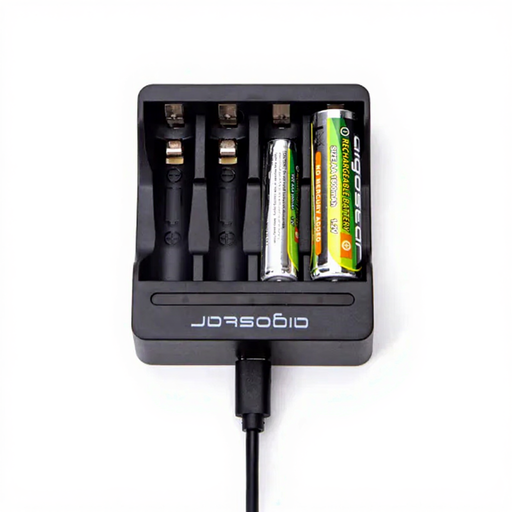
Aigostar Quick Battery Charger with Smart IC, 4 AA/AAA, black
Designed to prepare AA and AAA cells for use in a shared workspace; first check that the wall clock allows the relevant battery chemistry.
View at Joybuy
Frequently asked questions
Can I use any rechargeable AA battery in the wall clock?
No, check the manual for the exact clock model. Panasonic gives eneloop cells a voltage of around 1.2 V, compared with typically around 1.5 V for a new alkaline cell. This difference doesn’t prove that your clock will accept the rechargeable cell.
Can I put a non-rechargeable AA battery in a NiMH charger?
No, only use the battery chemistry permitted by the charger you choose. Panasonic describes the BQ-CC17’s detection of an inserted dry battery as a safety feature, not as a way to charge that battery.
How can I keep charging organised at a shared desk?
If you regularly prepare individual cells, choose a model with an indicator for each channel and agree on where to put charged batteries and those waiting to be charged. Follow the polarity markings and instructions for the charger; IKEA Nederland advises removing charged batteries from the STENKOL.
What extra items should I check?
Check whether AA cells are included and what power supply the charger requires. For the LCD Multi Charger+ type 57681, VARTA AG states that a suitable USB-C-PD adapter is required and isn’t included.
Can I put used batteries in general waste in the Netherlands?
No. According to the Government of the Netherlands, used batteries must not be put in the bin. You can return household batteries to shops and supermarkets that sell batteries, among other places.


