
Managing one shared microphone
You want a tidy charging area and a clear status indicator for the next user. First, check whether the transmitter accepts individual rechargeable AA cells.


First, check the microphone transmitter’s manual to see whether it supports the type of rechargeable AA cell you plan to use; not every wireless microphone takes individual AA cells. Then choose enough separate charging slots for all the cells that need to be ready at the same time. Compare charging times only when the number of cells, their capacity and their starting charge are similar. For a shared desk, a clear status indicator for each cell is more useful than a vague promise of fast charging.
You want a tidy charging area and a clear status indicator for the next user. First, check whether the transmitter accepts individual rechargeable AA cells.
You need to prepare several compatible AA cells or spare sets at the same time, so the number of separate charging slots and the power supply required are your main considerations.
You have little time to get cells ready, so compare charging claims based on cell capacity, number of cells and charge level reached—not just the number of minutes.
Choose this option: if your transmitter uses compatible individual AA NiMH cells and you prepare no more than four cells per charging cycle.
Bear in mind: IKEA STENKOL takes 6–8 hours to charge four AA cells. Panasonic quotes around 90 minutes for two AA eneloop cells, depending on the conditions.
Choose this option: if you want to prepare compatible AA NiMH cells for several microphones or spare sets at the same time.
Bear in mind: VARTA’s quoted four-hour charging time is based on four 1600 mAh AA cells. The 57681 requires a compatible Power Delivery adapter, which is not included.
Choose this option: if your transmitter accepts AA NiMH cells and you have little time to prepare a small number of cells.
Bear in mind: Duracell’s 15-minute claim is based on charging its own 1300 mAh AA NiMH cells to around 95%. This does not mean other cells are guaranteed to be fully charged in that time.
Choose this option: if your particular transmitter is designed to work with its own battery and charging system.
Bear in mind: this type of system is not compatible with a standard AA charger. Check the manual for your exact transmitter model.
| What to consider | What to check before buying | Who is this important for? |
|---|---|---|
| Battery type and compatibility | Check the exact transmitter model, which battery types it supports and which chemistries the charger can charge. | If I want to use the same cells in a charger and a microphone, I first need to know whether the transmitter supports them. Around 33% of consumers say compatibility is their main reason for buying. |
| Enough charging slots | Count the AA cells that need to be ready at the same time. Check whether the slots work independently and what power supply is required. | If I’m preparing several microphones or a spare set, I want to be able to get all the cells I need ready in one charging cycle. Around 27% of consumers prioritise having enough capacity to charge several cells at once. |
| Charging time | Compare claims based on the same number of cells, the same capacity in mAh and a similar definition of ‘charged’. | If there’s little time between users, I want to know how much charge the cells will actually gain in that time. Around 20% of consumers say short preparation time is their main priority. |
| Passing on charging status | Check whether the status is shown for each slot and how an error is indicated. Keep used cells separate from ready-to-use ones. | If the next user needs to pick up cells without assistance, I want to be able to see at a glance which ones are ready. Around 20% of consumers prioritise clear communication of charging status. |
A transmitter may restrict the battery chemistry you can use or require a device-specific battery. Shure’s manuals list different battery options for different transmitter models.
Check the requirements for your exact transmitter model before choosing a NiMH charger.
If the combination isn’t suitable, you may still need to buy a compatible device-specific battery and charger.
Manufacturers base their charging times on different numbers of cells, capacities and charge levels. A short charging-time claim is therefore not automatically comparable with a full charging cycle for your microphone.
Compare the conditions for the exact model and, if needed, have a charged spare set ready in advance.
VARTA says the LCD Multi Charger+ type 57681 needs a compatible Power Delivery adapter, which is not included.
Check the power requirements and what comes in the box for the exact version.
You may also need to source a compatible adapter for this version.
A charging indicator shows what the charger reports about the cell, but it doesn’t tell you how long that cell will last in a particular microphone transmitter. Shure notes that NiMH cell runtime can vary.
Use the charging status to get cells ready, and check the expected runtime for your specific combination of transmitter and cells.
STENKOL is a NiMH charger with separate slots for one to four AA or AAA cells, making it suitable for a small charging cycle at a shared desk.
The BQ-CC55 is designed to charge and display the status of up to four compatible AA or AAA eneloop cells individually.
The LCD Multi Charger+ type 57681 is designed to charge up to eight AA or AAA NiMH cells at once, with a separate slot for each cell.
The Hi-Speed Expert CEF15 is an AA and AAA charger for anyone who needs to get cells ready quickly.
According to XTAR, the VC4SL combines four charging slots with a display and testing functions for users who want to check their cells in more detail.
This product selection is aimed at getting rechargeable AA cells ready at the same time. First, check whether your microphone transmitter supports the cell type in question.
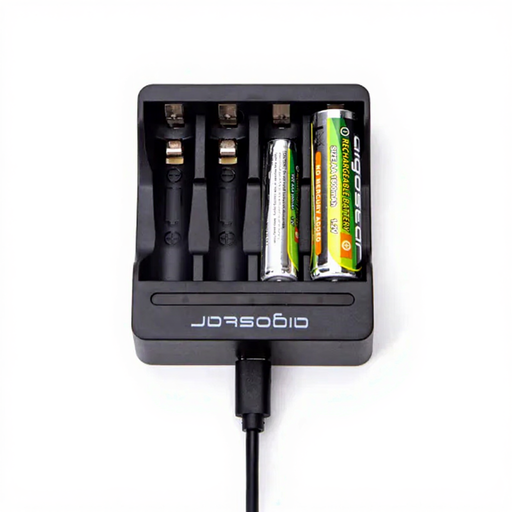 No image available
May be suitable if your microphone transmitter supports rechargeable AA cells of a compatible type; check the transmitter’s manual.
The product description lists four independent charging channels for rechargeable AA NiMH and NiCd cells.
According to the description, red indicates charging, green indicates a full cell and flashing red indicates that a cell is inserted incorrectly.
The specified power supply is DC 5 V, 1 A via USB; a USB cable is included. Dimensions: 75 × 66 × 25,2 mm.
No. AA size alone doesn’t tell you whether a cell is suitable. Check the manual for your exact transmitter model to see which battery chemistries are supported and whether the device requires its own battery. Shure lists different options for different transmitters.
Keep used cells separate from those ready for the next session, and use the status for each slot to distinguish between charging, ready and error states. Insert cells with the positive and negative ends facing the indicated directions. A charging indicator doesn’t guarantee a particular runtime in the microphone.
Not with the VARTA LCD Multi Charger+ type 57681, according to the manufacturer. It requires a compatible Power Delivery adapter, which is not included. Check the version and what comes in the box.
Take used batteries to a collection point, such as a shop that sells batteries; according to the Dutch government, they must not be put in the rubbish bin. You can take a discarded electrical appliance to a collection point or recycling centre, among other places.