
AA remote control user
Wants a suitable, straightforward way to keep one or two rechargeable AA cells ready, and first checks which battery type the remote control accepts.


First, check whether your remote control uses AA batteries and which type of rechargeable cell its manual allows. For compatible AA NiMH cells, a charger with individual channels can be useful if you sometimes charge just one or two cells. A charger for rechargeable 1.5V lithium-ion cells is only suitable if those cells work with your remote control. Also check whether batteries and a power supply are included, and under what conditions the stated charging time applies.
Wants a suitable, straightforward way to keep one or two rechargeable AA cells ready, and first checks which battery type the remote control accepts.
Is looking for suitable rechargeable AA cells as well as a charger, so checks the difference between a standalone charger and a complete set.
May be considering rechargeable 1.5V lithium-ion AA cells, for example, and checks that both the charger and the remote control are compatible.
Start with the remote control’s manual and the marking on the cell. Then choose a charger that explicitly supports that cell type, and decide whether you need individual cells or a set.
| What to consider | What should you check? | Who should pay particular attention? |
|---|---|---|
| Cell type and compatibility | Compare the battery marking and device manual with the charger’s stated support. Never recharge a non-rechargeable battery. | If I’m not sure which cell type my remote control accepts, I want to check before buying; around 36% of consumers put compatibility first. |
| Charging a small number of cells | Check whether you can charge one or two cells independently, and look at the charging indicator and the power supply required. | I want to be able to charge a small number of spare cells without relying on a complete pair; around 29% of consumers prioritise being able to charge a few cells easily. |
| Cells included | Check exactly what the set contains, the cell type, and the charging time for the stated number of cells and capacity. | If I don’t yet have suitable spare AA cells, I want to know whether they’re included with the charger; around 21% of consumers prioritise a complete starter set. |
| Specific cell technology | Check that the manual, cell and charger are compatible; for USB chargers, also check what power supply is required. | I may be looking for a specific type, such as a rechargeable 1.5V lithium-ion AA cell, and don’t want to rely on the AA size alone; around 14% of consumers prioritise this kind of specific cell requirement. |
AA describes the size, not the charging chemistry. A charger for NiMH cells isn’t automatically suitable for rechargeable 1.5V lithium-ion cells.
Check the remote control’s manual, the cell type marked on the battery and the charger’s stated support, in that order.
A charger that doesn’t support the cell chemistry you need can’t be used with those cells; you may also need to buy compatible cells separately.
IKEA and Panasonic give charging times for specific numbers and types of cells. A time stated for one combination won’t necessarily apply to another.
Only compare charging times when the number of cells, capacity and stated power supply are the same.
What’s included varies by version. Some chargers also require a particular USB power supply.
Read the contents listed for the version you’ve chosen and check what power supply is required before ordering.
If compatible cells or the required power supply aren’t in the pack, you’ll need to arrange them separately.
The STENKOL is a straightforward charger for AA and AAA NiMH cells.
The eneloop BQ-CC55 is worth considering if you want independently monitored charging channels for the eneloop cells specified by Panasonic.
The ReCyko Pro P461 is a USB charger to consider if you’re looking for a version supplied with AA cells.
The LCD Charger+ range includes AA/AAA NiMH models with different numbers of charging bays.
The VX4 V2 is designed for those who want to charge rechargeable 1.5V lithium-ion AA cells as well as NiMH cells.
These products represent two different options: a set of rechargeable 1.5V lithium-ion AA cells with a USB-C charger, and a charger for AA/AAA batteries. Check the remote control and product details to make sure the cell type and power supply are suitable.
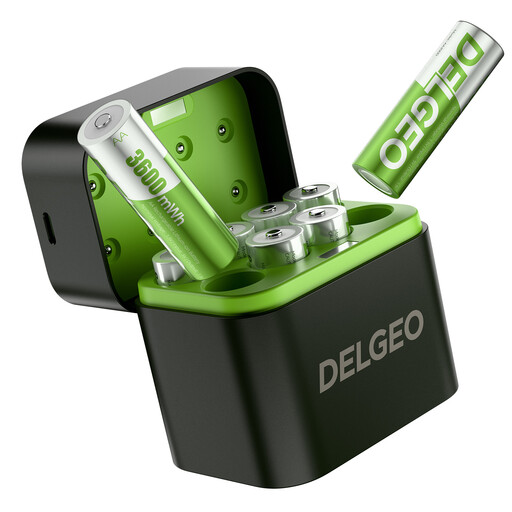 Image unavailable
An option if you’re looking for rechargeable 1.5V lithium-ion AA cells and your remote control’s manual allows this cell type.
The product name lists eight AA cells and a USB-C charger. The product information specifies a 5V/3A power supply as the charging source; check whether a suitable adapter is included.
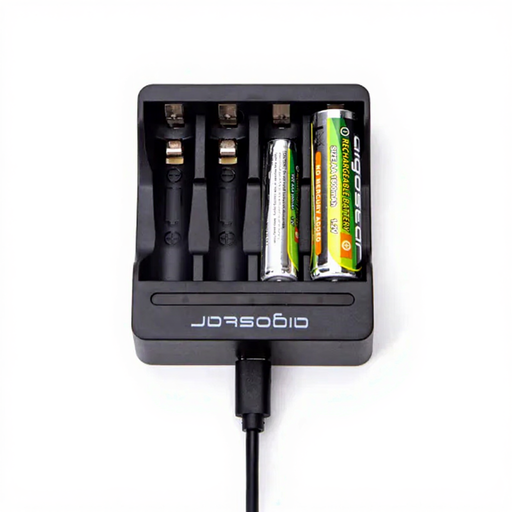 Image unavailable
An option if you’re looking for a charger for AA/AAA batteries; check the product details to make sure the version supports the cell type your remote control accepts.
The product title specifies four AA/AAA batteries. Also check what power supply is required for this version.
No. Only recharge cells explicitly marked as rechargeable and supported by the charger. Panasonic says the BQ-CC55 recognises an incorrectly inserted dry battery as an error; this safety feature is no reason to recharge a non-rechargeable battery.
No, the AA size alone doesn’t tell you which cell type is suitable. Panasonic gives a starting voltage of around 1.2 V for eneloop NiMH cells, compared with around 1.5 V for alkaline cells; XTAR separately lists support for rechargeable 1.5V lithium-ion AA cells in the VX4 V2. Always check the manual for your specific remote control.
Follow the plus and minus markings on the charger. For the STENKOL, IKEA advises unplugging it before cleaning and wiping it with a dry cloth; these instructions apply to this model.
According to ACM ConsuWijzer, in the Netherlands you have a legal guarantee, in addition to any manufacturer’s warranty, if a product doesn’t meet what you could reasonably expect. The retailer is your point of contact; there isn’t automatically one fixed warranty period for every charger.
According to the Dutch government, flat batteries must not go in general waste and can be handed in at places including shops that sell batteries. If you buy a new, similar electrical appliance, the shop must take back the old one, according to the Dutch government.