Start with the battery type specified for your lantern and how many AA cells you want to prepare at once. A USB charger can free up a mains socket if you already have a suitable USB power source; a charger with more bays can handle more cells at once, but won’t necessarily have the connection you need. Check whether an adapter is included with each model and whether the stated charging time suits your cells.
Which charger is right for you?
Lantern user with few available sockets
You want to prepare a set of AA cells without tying up a mains socket for a long time. A USB charger is worth considering if you have a suitable USB power source; check whether you’ll also need an adapter. Panasonic says the BQ-CC61 is supplied without a USB mains adapter.
Preparing several sets of AA cells
You want to prepare cells for your lantern and perhaps a spare set in fewer charging sessions. A model with eight charging bays could be a good option; VARTA, IKEA and ANSMANN describe models with up to eight bays, but the power connection varies by model.
User who wants to monitor cells individually
You don’t always charge a fixed pair and want to be able to insert cells individually or check their charging status by bay. Panasonic describes the BQ-CC61 as charging in pairs, while Panasonic says the BQ-CC55 and IKEA says the STENKOL have individual charging bays.
What should you look for when choosing?
| What to consider |
What should you check? |
Who is this important for? |
| Power without using an extra mains socket |
Check the USB connection and required power specifications, and see whether an adapter is included. |
If I have few spare sockets, I want to know whether my existing USB power source is suitable. For around 36% of consumers, the power supply is the first concern. |
| Charging several cells at once |
Count the AA cells your lantern needs and compare that number with the AA capacity per charge. |
I also want to prepare a spare set without needing more charging sessions than necessary. The number of cells that can be charged at once is the top priority for around 29% of consumers. |
| Charging and monitoring cells individually |
Check whether you can charge a single cell and whether the charging status is shown for each bay or pair. |
If my cells aren’t always in fixed pairs, I want to know whether I can charge and monitor them individually. For around 21% of consumers, individual charging control is the most important factor. |
| Ease of use and planning |
Check whether batteries are included and how long it takes to charge the number and type of cells you use. |
I want the cells ready to use in good time and would rather not have to work out a complicated connection. Ease of use and planning are the top priority for around 14% of consumers. |
Common mistakes
-
Assuming USB power means you don’t need a power source
A USB charger still needs a suitable power source. Panasonic says the BQ-CC61 is supplied without a USB mains adapter; according to VARTA, the 57681 requires a suitable USB-C PD adapter, which is not included.
Before buying, check that your existing adapter meets the requirements of that specific model.
-
Looking only at the number of charging bays
A model with eight bays may still need a mains socket. According to VARTA, the 57681 uses USB-C, while IKEA specifies mains power for the LITOSFÄR and ANSMANN for the Powerline 8.
First decide where the charger will get its power, then work out how many cells you want to charge at once.
-
Assuming one charging time applies to every set of AA cells
The stated charging time may depend on the number of cells and their capacity. IKEA gives different charging times for the STENKOL depending on how many bays are in use; Panasonic warns that the BQ-CC61’s fixed charging period may not be long enough for cells above the stated maximum capacity.
Only compare charging times when the number of cells and relevant capacity match your set.
Brands to consider
Panasonic
The eneloop charger range includes both a USB-powered model and a plug-in charger among the models covered here.
- Panasonic describes the BQ-CC61 as USB-powered and the BQ-CC55 as able to charge one to four cells individually.
- The BQ-CC61 charges cells in pairs and is supplied without a USB mains adapter. The BQ-CC55 uses a mains socket; check the plug type for your region.
VARTA
The LCD Multi Charger+ 57681 is a USB-C model with up to eight charging bays for NiMH AA cells.
- VARTA specifies one to eight NiMH AA cells and an LCD screen.
- According to VARTA, a suitable USB-C PD power adapter is required but not included. The stated charging time applies to a specific battery configuration and capacity.
IKEA
The models covered here range from a compact four-channel plug-in charger to one with eight charging bays.
- According to IKEA, the STENKOL charges one to four compatible NiMH AA/AAA cells individually. The LITOSFÄR has eight individual charging bays.
- Both models covered here use a mains socket while charging.
ANSMANN
The Powerline 8 is a mains-powered model with up to eight charging bays for AA and AAA cells.
- ANSMANN specifies individual monitoring and charging for one to eight NiMH or NiCd AA/AAA cells.
- The model covered here uses mains power, so it doesn’t offer the same choice of connections as a USB-powered charger.
Joybuy products
Here you’ll find USB-powered AA/AAA chargers and a set of AA lithium batteries with a USB-C charger. For each option, check that the charger and battery type meet your lantern’s requirements.
 No image available
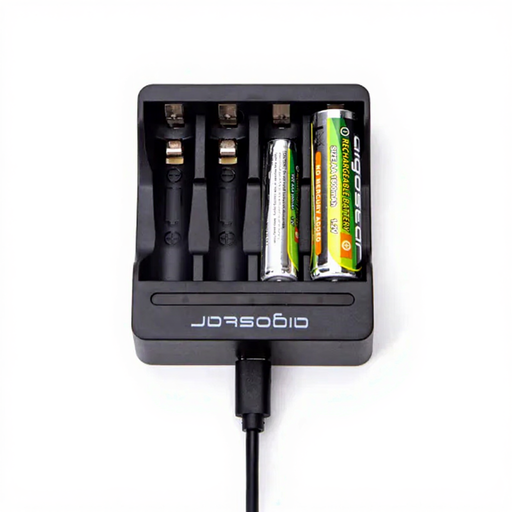
Aigostar Quick Battery Charger with Smart IC for 4 AA/AAA Black
A USB-powered option if you want to prepare up to four AA cells and have a suitable USB power source.
The product name specifies four AA/AAA bays. Check that the supported cell type matches the type specified in your lantern’s manual.
View at Joybuy
 No image available
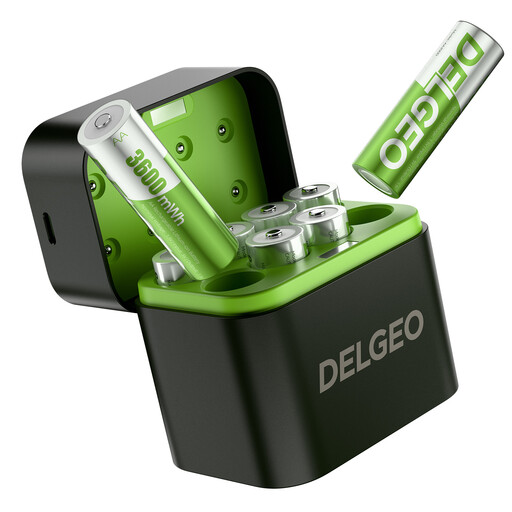
Set of 8 AA lithium batteries with USB-C charger
This set could be a good option if you want to prepare several cells using a USB-C charger and have a suitable USB-C power source.
The product name specifies eight AA lithium batteries and a constant output of 1.5 V. Only use these cells if the battery type is permitted by your lantern’s manual.
View at Joybuy
Frequently asked questions
Can I charge any AA battery in these chargers?
No. Only use cells of a type supported by the charger and specified by the lantern manufacturer. The models covered here include NiMH and, in the case of the ANSMANN Powerline 8, NiCd. Milieu Centraal advises using the specified battery type and not mixing rechargeable and non-rechargeable batteries in one device.
How should I charge and store the cells safely?
Follow the charger and battery manuals, and pay attention to the polarity markings. Brandweer Nederland advises placing the charger in an open space so heat can escape and avoiding damaged cables. Milieu Centraal recommends storing batteries in a cool, dry place and replacing all the batteries in a device at the same time.
What else do I need, and what about the warranty?
Check whether a suitable power adapter and AA cells are included: the Panasonic BQ-CC61 is supplied without a USB mains adapter, while the VARTA 57681 requires a suitable USB-C PD adapter that is not included. If you buy as a consumer in the Netherlands, you’re also covered by the statutory guarantee. ACM ConsuWijzer explains that the seller must help resolve the issue free of charge if a product breaks during normal use sooner than reasonably expected.
Can I put used AA cells and a discarded charger in general waste?
No. The Dutch government says used batteries must not go in the rubbish bin; you can take them to shops and supermarkets that sell batteries, among other places. For discarded electrical appliances, the Dutch government lists collection points and returning them when buying a new appliance of the same kind.


