First, check whether your kitchen timer accepts rechargeable AA cells. A charger is only suitable if both the cells and the charger are compatible with the device. If you can use a suitable USB power supply you already own, a USB charger could save you from using another socket, but check the power requirements for the exact model. Milieu Centraal notes that alkaline batteries can sometimes make more sense for a device that uses very little power.
Who is this guide for?
Cook with sockets in use
Wants to prepare AA cells using an existing USB power supply, without having to reserve a kitchen socket for the charger while it’s in use. A USB connection alone doesn’t prove that the available power supply is suitable. VARTA AG and Panasonic Energy list USB-powered models with their own power requirements.
Kitchen timer user who wants to be sure about batteries
Wants to check first whether the timer accepts rechargeable AA cells, then choose a charger that’s suitable for the battery chemistry. Panasonic Energy, XTAR and IKEA specify different cell types for their chargers.
Occasional battery user
Mostly uses one low-power device and wants to weigh up whether a new charging set is worthwhile. Milieu Centraal notes that alkaline batteries can sometimes make more sense for devices that use very little power.
What should you look for in an AA charger?
First, check the battery requirements for your kitchen timer and decide which power supply you can use without needing another socket. Then compare the battery chemistries the charger supports and how it handles individual cells.
| What to consider |
What to look for |
Who is this important for? |
| Charging without using another socket |
Check the input type and power requirements for the exact model, and find out which USB power supply you can actually use. |
I want to use an existing USB power supply so the charger doesn’t need another socket; around 36% of consumers say socket availability is their main concern when buying. |
| Compatible AA cells |
Read the timer’s battery requirements, then check that the charger can charge the specified battery chemistry. |
I want to avoid choosing a cell or charger that isn’t compatible with my kitchen timer; around 29% of consumers say battery compatibility is their main concern when buying. |
| Charging cells individually and checking their status |
Check whether you can charge a single cell on its own and how the charger indicates its charging status. |
I want to charge one or a few spare cells and check their status; around 21% of consumers say charging status is their main concern when buying. |
| Whether it’s worthwhile for occasional use |
Consider whether the timer uses little power and whether you’ll also use the charger for other compatible devices. |
I only use my kitchen timer occasionally and don’t want to buy a charging set without a good reason; around 14% of consumers say whether it’s worthwhile for occasional use is their main concern when buying. |
Common buying mistakes
-
Assuming USB-C charging means you won’t need a socket
The connection on the charger doesn’t tell you what power supply it needs. Panasonic Energy states that a USB mains adaptor isn’t included with the BQ-CC87.
Before buying, check which existing USB power supply you can use and compare it with the requirements of the exact charger model.
-
Assuming all AA cells are rechargeable
AA refers to the size, not the battery chemistry. The chargers reviewed have different restrictions on the cells they can charge.
Check the kitchen timer’s requirements, the marking on the cell and the charger’s instructions. Don’t recharge disposable batteries.
-
Assuming a stated charging time applies to every AA cell
VARTA AG bases the stated one-hour charging time for the Eco Charger Pro Recycled on two 1600 mAh AA cells. IKEA gives different typical charging times for STENKOL, depending on the number and capacity of the cells.
Only compare charging times when the number of cells, their capacity and the power conditions are the same.
-
Automatically buying a new charging set for a kitchen timer you rarely use
Milieu Centraal notes that alkaline batteries can sometimes make more sense when a device uses very little power.
Consider how often you use your own kitchen timer and whether you’d also use the charger for other compatible devices.
Brands to consider
VARTA
The Eco Charger Pro Recycled has a USB-C input and four individual slots for AA and AAA NiMH cells. The Eco Charger Multi Recycled has eight slots, making it a good option if you also want to prepare more cells for other devices.
- According to VARTA, the Pro version detects alkaline and faulty cells.
- VARTA’s stated one-hour charging time applies to two 1600 mAh AA cells under the specified test conditions. Check the power requirements for the exact version.
Panasonic
The BQ-CC87 is a USB-powered charger for eneloop and eneloop pro cells in AA or AAA sizes.
- Panasonic specifies individual charging for one to four cells, along with a status indicator.
- For charging, Panasonic specifies eneloop or eneloop pro cells. The USB mains adaptor isn’t included; the USB emergency output doesn’t mean that other AA cells are suitable for charging with this model.
XTAR
The USB-C-powered L4 is designed for AA and AAA NiMH cells and certain rechargeable 1.5 V lithium cells.
- XTAR lists support for both of these battery chemistries and detection of non-rechargeable cells.
- XTAR excludes 3,2/3,6/3,7 V lithium cells from use with this model. Don’t assume that every AA-size lithium cell is suitable.
IKEA
STENKOL is an AA/AAA NiMH charger that plugs directly into a socket.
- According to IKEA, STENKOL has four individual charging channels and a status light for each slot.
- The charger uses a socket while charging and, according to the manual, is intended for compatible NiMH cells.
Joybuy products
This selection focuses on AA chargers with a USB input for preparing cells. Check that the battery chemistry is compatible with your kitchen timer and that the USB power supply you have available meets the charger’s requirements.
 No image available
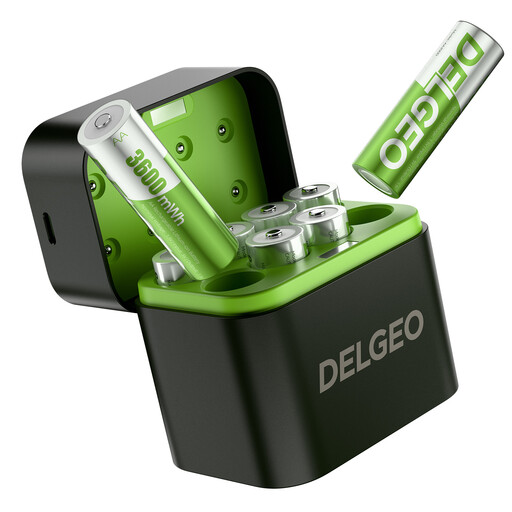
Set of eight AA lithium batteries with USB-C charger
The product title combines eight AA lithium batteries with a USB-C charger. Check that your kitchen timer accepts this battery chemistry and that the USB power supply you have available meets the charger’s requirements.
View at Joybuy
 No image available
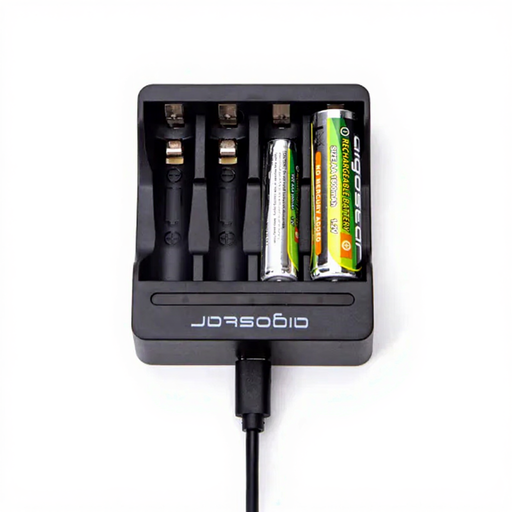
Aigostar Quick Battery Charger for 4 AA/AAA
The product title describes a charger for four AA or AAA cells. Check the product information to see which battery chemistry it supports and what USB power supply it needs.
View at Joybuy
Frequently asked questions
Can I put alkaline AA batteries in a rechargeable AA charger?
No. The IKEA STENKOL manual prohibits charging non-rechargeable batteries, and Panasonic says the same for the BQ-CC87. Always follow the charger’s instructions for battery chemistry, even if a cell fits in the slot.
Will a rechargeable AA cell work in every kitchen timer?
It depends on the model and the kitchen timer’s battery requirements. Panasonic gives eneloop a nominal voltage of around 1.2 V; alkaline cells are usually around 1.5 V. So check the instructions for your own device, not just the AA size.
Does a USB charger mean I don’t need a socket?
Only if you can use a suitable USB power supply you already own. Check the power requirements for the exact model and find out whether a required adaptor is included; Panasonic says that a USB mains adaptor isn’t included with the BQ-CC87.
How do I use a plug-in charger safely?
Follow the model instructions for polarity and battery type. For STENKOL, IKEA specifies indoor use and recommends unplugging the charger before cleaning it or when it’s not in use. Don’t immerse the charger in water.
Where can I take used batteries and a discarded charger?
According to the Dutch government, used batteries must not go in general waste; you can take them to a shop that sells batteries, for example. You can also return a discarded electrical appliance when buying a new, similar one through the old-for-new scheme.


