
You want to check battery compatibility first
You’re not sure whether your doorbell receiver accepts rechargeable AA cells and want to avoid choosing an unsuitable charger. Check the receiver’s manual before buying a charger.


First, check your doorbell receiver’s manual to see whether rechargeable AA cells are permitted: the AA size alone doesn’t confirm compatibility. If NiMH cells are suitable, a charger with individual slots can be useful for a spare set. Only choose extra charging programmes or a fast charger if you need those features.
You’re not sure whether your doorbell receiver accepts rechargeable AA cells and want to avoid choosing an unsuitable charger. Check the receiver’s manual before buying a charger.
You want to charge AA cells in advance and swap them over when the receiver runs out of power. IKEA and ANSMANN describe chargers with individual slots for charging cells.
You don’t always have a charged spare set, so you’re comparing charging times and the conditions they’re quoted for. IKEA and Duracell provide information about charging times under specific conditions.
Start with the receiver’s battery requirements. Then choose a charger and, if needed, a spare set that suit the cell type and how you want to prepare the cells.
| What to consider | What should you look for? | Who is this important for? |
|---|---|---|
| Compatibility | Check the cell type in the receiver’s manual and make sure the charger supports it. | I want to find out first whether my receiver accepts rechargeable AA cells; otherwise, I won’t know which charger is suitable. Around 36% of consumers put compatibility first. |
| Spare set | Check how many cells the receiver uses and whether the charger can charge that number individually. | I want to be able to swap in pre-charged cells when my receiver runs out of power. Around 29% of consumers prioritise having a charged spare set. |
| Charging time and operation | Only compare charging times for the same number of cells, the same capacity and the same charge level. | I want to know when my cells will be ready and how much time to allow before replacing them. Around 21% of consumers focus primarily on charging time and operation. |
| Purchase and contents | Check whether the pack contains just a charger or includes cells too, and whether you need a spare set. | I don’t want to buy unnecessary features or an incomplete set. Around 14% of consumers prioritise additional purchase costs. |
The size doesn’t tell you whether the receiver accepts rechargeable cells. Your receiver’s battery requirements determine which cells you can use.
Read the manual and check the markings in the battery compartment before choosing a charger and cells.
A charger or set of cells that isn’t compatible with the receiver may mean you have to buy another set after all.
IKEA’s STENKOL manual warns against putting non-rechargeable batteries in the charger.
Before charging, check the marking on each cell and follow the charger’s instructions.
Duracell states that its 1300 mAh AA NiMH cells reach around 85% charge after 45 minutes. For four AA cells in the STENKOL, IKEA quotes a typical charging time of 6–8 hours. These claims relate to different products and conditions.
Only compare charging times when the cell type, capacity, number of cells and intended charge level are the same.
STENKOL is a straightforward option for charging rechargeable AA or AAA NiMH cells. IKEA also offers a STENKOL/LADDA set with cells included.
The Hi-Speed Advanced Charger CEF27 is aimed at anyone who wants to get NiMH cells ready more quickly.
The Powerline 4.2 Pro is a more advanced option for anyone managing several sets of NiMH cells.
According to the product specification, the Pro Charger CHPRO is designed to charge two or four AA or AAA cells.
This selection includes a charger for AA and AAA cells and an AA lithium set with a USB-C charger. Before buying, check whether the specific cell type is permitted in your doorbell receiver.
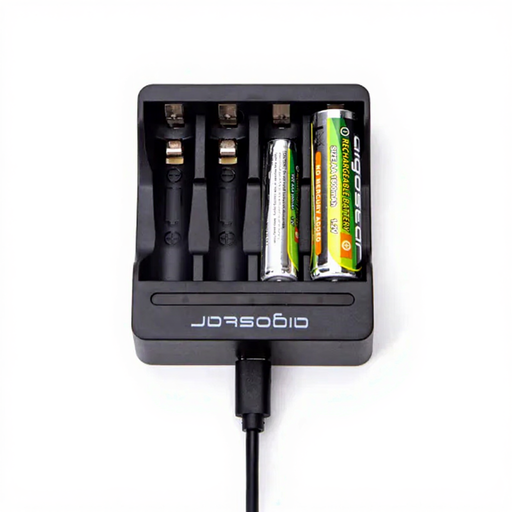 No image available
Only consider this charger if your doorbell receiver accepts the cell type; the product information lists rechargeable NiMH or NiCd cells.
The product title specifies a charger for four AA or AAA cells.
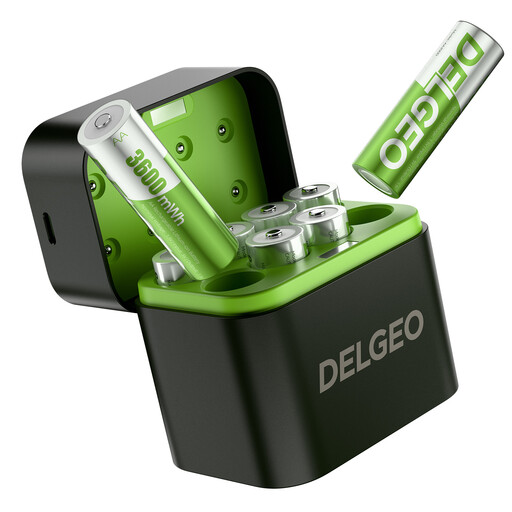 No image available
Check your doorbell receiver’s manual to see whether this specific AA cell type is permitted; the AA size alone doesn’t confirm compatibility.
The product title specifies eight AA lithium batteries, a USB-C charger and a constant 1.5 V output.
Only if they’re rechargeable cells, the charger supports their cell type and the receiver accepts rechargeable cells. IKEA’s STENKOL manual permits NiMH cells and warns against charging non-rechargeable batteries. Also check the instructions for your doorbell receiver.
Follow the plus and minus markings and the charger’s manual. For STENKOL, IKEA advises unplugging the charger before cleaning it and using it indoors only.
That depends on what you already have and what’s included in the package. IKEA offers both a standalone STENKOL charger and a STENKOL/LADDA set with four batteries, so check which version you’re looking at.
According to the Dutch government, flat batteries shouldn’t go in the bin; you can drop them off at shops that sell batteries, among other places. When buying a new, similar appliance, private customers can also use the old-for-new scheme to return their old charger, including when buying online.
No. According to the European Commission, CE marking is neither a comparative performance test nor a central EU approval. It relates to the manufacturer’s declaration that the product complies with the applicable EU product rules. Don’t assume from the logo alone that a charger is suitable for your doorbell.