
People with few spare sockets
If you want to charge rechargeable AA batteries approved for your chime using a USB power source, first check that the chime accepts them and see which USB power sources you have available.


A USB AA charger is a good option when sockets are scarce, provided your chime’s manual allows rechargeable AA batteries and you have a suitable USB power source. A plug-in charger still needs a socket while charging. First, check the exact chime model: the manual for the KlikAanKlikUit ACDB-9000C specifies alkaline AA batteries, and Honeywell Home advises against using NiMH rechargeable batteries in its doorbells.
If you want to charge rechargeable AA batteries approved for your chime using a USB power source, first check that the chime accepts them and see which USB power sources you have available.
First, check whether the manual allows rechargeable AA batteries. The AA size alone doesn’t tell you which battery chemistry or voltage is suitable.
If you’re preparing several rechargeable batteries, check how many charging channels the charger has and how it indicates charge status.
| What to consider | What should you check? | Who is this for? |
|---|---|---|
| Compatibility with the chime | Look up the exact chime model and check the approved battery type and voltage. | I want to check first whether my chime accepts rechargeable AA batteries, so I don’t choose a charger for batteries I’m not allowed to use. Around 36% of shoppers prioritise compatibility. |
| Power supply when sockets are scarce | Compare the charger’s input with the USB port, cable or adapter you have available; check what’s included. | I want to charge without plugging another charger into a socket, but USB is only useful if I have a suitable power source. Around 28% of shoppers prioritise the power supply they have available. |
| Number of cells and charge status | Count the AA batteries you need and check how many cells the charger can charge at once and individually, as well as what its indicator lights mean. | I want to be able to lay out the number of rechargeable batteries my chime needs in an organised way. Around 22% of shoppers focus mainly on how charging is arranged. |
| What you need to use it | Check the packaging, approved rechargeable batteries and whether you need a suitable adapter or cable. | I want to know in advance which parts I need to charge and use the rechargeable batteries. Around 14% of shoppers make this their priority. |
The manual for the KlikAanKlikUit ACDB-9000C specifies 2 × 1.5V alkaline AA batteries. Honeywell Home advises against using NiMH rechargeable batteries in its doorbells. These recommendations apply to particular models or manufacturers.
Before buying, check the manual for your exact chime model and the approved battery type.
The Panasonic BQ-CC87 uses 5V USB, but a USB mains adapter isn’t included.
Check which USB power source and cable you already have, and what comes with your chosen charger.
A stated charging time doesn’t automatically apply to every cell. Duracell’s claim of around four hours is based on specific battery capacities and charging conditions.
Only compare charging times when the number of cells, relevant capacity and conditions are the same.
The BQ-CC87 is a USB-powered charger for compatible eneloop and eneloop pro cells.
The L4 is a USB-C charger for supported NiMH and rechargeable 1.5V lithium AA and AAA cells.
The Hi-Speed Value Charger CEF14 is a mains-powered AA and AAA NiMH charger for anyone happy to charge batteries in pairs.
This Joybuy selection includes AA lithium batteries with a USB-C charger, as well as a charger for AA and AAA batteries. Before using rechargeable cells in a doorbell chime, check whether its manual allows that battery type.
 No image available
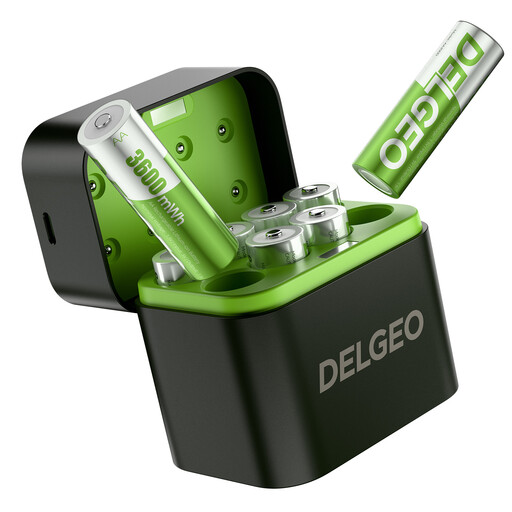
A possible choice if you want to keep several AA lithium batteries ready with a USB-C charger; first check whether your chime allows these rechargeable cells.
The product name specifies a pack of 8 AA lithium batteries, a USB-C charger and a constant 1.5V output.
 No image available
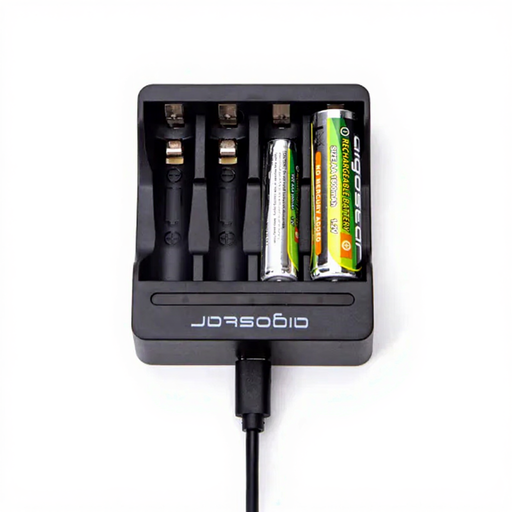
A possible choice if you’re looking for a charger for AA or AAA batteries; check whether your chime allows rechargeable cells of the type you choose.
The product name specifies a charger for 4 AA/AAA batteries. Check the charger manual for the approved battery chemistry and usage instructions.
No, you can’t tell from the AA size alone. The manual for the KlikAanKlikUit ACDB-9000C specifies 2 × 1.5V alkaline AA batteries, and Honeywell Home advises against using NiMH batteries in its doorbells. So check the instructions for your exact chime model.
No. Panasonic states that dry batteries must not be charged in the BQ-CC87. Only charge the cell types that your charger’s manual explicitly says are rechargeable.
Check whether you already have a USB power source that’s suitable for the charger. Panasonic lists a laptop port or power bank among the options for the BQ-CC87, and says that the USB mains adapter isn’t included. Without a suitable alternative, even a USB charger may still need a socket.
According to the Rijksoverheid, you’re entitled to a product that works properly when you buy it, and the seller must provide a solution if there’s a problem. A manufacturer’s guarantee is in addition to your statutory rights. Check who the seller is and keep your proof of purchase.
The Rijksoverheid says that used batteries must not be put in general waste and can be handed in at places including shops that sell batteries. Take a discarded charger to an appropriate collection point or your local council recycling centre. When you buy a similar new appliance, the old-for-new scheme described also applies to private purchases.