
People looking after one shared clock
You want to replace a single AA battery promptly and first check whether the clock manual allows rechargeable NiMH cells.


An AA charger is only suitable for a shared desk clock if the manual for that exact clock model allows rechargeable NiMH cells. A clock manual may specify 1.5 V alkaline AA batteries, while Panasonic Energy lists NiMH cells at around 1.2 V. If your clock does support NiMH cells, a charger that can charge cells individually is useful for keeping a single spare cell ready. Also check the charging indicator and the cost of the rechargeable batteries.
You want to replace a single AA battery promptly and first check whether the clock manual allows rechargeable NiMH cells.
You want to see which rechargeable batteries are ready to use and check whether you can charge one cell on its own or need to charge several at once.
You want to weigh up whether a separate charger and rechargeable cells make sense for your limited battery use.
Start with the clock manual. Then check whether you need to charge a single cell on its own, what kind of charging indicator you want, and whether the charger and rechargeable batteries suit the way you use them.
| What to consider | What to look for | Who is this important for? |
|---|---|---|
| Clock compatibility | Check the manual for your exact clock model and confirm that the clock supports your chosen battery chemistry. | I want to find out first whether my clock supports NiMH AA batteries, so I don't buy an unsuitable combination. Around 36% of consumers say clock compatibility is their main concern. |
| Charging a single spare cell | Check whether the charger can charge one cell on its own and whether it clearly indicates the charging status. | At a shared desk, I want to prepare a spare AA without having to charge several cells at once unnecessarily. Around 29% of consumers prioritise being able to charge a single spare cell on its own. |
| Use after storage | Compare information on self-discharge and long-term use; don't base your choice on the mAh rating alone. | If a spare cell has been sitting unused for a long time, I want to know whether it will still work when the clock needs a replacement. Around 21% of consumers prioritise charge retention after storage. |
| Cost if you rarely replace batteries | Compare the charger and compatible rechargeable batteries with how often you replace batteries, and check whether any cells are included. | If I rarely change batteries, I want to weigh up whether a charger and rechargeable batteries are worthwhile for this clock alone. Around 14% of consumers focus on the total upfront cost when use is limited. |
The AA size doesn't tell you which battery chemistry the clock supports. The manual may specify alkaline AA batteries.
Read the manual for your exact clock model before choosing rechargeable batteries or a charger.
A model with slots for two or four cells won't necessarily let you charge one cell on its own.
Check how many cells the exact model can charge at once and whether it supports charging cells individually.
The Dutch Consumers' Association warns that a rechargeable battery with the highest stated capacity isn't automatically the best choice; a high capacity can come at the expense of long-term performance.
For a spare cell, also compare information on charge retention and performance after repeated recharging.
The STENKOL is a NiMH charger for AA and AAA cells, including situations where you want to prepare a single spare cell.
The Mini Charger 57656 is designed to charge two cells at a time, while the LCD Charger 57070 has a screen to show charging status.
The Hi-Speed Value Charger CEF14 is a NiMH charger for two or four AA or AAA cells.
This selection is for anyone who wants to prepare a single rechargeable AA spare cell. Use it in your clock only if the manual allows that battery chemistry.
 No image available
Suitable for preparing a single spare cell, provided the clock manual allows the chosen rechargeable battery chemistry.
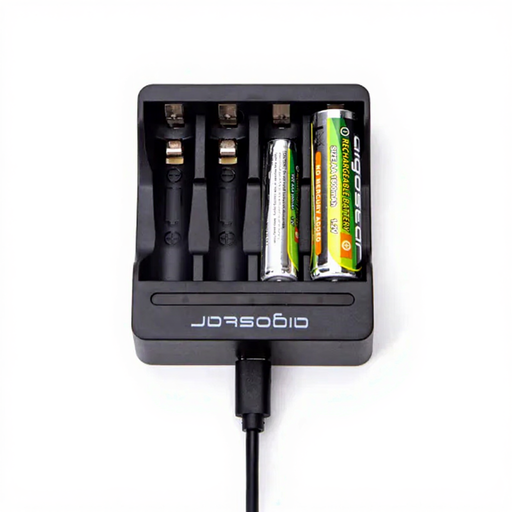
Listed as compatible with rechargeable NiMH and NiCd AA and AAA cells. It has four independent charging channels, supports charging individual cells and uses LED indicators to show when batteries are charging or fully charged.
Do not recharge ordinary alkaline batteries.
No. Only recharge batteries that are explicitly labelled as rechargeable and whose chemistry is suitable for the charger, according to its manual. Energizer warns that recharging a non-rechargeable battery can cause leakage or damage.
You can't tell from the AA size alone. Panasonic Energy lists NiMH cells at around 1.2 V, compared with the typical 1.5 V for alkaline batteries. A manual for one specific Acctim clock model specifies a single 1.5 V alkaline AA battery only. So always follow the manual for your exact clock model.
If your clock supports NiMH cells, choose a charger that can charge one cell on its own and check the charging status. IKEA says the STENKOL can charge one to four cells using separate channels.
Check the instructions, the stated power supply and the applicable CE marking. The Dutch government says electrical appliances sold in the EU must carry a CE marking; this doesn't tell you whether the charger supports your battery type.
When you buy as a consumer in the Netherlands, you're entitled to a legal guarantee as well as any manufacturer's warranty. The Netherlands Authority for Consumers and Markets' ConsuWijzer explains that the seller must offer an appropriate free solution if a product breaks down sooner than you could reasonably expect during normal use. There isn't one fixed statutory guarantee period for all chargers.