
People with few spare sockets
If you want to get a suitable rechargeable AA cell ready using USB, check that the available USB power supply meets the charger’s requirements.


First, check your desk clock’s manual: manufacturers don’t give the same advice about rechargeable AA batteries for every clock model. If your clock supports the rechargeable cell type you’ve chosen, a USB charger can be handy when you have few spare sockets. Also check how many cells you can charge at a time and what power supply the charger requires.
If you want to get a suitable rechargeable AA cell ready using USB, check that the available USB power supply meets the charger’s requirements.
If you want to charge one cell without waiting until you have a second empty one, check whether the charger supports charging cells individually. IKEA lists four separate charging channels for the STENKOL, while GP says the E821 charges a minimum of two cells at a time.
If you want to use the same charger and rechargeable cells with other devices, check which cell types are permitted for each device and whether the charger supports their chemistry.
First, check that your clock allows the rechargeable cell type you’ve chosen. Then compare the power source and minimum number of cells per charging session with what you can actually use at home.
| What to consider | What should you check? | Who is this important for? |
|---|---|---|
| Charging without using another socket | Check what type of USB power supply the charger needs. GP says the E821’s charging time also depends on the USB adaptor. According to VARTA, the VARTA LCD Multi Charger+ 57681 requires a USB-C PD power supply of at least 9V/2A or 12V/1,25A; the adaptor is not included. | If I don’t want to free up a socket for the charger, I’m looking for a power supply I can already use. Around 31% of consumers prioritise charging without needing another socket for the charger. |
| Suitability for your clock | Read your clock’s manual and check which battery chemistries are allowed. IKEA recommends LADDA for the IKEA PS 2026 table clock, while an Energizer charger manual advises against using NiMH batteries in clocks. These recommendations apply to the products mentioned and not automatically to every clock model. | If I want to use a rechargeable cell in my own clock, I want to know first whether it’s suitable for that model. Around 31% of consumers give suitability for their clock top priority. |
| Charging one AA cell | Check the minimum number of cells per charging session. IKEA says the STENKOL can charge 1 to 4 cells, GP says the E821 can charge 2, 4, 6 or 8 cells, and VARTA says the LCD Multi Charger+ can charge from one NiMH cell. | If my clock takes just one AA cell, I want to be able to charge it without first having to find a second one. Around 23% of consumers put charging one cell individually first. |
| Charging indicators and what’s included | Check the charging indicator or shut-off features on the exact model, and what’s included. IKEA and GP list automatic shut-off; VARTA lists a display for the 57681 and says the required PD adaptor is not included. | If I want to use the charger without missing parts or uncertainty while it’s charging, I check its features and what’s in the box. Around 15% of consumers prioritise charging indicators and what’s included. |
An AA label on its own doesn’t mean that a cell can safely be recharged. Only cells labelled as rechargeable and with chemistry supported by the charger are designed for recharging.
Before charging, check the label on the cell and the charger’s chemistry requirements.
A USB connection isn’t automatically the right power supply for every charger. VARTA says the LCD Multi Charger+ 57681 requires a USB-C PD adaptor, which isn’t included.
Compare the exact model’s power requirements with the USB source you want to use, and check which cable and adaptor are included.
A charger with several slots may still require at least two cells per charging session. That’s inconvenient if you only want to charge one AA cell for your clock.
Check the minimum number of cells per charging session and whether separate charging channels are listed.
Manufacturers don’t give the same advice about rechargeable cells for every clock model. IKEA recommends LADDA for the IKEA PS 2026 table clock, while an Energizer charger manual advises against using NiMH cells in clocks.
Check the manual for your own clock before choosing rechargeable cells.
IKEA describes the STENKOL as a NiMH charger for AA and AAA cells, with individual charging.
GP describes the RECYKO E821 as a USB-powered NiMH charger for multiple AA or AAA cells.
VARTA describes the LCD Multi Charger+ type 57681 as a USB-C charger for individual NiMH AA and AAA cells.
XTAR describes the L4 as a USB-C charger for NiMH cells and compatible rechargeable 1,5V lithium AA and AAA cells.
These products are suited to USB power: a set of rechargeable AA lithium cells and a USB-powered AA/AAA charger. Before use, check that both your clock and the charger support the cell type you’ve chosen.
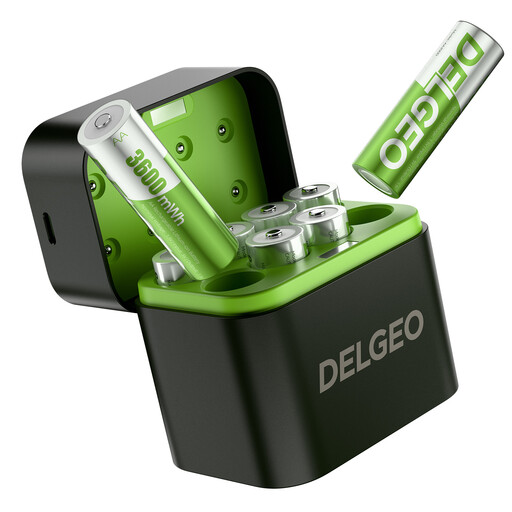 No image available
A set for anyone who wants to get AA lithium cells ready using a USB-C charger. Use these cells in your clock only if its manual says this cell type is suitable.
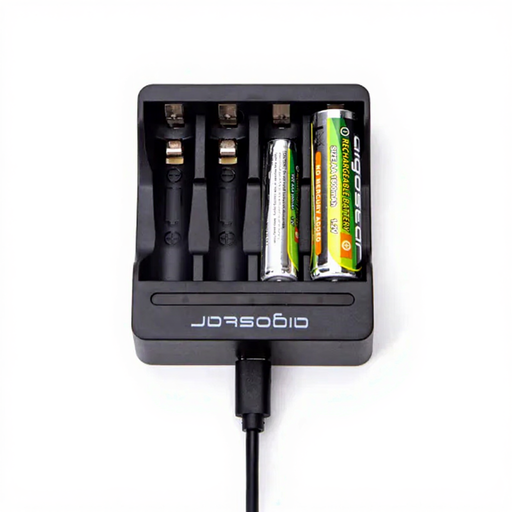 No image available
An option for anyone looking for a USB-powered charger that can charge one AA cell individually. Only use rechargeable cells that the charger supports and that are suitable for your clock according to its manual.
It depends on your clock’s manual. IKEA recommends LADDA for the IKEA PS 2026 table clock, while an Energizer charger manual advises against using NiMH cells in clocks. Don’t automatically apply either recommendation to a different model.
No. Check the exact model’s power requirements. GP says the E821’s charging time also depends on the USB adaptor. According to VARTA, the LCD Multi Charger+ 57681 requires a suitable USB-C PD power supply, which is not included.
Only charge rechargeable cells supported by the charger. The Zaanstreek-Waterland Safety Region recommends charging batteries only when you’re at home and awake, if possible, and placing them on a hard, non-flammable surface.
Check whether the version you’ve chosen includes the required USB cable, power supply and rechargeable cells. VARTA says the LCD Multi Charger+ type 57681 comes with a USB-C cable, but not the required PD mains adaptor.
According to the Dutch Government, used batteries must not go in the bin; take them to a collection point. Discarded chargers are covered by the rules for electrical appliances: when buying a similar new appliance, individuals can return the old one to the retailer, including when buying online, following the procedure described.