
CD listeners who want to check compatibility first
You have a portable CD player but aren’t sure whether it accepts rechargeable AA cells. Check the manual for your exact model: Sony manuals show that battery requirements can vary between players.


First, check your CD player’s manual to see whether rechargeable AA cells are supported; the AA size alone does not guarantee compatibility. Then choose a charger that supports the right chemistry and suits your available power connection, preferred charging speed and need for individual charging channels. Fast charging times apply to specific cells and charge levels, not necessarily to every battery.
You have a portable CD player but aren’t sure whether it accepts rechargeable AA cells. Check the manual for your exact model: Sony manuals show that battery requirements can vary between players.
You want to charge two suitable AA cells between listening sessions. So, compare charging times only for compatible cells and under similar charging conditions.
You want to check the charging status at a glance and prepare individual cells. Also consider the available connection and the space the charger takes up.
| What to consider | What to look for | Who it matters to |
|---|---|---|
| Compatibility | Check the player’s manual for the permitted battery type and chemistry. Compare these with the cells supported by the charger. | If you want to be sure the combination will power your specific CD player, check the manual first. Around 36% of consumers put compatibility first. |
| Charging time | Compare the time taken to charge two AA cells, the stated cell capacity and the charge level reached. Also check whether the charger accepts the number of individual cells you want to charge. | If you want two compatible cells ready between listening sessions, check the charging time under conditions that suit your cells. Around 29% of consumers prioritise preparation time. |
| Charging at a shared desk | Check the required mains or USB connection, individual charging channels and how the charging status is displayed. Find out whether a cable or power adapter is included. | If you share a desk, you’ll want to use the available connection without losing sight of the charging status. Around 21% of consumers focus on practical, easy-to-monitor charging. |
| Complete set and cells | Check whether suitable AA cells and the necessary accessories are included. Compare cell performance and replaceability separately from the charger; the Dutch Consumers’ Association notes that the highest stated capacity isn’t automatically the best choice for long-term use. | If you want to put together a practical set and replace the cells later, check what’s included and how the cells perform. Around 14% of consumers prioritise a complete set and cell lifespan. |
Battery requirements vary between CD player models. An AA compartment alone doesn’t tell you whether the player accepts rechargeable NiMH cells.
Look up the exact model and check which battery chemistry the manual specifies before choosing cells and a charger.
A stated time may apply to a particular number of cells and a partial charge. Duracell states that the Advanced CEF27 reaches around 85% in 45 minutes with its own 1,300 mAh AA NiMH cells. This isn’t a general time to a full charge.
Compare the number of cells, cell requirements and stated final charge level before weighing up charging times.
A USB connection alone doesn’t tell you whether the required power supply is available or which accessories come with a particular model.
Check the input requirements, whether a cable or adapter is included, and how the charger indicates that charging is complete. Also check the CE marking and the relevant product safety information.
The STENKOL charger is a NiMH option for AA and AAA cells, with individual charging channels.
The eneloop BQ-CC55 is designed to charge the AA and AAA eneloop variants listed by Panasonic individually.
Duracell’s Dutch Hi-Speed range includes the Advanced CEF27 for AA and AAA cells.
The LCD Charger type 57070 is a NiMH charger for AA and AAA cells, with an LCD display.
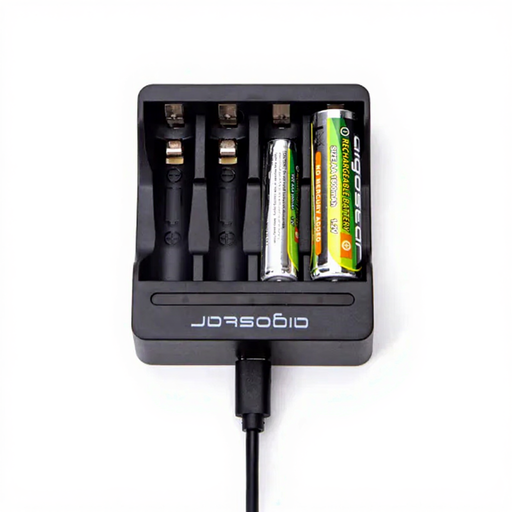
This Joybuy pick is for anyone who wants to prepare rechargeable AA cells via USB at a shared desk. First, check that your CD player accepts the chosen battery chemistry.
 No image available
An option for anyone who wants to prepare AA or AAA cells via USB at a shared desk. Check that the connection and power supply suit the available power source.
The product name describes a charger for four AA/AAA cells. Before use, check that your player supports the chosen rechargeable cell chemistry, and check the CE marking and relevant product safety information.
No, the AA size alone doesn’t mean it will work. A Sony D-NE050 manual specifies two LR6 alkaline cells, while another Sony manual covers specific rechargeable cells and a charging cradle. Check the manual for your exact model before buying NiMH cells.
Follow the plus and minus markings and the charger’s instructions. IKEA and the Dutch Fire Service recommend placing the charger in an open area so heat can dissipate, and not using a damaged cable. Also follow the manufacturer’s instructions for your chosen model.
Not unless you check the conditions. Duracell states that the Advanced CEF27 reaches around 85% in 45 minutes with 1,300 mAh AA NiMH cells. Only compare claims when the cell capacity, number of cells and final charge level match.
Check that suitable AA cells and, for USB power, a compatible cable and power source are included with the exact version. Duracell lists a 10-year warranty for the Advanced CEF27; check the terms for the version and seller you’re considering.
The Netherlands Food and Consumer Product Safety Authority (NVWA) states that CE marking is compulsory for electrical products; the specific electrical rules that apply also depend on the product version. According to the Dutch government, spent batteries must not go in general waste and can be returned to shops that sell batteries, among other places. The European Commission says that new ecodesign requirements for products including standalone chargers for AA and AAA cells will come into force on 14 December 2028, after October 2026.