
Travellers with limited charging space
If you want to charge NiMH AA cells for a torch in a hotel room, look for a compact charger and check what USB power or suitable mains sockets are available.


Choose a charger that matches the chemistry of the rechargeable AA cells your torch supports, as stated in its manual. Then check whether you have USB power or a suitable mains socket, whether the charger can charge the cells you need individually, and how much time you have. Place the charger in an open, clear space while charging and follow the instructions; never charge it covered up on a hotel bed.
If you want to charge NiMH AA cells for a torch in a hotel room, look for a compact charger and check what USB power or suitable mains sockets are available.
If you want to charge one or a few rechargeable AA cells, check the battery chemistry and how many independent charging channels the charger has.
If you need your torch by a particular time, factor in the charging time and status indicator. Manufacturer figures apply only under the conditions stated.
First, check which cells your torch supports and what power source you can use in your room. Then compare the charging channels, charging time and how the charger indicates progress.
| What to consider | What to look for when buying | Who is this important for? |
|---|---|---|
| Power supply and portability | Check whether the charger uses USB power or a mains socket, and whether the right power source or plug is available. | If space is limited and I want to charge using the connection available in my hotel room, this is a key consideration. Around 33% of consumers give power supply and portability top priority. |
| Cell compatibility and charging channels | Check the battery chemistry and whether the charger can charge a single cell on its own; four slots do not always mean four channels. | If I only need to charge one or a few cells, I want to be sure that both the chemistry and the charging setup are suitable. Around 25% of consumers prioritise compatibility and the number of charging channels. |
| Charging time and status | Compare charging times only for cells with the same capacity, the same number of cells and comparable power conditions. Also check what the indicator shows. | If I need my torch by a particular time, I want to estimate how long charging will take and know whether it is still in progress. Around 25% of consumers give preparation time and visibility of charging progress top priority. |
| Safe charging | Follow the instructions, use undamaged equipment and place the charger in an open, clear space. If you are considering a particular version, check that it has the required CE marking. | If I’m charging in a shared sleeping space, I want to be able to place the charger somewhere clear and follow the instructions. Around 17% of consumers make safe charging and fault alerts their main buying priorities. |
GP specifies that the GP B421 has four slots but two charging channels. The VARTA type 57070 is specified for charging two or four cells at a time.
If you need to charge a single AA cell, check how many independent charging channels the exact charger has.
Manufacturer figures may relate to a different number of cells, a different capacity or different power conditions.
Compare charging times only when the conditions match, and allow for any variation stated by the manufacturer.
AA refers to the size, not the battery chemistry. The chargers reviewed do not all support the same cell types.
Check the markings on the cells and charger, and follow the instructions in your torch manual.
The BQ-CC55 is a mains plug-in charger for compatible eneloop and eneloop pro AA and AAA cells.
The ReCyko B421 is a compact USB charger for NiMH AA and AAA cells.
The LCD Charger type 57070 is a mains-powered NiMH charger with an LCD for AA and AAA cells.
The VC4SL is a USB-C charger for the 1.2 V NiMH and 3.6/3.7 V lithium-ion cells listed by XTAR.
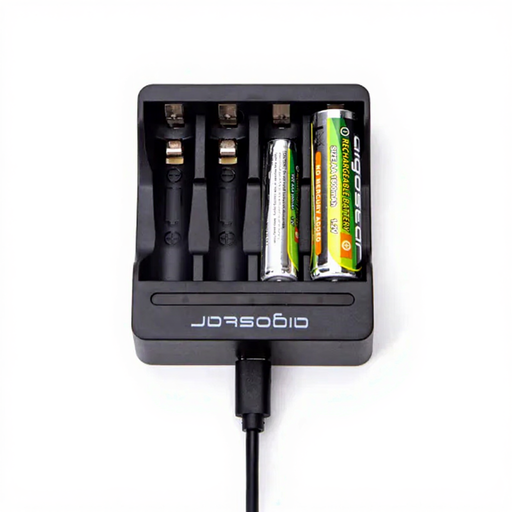
This selection focuses on a compact USB charger for rechargeable NiMH AA cells, suitable for use with a torch.
 No image available
A good option if you want to charge rechargeable NiMH AA cells for a torch using USB power; check that you have a suitable USB power source.
Before buying, check that the exact version has the required CE marking. The Netherlands Food and Consumer Product Safety Authority states that CE marking is mandatory for electrical products placed on the Dutch market.
No, do not recharge alkaline batteries. Only use cell types that the manual for your exact charger says are suitable. Panasonic and GP describe fault alerts for non-rechargeable cells; this does not mean you can charge them.
Place the charger in an open, clear space, away from bedding, and don’t use a damaged charger or cable. The fire service advises keeping chargers clear so heat can escape; also follow the instructions for the cells and charger you’re using.
If there’s a fault, contact the seller; in the Netherlands, you’re entitled to a product that works as it should. According to the Government of the Netherlands, there is no fixed statutory warranty period that applies to all products.
The Netherlands Food and Consumer Product Safety Authority states that CE marking is mandatory for electrical products. This requirement alone does not prove that a specific version complies. Take used batteries to a collection point; the Government of the Netherlands lists shops that sell batteries among the places where you can return them.