
Clock owners who want to check compatibility
You want to check the manual first to see whether your wall clock accepts the specific type of rechargeable AA cell. The AA size alone doesn’t confirm that a battery is suitable.


An AA charger only makes sense if your wall clock accepts the specific type of rechargeable battery you want to use. So check the manual first. For a low-power clock that rarely needs a new battery, the recommended disposable battery may be a more sensible choice than a charging set, according to Milieu Centraal. If you also use other devices that take compatible AA or AAA cells, focus on chargers that can charge one cell at a time.
You want to check the manual first to see whether your wall clock accepts the specific type of rechargeable AA cell. The AA size alone doesn’t confirm that a battery is suitable.
You rarely replace the battery and want to weigh up whether buying a charger just for this clock makes sense. Milieu Centraal says an alkaline battery can sometimes be a sensible choice for devices with very low power consumption; always follow the battery type specified by the manufacturer.
You also want to have batteries ready for other devices and are looking for a charger that suits the number of cells you want to charge at once.
Choose this if: your clock doesn’t allow NiMH cells, or you’d only use the charger for a low-power clock.
Trade-off: you avoid the cost of buying a charger, but need to keep using the specified battery type.
Choose this if: your clock accepts NiMH cells and you want to charge one or a few AA or AAA cells.
Trade-off: check whether compatible rechargeable batteries are included and how many cells the charger can take at a time.
Choose this if: you regularly use rechargeable batteries in several devices and want to see their charging status.
Trade-off: extra features don’t change which battery types your wall clock accepts; charging times are only comparable when the cells and conditions are the same.
| What to consider | What should you check? | Who is this important to? |
|---|---|---|
| Clock compatibility | Check the manual for the specified battery type and whether the clock accepts the rechargeable cell you’ve chosen. | I want to avoid buying a cell that isn’t suitable for my clock. Around 36% of consumers put compatibility first. |
| Value for low-power use | Consider how often you replace the clock battery and whether you’ll use the charger for other devices too. | If I rarely replace the battery, I want to know whether a charger just for this clock makes sense. Around 29% of consumers prioritise whether it’s worthwhile for low-power use. |
| Charging one cell | Check the minimum number of cells per charge and whether the charger has individual charging channels. | I want to be able to charge a single clock cell without having to add a second one. Around 21% of consumers prioritise the convenience of charging one cell. |
| Total cost | Check whether compatible AA cells are included and whether the charger also suits your AAA devices. | When I want to understand the full cost, I consider both the charger and the rechargeable batteries I’ll need. Around 14% of consumers prioritise the total cost. |
An AA cell isn’t automatically compatible with your wall clock’s battery requirements. Panasonic Energy gives eneloop’s voltage as approximately 1.2 V, compared with typically around 1.5 V for an alkaline cell.
Check your clock’s manual before choosing a rechargeable cell.
A charger may require a minimum number of cells per charge. Duracell says the CEF14 charges two or four cells at a time.
Check the exact model to see how many cells you can charge at once.
A charger sold on its own doesn’t automatically come with rechargeable AA cells for your clock.
Check what’s included in the pack and factor in the cost of compatible rechargeable batteries when making your choice.
Manufacturers give charging times for specific cells and quantities. Panasonic Energy also notes that conditions and battery condition can affect charging time.
Only compare charging times when the battery type, number of cells and conditions are the same.
The BQ-CC55 is designed to charge one to four eneloop or eneloop pro cells individually.
The LCD Charger range is worth considering if you want to see charging status on a screen; check the specifications of the exact model.
The Hi-Speed Value Charger CEF14 is designed for people who usually charge two or four NiMH cells at a time.
These product picks are intended to help you get AA batteries ready for a wall clock: a set of AA lithium cells and a standalone AA/AAA charger. Before buying, check that the battery chemistry matches your clock’s requirements.
 No image available
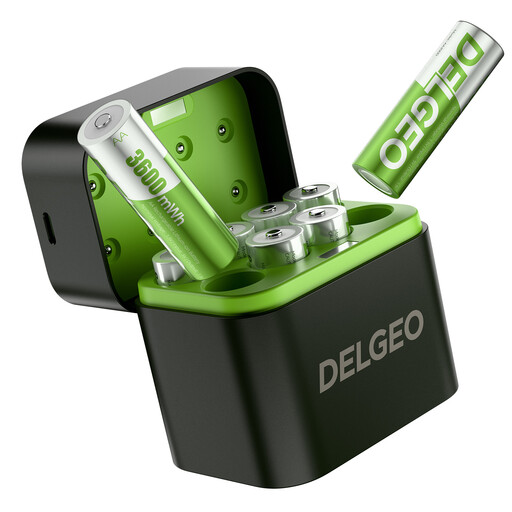
Only suitable if your clock’s manual allows this type of rechargeable AA lithium cell; the stated output is a constant 1,5 V.
The set is described as eight AA lithium cells with a USB-C charger.
 No image available
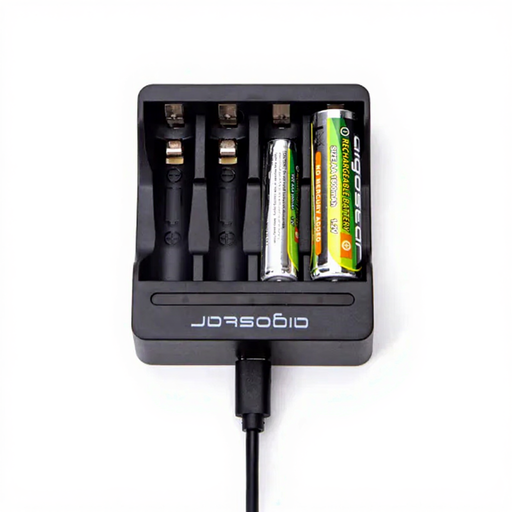
Individual charging channels can be useful if you want to charge one cell at a time; check that the battery chemistry of the exact model matches your clock’s requirements.
The product information lists single-cell charging, automatic shut-off and LED charging-status indicators for AA and AAA cells.
No. Use the battery type specified by your clock’s manufacturer. Panasonic Energy gives eneloop’s voltage as approximately 1.2 V, compared with typically around 1.5 V for an alkaline cell; these general figures don’t replace the manual for your own clock.
It depends on the model. Panasonic Energy says the BQ-CC55 can charge one to four cells individually, while Duracell specifies that the CEF14 charges two or four cells at a time. Check the minimum number of cells required by the charger you’re considering.
Not always. It depends partly on how often you replace the battery and whether you use the charger for other devices. Milieu Centraal says an alkaline battery can sometimes be a sensible choice for a device with very low power consumption, but recommends using the type specified by the manufacturer.
According to the Dutch government, used batteries shouldn’t go in the bin; you can take them to shops and supermarkets that sell batteries, among other collection points. A discarded charger should be recycled with electrical appliances. When you buy a new, similar appliance, the Dutch government says you can use the old-for-new scheme.
If there’s a fault, contact the retailer in the Netherlands. The Dutch government doesn’t specify a fixed statutory warranty period; what you can expect from a product depends on factors including the product itself and normal use.