
Toy train owners who want to check compatibility first
You want to check whether your train can use rechargeable AA cells before choosing a charger. The IKEA STENKOL manual distinguishes between NiMH cells and non-rechargeable batteries.


First, check the toy train’s manual to see whether rechargeable AA cells are permitted and which type is required. Then choose a charger that’s compatible with those cells. On a shared desk, separate charging channels, a clear charging indicator or a dedicated storage spot can help keep cells organised. Charging times depend on the cells used and the conditions specified by the manufacturer.
You want to check whether your train can use rechargeable AA cells before choosing a charger. The IKEA STENKOL manual distinguishes between NiMH cells and non-rechargeable batteries.
You want to keep an eye on charging status and spare batteries in a space used by others too. Models from IKEA and GP include features such as charging indicators, a cassette or a storage compartment.
You don’t yet have suitable AA cells and want to find out how many batteries are included and what power supply the charger needs. GP states that four AA NiMH cells are included with the B421.
Start with the train’s requirements and the cells you’ll be using. Then compare the charging channels, storage options and what you’ll need to use the charger at your desk.
| What to consider | What should you check? | Who is this important for? |
|---|---|---|
| Cell type and safe use | Check the train’s manual and make sure the charger is suitable for the permitted cell type. The NVWA states that electrical products sold in the Dutch market must carry the CE marking. | I want to check first whether my train can use rechargeable AA cells. For around 33% of consumers, compatibility and safe use come first. |
| Keeping things organised on your desk | Look for a charging indicator for each slot and a cassette or storage compartment for loose cells. | I want to keep charged and empty cells separate in a shared workspace. Around 27% of consumers give top priority to keeping their desk organised. |
| Flexible charging and charging time | Check the number of charging channels, whether a single cell can be charged, and which cells and conditions a stated charging time is based on. | I don’t always charge the same number of cells and want to know when they’ll be ready. For around 20% of consumers, flexible charging or preparation time is the main consideration. |
| Complete set and power supply | Check how many AA NiMH cells are included and which USB power supply is needed; assess the cells separately from the charger. | I’m looking for my first set and want to know in advance what else I’ll need to use it. Around 20% of consumers prioritise a complete first set. |
AA size doesn’t tell you whether a battery is rechargeable or suitable for your train and charger. The IKEA STENKOL manual warns against charging non-rechargeable or damaged batteries.
Check the train, battery and charger manuals before charging any cells.
GP specifies that the B421 has four slots but two charging channels. IKEA states that the STENKOL has four independent channels.
Check the number of charging channels if you want to recharge cells individually.
Duracell’s four-hour claim refers to around 90% charge for specific Duracell AA NiMH cells with a capacity of 1300 mAh. IKEA says that charging times for the STENKOL vary depending on cell capacity and the number of cells.
Only compare charging times when the cell capacity, number of cells and description of the charge are the same.
GP specifies a 5 V/1 A USB input for the B421. So, included batteries don’t automatically tell you which power supply you can use at your desk.
Before buying, check which power supply is needed and what’s included in the box.
The features listed apply to the specific models below; they’re not a general assessment of every charger from each brand.
The STENKOL is designed to charge one to four AA or AAA NiMH cells, while the LITOSFÄR combines charging with a separate storage compartment.
The ReCyko B421 is a USB charging set that comes with four AA NiMH cells and a storage cassette.
The Hi-Speed Value Charger CEF14 is designed for people who usually charge two or four AA or AAA cells at a time using mains power.
The LCD Charger type 57070 is an option if you want a display while charging.
This Joybuy selection is designed to help you prepare AA and AAA cells at your desk, with charging status and charging cells individually among the key considerations.
 No image available
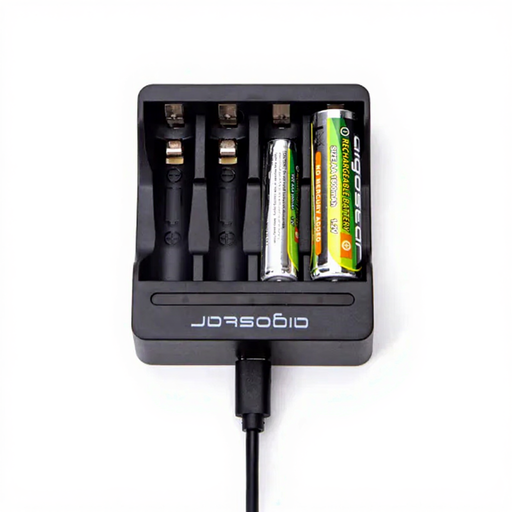
An option for a desk where you want to charge AA or AAA cells and check the charging status of each slot.
The product name indicates a charger for four AA/AAA batteries. The product information lists independent charging channels, charging status LEDs and automatic shut-off when charging is complete.
The required USB power supply is 5 V/1 A; a USB cable is included. Before buying, check that the cell type is suitable for your train and charger, and that the product information confirms the required CE marking.
Only if they’re rechargeable cells permitted by the train’s manual and supported by the charger. The IKEA STENKOL manual allows only NiMH cells within the stated capacity limits and warns against charging non-rechargeable or damaged batteries. Don’t assume a cell is suitable just because it’s AA size.
No. Milieu Centraal advises recharging modern NiMH batteries before they’re fully discharged. You should also follow the instructions for the battery and charger you choose.
Use the charging status indicator and keep loose cells in a dedicated place out of children’s reach. VeiligheidNL warns that loose batteries can be swallowed; the research findings cited relate mainly to button cells and aren’t a risk figure for AA cells.
For a faulty product, contact the seller about your statutory rights under the Dutch legal guarantee; according to the Dutch government, there’s no fixed statutory guarantee period. Dispose of used batteries separately at a collection point, as advised by Milieu Centraal.
According to the NVWA, electrical products sold in the Dutch market must carry the CE marking. The CE marking indicates conformity; on its own, it doesn’t prove that an independent body has tested the specific charger.