Who is this buying guide for?

Parents who want to charge safely

You want to charge the train’s AA batteries without putting disposable or damaged cells in a charger. Clear charging indicators and practical instructions are important; the Dutch Fire Service advises placing a charger in an open space so heat can escape.

Parents short on preparation time

You want to have the batteries ready before playtime. So compare the charging time for the right number and type of cells, rather than just the shortest time quoted on the packaging.

Travellers with limited space for charging

You need a suitable place to plug in the charger in your hotel room. With a USB-C model, you’ll also need to check whether you have the required power supply and can take it with you.

What should you look for when buying?

Plug-in charger

Choose this if: you want to charge one to four compatible AA or AAA cells and have an accessible socket.

Bear in mind: charging time varies depending on the number of cells and the model; also check the plug on the version you’re buying.

USB-C charger

Choose this if: you want to place the charger somewhere other than directly in a wall socket and can bring the specified power supply.

Bear in mind: a USB-C connection doesn’t automatically mean that any phone adapter will work. The VARTA LCD Smart Charger+ requires a compatible Power Delivery adapter, which isn’t included.

Fast charger

Choose this if: the batteries need charging shortly before playtime and the stated charging conditions suit your cells.

Bear in mind: a manufacturer’s fast-charging claim won’t necessarily apply to every capacity or a full set of batteries.

What to consider What should you check? Who is this most important to?
Compatible cells and safe charging Check the train’s manual to find out how many AA cells it needs and whether rechargeable cells are allowed. Then check the charger’s cell chemistry and charging requirements. If you don’t want to risk using an incompatible cell or charging method, compatibility and safe charging are the top priorities. This applies to around 33% of consumers in this situation.
Charging a full set in time Compare the charging time for exactly the number of cells in the train and for the capacity of the batteries you use. If you want the whole set ready before playtime, focus on the time needed to charge all the required cells. Consumers with this as their main priority make up around 27% of consumers in this situation.
Power supply and placement Check the plug or the required USB power specifications for the exact version. Place the charger in an open space while it’s in use. If you need to find a suitable place to charge in a hotel room and would rather not rely on an unsuitable connection, power supply and placement are your main priorities. This applies to around 20% of consumers in this situation.
Complete purchase and reusability Check whether the package includes a charger, AA cells and, if needed, a power adapter, and whether the number and type of cells suit the train. If you want to get everything you need at once to prepare rechargeable cells for the train, the contents of the set are key. Around 20% of consumers in this situation prioritise a complete, reusable starter set.

Common buying mistakes

  • Assuming the shortest charging time applies to your full set

    A quoted time may apply to a different number of cells or a specific capacity. IKEA gives different typical charging times for different numbers of AA cells for the STENKOL; fast-charging claims also depend on particular cells and conditions.

    Compare the charging time for the same number of AA cells and a similar capacity with the time you have before playtime.

    An overly optimistic plan could mean a longer wait or that you need a second charging session.

  • Assuming a USB-C cable is all you need

    For the VARTA LCD Smart Charger+, the manufacturer specifies a compatible Power Delivery adapter, which VARTA says isn’t included.

    Before you set off, check the input requirements and what’s included with the exact version.

    You may need a separate power adapter to use the charger.

  • Comparing a charger on its own with a set that includes batteries

    IKEA sells the STENKOL charger on its own, as well as in a set with four LADDA AA cells. A standalone charger won’t automatically include the cells you need.

    Check what’s included and whether the number and type of cells are suitable for the train.

    If you don’t already have suitable rechargeable AA cells, you’ll need to buy them separately with a standalone charger.

Brands to consider

IKEA

IKEA sells the STENKOL charger on its own and in a set with four LADDA AA cells.

  • IKEA says the STENKOL has individual charging indicators and stops charging automatically. For four AA cells, IKEA gives a typical charging time of 6–8 hours.
  • Check whether you’re choosing the standalone charger or the set with cells, and whether the plug on that version is suitable.

Panasonic

The eneloop BQ-CC55 is designed for one to four eneloop or eneloop pro cells in AA or AAA size.

  • Panasonic specifies a charging indicator for each cell and a charging time of around 90 minutes for two eneloop AA cells.
  • That charging time won’t necessarily apply to every combination of cells. Panasonic says the plug varies by sales region.

VARTA

The LCD Smart Charger+ is a USB-C charger for one to four NiMH AA or AAA cells, with a display and individual charging channels.

  • VARTA specifies charging and refresh modes. The quoted charging time of 1.5 hours applies to two 1600 mAh AA cells.
  • VARTA says this model requires a Power Delivery adapter, which isn’t included. The quoted charging time won’t necessarily apply to other cells or quantities.

Duracell

The Hi-Speed Expert Charger CEF15 is an AA/AAA charger to consider if you’re short on preparation time.

  • Duracell claims around 95% charge in 15 minutes with its own 1300 mAh AA NiMH cells, and says it can charge one to four cells.
  • According to Duracell, this claim applies under the stated cell conditions and shouldn’t be assumed to apply to other cells or quantities without checking.

Joybuy product selection

This Joybuy selection features a USB-powered charger for rechargeable AA and AAA cells. Before use, check that the cell chemistry and power supply are suitable for your train and the available connection.
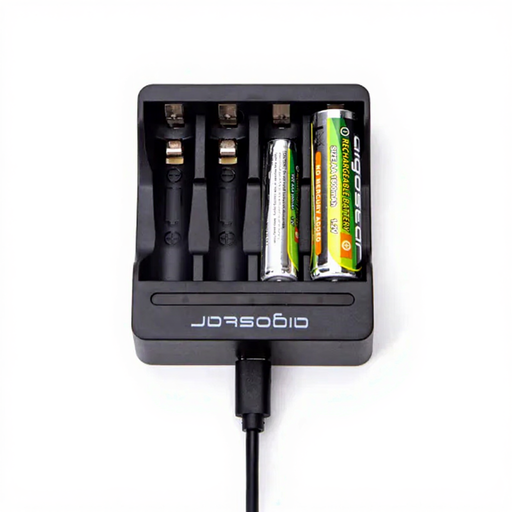
Aigostar Quick Battery Charger with Smart IC for 4 AA/AAA Black

Aigostar Quick Battery Charger with Smart IC for 4 AA/AAA Black

The four individual charging channels listed may be useful if you want to prepare several compatible rechargeable cells at once.

The product information states that it supports rechargeable NiMH or NiCd cells, has LED charging indicators and switches off automatically when the cells are full.

The specified power supply is USB DC 5 V 1 A, so you’ll need a compatible USB power source. For this exact version and any adapter, check which applicable EU product requirements apply.

Joybuy

Frequently asked questions

Can I put the train’s AA batteries in any AA charger?

No. First check the train’s manual and the charger specifications. The IKEA STENKOL manual only allows suitable rechargeable NiMH cells and warns against charging non-rechargeable or damaged batteries; other chargers have their own requirements.

Where should I put a battery charger in a hotel room?

Place the charger in an open space so heat can escape, not under a pillow or duvet. The Dutch Fire Service advises placing chargers in an open space; also follow the instructions for your chosen charger and any hotel rules.

Will my phone adapter automatically work with a USB-C AA charger?

No. It depends on the model’s power requirements. VARTA specifies a Power Delivery adapter of at least 9 V/2 A or 12 V/1.25 A for the VARTA LCD Smart Charger+, and says that it isn’t included.

Does a battery charger sold in the Netherlands have to meet product regulations?

Yes. Applicable European safety requirements apply to electrical and electronic equipment. Business.gov.nl says equipment must comply with the relevant European rules; CE marking is only required when the product falls under rules that require it, as explained by the European Union through Your Europe. Check the requirements that apply to the specific model and any adapter.

What warranty and disposal options are available in the Netherlands?

When you buy a product, the Dutch government says you’re entitled to a product that works properly under the statutory guarantee; a manufacturer’s warranty is in addition to this. Take used batteries to a collection point and don’t put them in general waste.
