
Train owners looking to switch safely
You want to check first whether your toy train can use rechargeable AA cells, then find a charger that suits the cell type. Milieu Centraal and Energizer offer useful guidance on using batteries safely.


First, check your train’s manual to see which type of AA cell is permitted and whether the cells are rechargeable. Milieu Centraal recommends using the specified battery type, while Energizer warns against putting non-rechargeable batteries in a charger. Then choose a charger that supports the chemistry of your rechargeable cells. Individual charging channels are useful when charging different numbers of cells, while extra charging slots are most beneficial if you want to prepare several sets at once.
You want to check first whether your toy train can use rechargeable AA cells, then find a charger that suits the cell type. Milieu Centraal and Energizer offer useful guidance on using batteries safely.
You may want to charge several AA cells at once, so you’re comparing the number of charging slots, individual channels and charging time for your chosen load. IKEA, Panasonic and VARTA describe chargers for different numbers of cells.
You may use both NiMH and rechargeable 1.5V lithium-ion cells. A charger that supports multiple chemistries is only relevant if both the charger and the train are compatible with the cells you choose. XTAR says the L4 Pro supports these cell types.
| What to consider | What should you check? | Who is this important for? |
|---|---|---|
| Cell type and safe charging | Check the train’s requirements, the markings on the cells and the chemistries supported by the charger. Never charge non-rechargeable cells. | I want to be sure my train supports rechargeable AA cells and that the charger is compatible with their chemistry; around 36% of consumers prioritise compatibility. |
| Number of charging slots | Count the cells in the train and any spares. Check how many AA cells the model can charge at once and whether it can charge them individually. | If I want to prepare a complete set and spare AA cells at the same time, the charger’s capacity matters most to me; around 29% of consumers prioritise the number of charging slots. |
| Charging time and progress | Only compare charging times for the same number and type of cells. Also check whether the charging status is shown for each cell. | I want to know when the cells are ready before using the train; around 21% of consumers prioritise charging time and progress updates. |
| Extras you may need | Check whether compatible cells, a cable and any required power adapter are included with the version you’ve chosen. | If I need a complete set, I want to know in advance what else I’ll need besides the charger; around 14% of consumers give required extras top priority. |
AA refers to the size, not whether a cell is rechargeable. Putting non-rechargeable cells in a charger can cause damage or unsafe charging.
Check the markings on each cell and read the train and charger manuals before charging.
Charging time can vary depending on the number of cells. IKEA gives different typical charging times for STENKOL when charging one or two, three, or four AA cells.
Compare the stated time with the number and capacity of the cells you actually want to charge.
A pack containing just a charger won’t necessarily include compatible rechargeable cells or the power supply you need.
Check what’s included with the specific version, including cells, cable and any adapter. For example, VARTA states that a USB-C-PD adapter is not included with the LCD Universal Charger+ type 57688.
Depending on the version, you may need to buy compatible AA cells or a suitable adapter separately.
STENKOL is a straightforward charger for one to four AA or AAA NiMH cells. IKEA also lists a separate STENKOL/LADDA set.
The eneloop BQ-CC55 is designed for supported eneloop AA and AAA NiMH cells that you want to charge and monitor individually.
The LCD Multi Charger+ type 57681 is designed for anyone who wants to prepare several AA or AAA NiMH cells at once.
The L4 Pro is worth considering if you use both supported rechargeable AA NiMH cells and 1.5V lithium-ion cells.
This selection focuses on charging rechargeable AA NiMH cells for a toy train. Before use, check whether the train supports this cell type.
 No image available
An option for preparing rechargeable AA NiMH cells, provided your train’s manual permits this cell type.
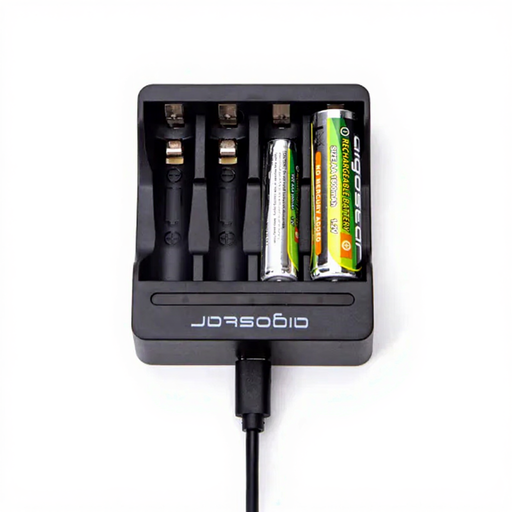
Suitable for rechargeable AA and AAA NiMH or NiCd cells. It has four independent charging channels, an LED status indicator and automatic shut-off when charging is complete. A USB cable is included.
Only if they’re rechargeable cells, your train’s manual says they can be used, and the charger supports their chemistry. An AA NiMH charger isn’t designed for standard non-rechargeable alkaline cells.
Not with every model. IKEA says STENKOL has one to four individual charging channels, while Panasonic says the BQ-CC55 can charge one to four supported cells individually. Follow your charger’s manual and check the positive and negative positions.
The EU common charger rules described by the European Commission cover specific categories of portable electronic devices, but not standalone AA battery chargers. So USB-C is a feature to compare when choosing a charger, not a requirement under those rules.
According to ACM ConsuWijzer, the seller is responsible for offering an appropriate solution if the product doesn’t perform as you could reasonably expect during normal use. This could include a repair, replacement or refund; what’s appropriate depends on the product and the circumstances.
Take used batteries to a collection point, such as a shop that sells batteries. The Dutch government says batteries shouldn’t go in the bin.