
Not many spare sockets
You want to charge AA cells without using an extra wall socket while they charge. The USB power supply you have available will help determine whether a USB charger is practical.


If you have a suitable USB power supply, you could consider a USB-powered NiMH charger so you don’t need to use an extra socket while charging. A plug-in charger may be suitable if you can free up a socket temporarily. First, check that your remote uses AA cells and that the charger and batteries you choose are compatible.
You want to charge AA cells without using an extra wall socket while they charge. The USB power supply you have available will help determine whether a USB charger is practical.
You want to check which type of cells your remote takes and avoid putting ordinary, non-rechargeable batteries in a NiMH charger.
You’re looking for a charger that comes with compatible AA cells, so you don’t have to choose a charger and batteries separately.
First, consider which power supply you can use while charging. Then check the battery chemistry and how many cells you want to have ready.
| What to consider | What to check before buying | Who should pay particular attention? |
|---|---|---|
| Power without using an extra socket | Check the power connection and whether the exact model requires an adapter. | If I can’t spare an extra socket while charging, I look for USB power and check whether my adapter is compatible. Around 36% of consumers prioritise being able to charge without using an extra socket. |
| The right cells and safe charging | Check that they are AA cells and that the charger is suitable for the batteries’ chemistry and capacity. | I want to make sure my remote uses AA cells and that the rechargeable type is compatible with the charger. Around 29% of consumers prioritise the right cells and safe charging. |
| Cells included with the charger | Check how many AA cells are included and how many your remote needs. | If I don’t have rechargeable AA cells yet, I look for a set with enough cells to get started. Around 21% of consumers prioritise a complete set with compatible cells. |
| Charging channels and preparation time | Check how many cells can be charged at once and which cells the stated charging time applies to. | If I want to prepare different numbers of cells, I look for individual charging channels and check how long my own cells will take to charge. Around 14% of consumers prioritise charging flexibility or preparation time. |
VARTA says the LCD Smart Charger+ requires a specific Power Delivery power supply; the adapter is not included.
Check that the voltage, current and Power Delivery support required by the charger match the power supply you already have.
The LCD Smart Charger+ is a USB-C-powered NiMH charger for anyone looking for individual charging channels.
The STENKOL is a plug-in NiMH charger. There is also a STENKOL/LADDA set with AA cells.
The Mini Charger sold in the Netherlands is a plug-in charger supplied with two AA NiMH cells. The Pro Charger is an option for larger charging sessions.
These products are designed for AA cells: a USB-C set with lithium cells and a USB-powered charger for rechargeable AA and AAA cells. Check that the cell chemistry and voltage are compatible with your remote and the charger.
 No image available
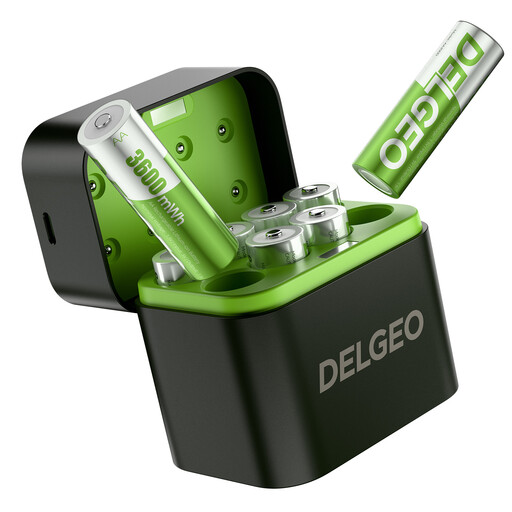
This set could suit you if you want to charge several AA lithium cells via USB-C. First, check whether your remote supports rechargeable lithium AA cells.
According to the product name, the set contains eight AA lithium cells and a USB-C charger.
The product name states that the cells have a 1.5 V output. Check that this matches your device’s requirements.
 No image available
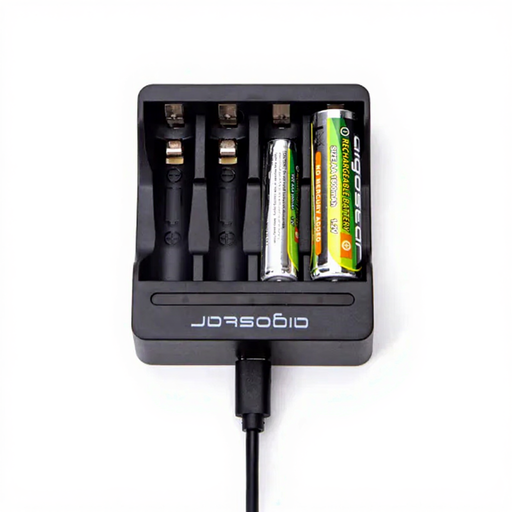
This USB-powered charger could suit you if you want to charge rechargeable AA cells without plugging the charger itself into a wall socket.
The product description lists four individual charging channels and a 5 V/1 A USB input.
The title mentions AA/AAA; the description specifies rechargeable NiMH or NiCd AA cells and indoor use.
Only if they are rechargeable cells suitable for the charger you’ve chosen. The IKEA STENKOL is designed for NiMH cells. Its manual says not to charge non-rechargeable or damaged batteries and specifies a minimum capacity of 1000 mAh for AA cells. Also check that your remote uses AA cells.
That depends on the model and the power supply you have. For the LCD Smart Charger+, VARTA specifies a Power Delivery adapter rated at at least 9 V/2 A or 12 V/1.25 A, which is not included. Check the specifications of your USB power supply before using it.
Follow the polarity markings and the manual for the exact model. IKEA says the STENKOL is for indoor use and recommends unplugging the charger when it is not in use or before cleaning it.
According to the Dutch Government, if a product develops a fault within the first year after purchase, the seller must show that the consumer caused it. If they cannot, the consumer is entitled to a free repair or replacement. Keep your proof of purchase and contact the seller.
The Dutch Government says electronic products sold on the EU market must carry a CE marking. Check that the specific charger has one. Used batteries must not go in household waste. You can take them to shops and supermarkets that sell batteries, among other collection points.