
Person responsible for the shared recorder
Wants to check that the battery size and type are compatible with the recorder before setting it up. For example, Sony states that the ICD-PX470 uses AAA cells, not AA.


First, check your voice recorder’s manual: not every model uses AA batteries or allows rechargeable cells. For example, Sony states that the ICD-PX470 uses AAA cells. If your recorder supports compatible AA NiMH cells, individual charging channels and a clear status indicator for each cell are useful on a shared desk. Extra charging slots or a shorter stated charging time matter most if you need that extra capacity or speed.
Wants to check that the battery size and type are compatible with the recorder before setting it up. For example, Sony states that the ICD-PX470 uses AAA cells, not AA.
Wants to be able to top up a single cell and see which cells are ready at each charging slot. IKEA and Panasonic describe chargers with individual charging channels or indicators.
Needs to decide whether a shorter stated charging time for a small set matters more than having extra slots to charge several cells at once. Stated times and capacities depend on the charger and conditions of use.
Start with the manual and the permitted battery chemistry. Then decide how many cells need to be ready at once and how much time you have before the next recording.
| What to consider | What should you check? | Who is this important to? |
|---|---|---|
| Recorder and battery compatibility | Check the exact recorder model, battery size and permitted battery type, and make sure the charger supports that size and chemistry. | I first check whether my recorder allows rechargeable AA cells; if the model uses AAA, I need a different size. Around 36% of consumers prioritise compatibility. |
| Individual cells and charging status | Check whether you can charge a single cell on its own and what each light or display indicates for each slot. | If colleagues put cells back at different times, I want to be able to charge them individually and see which ones the charger says are ready. Around 29% of consumers say this is a priority. |
| Charging time before the next recording | Only compare charging times for the same number of cells and the same stated capacity; check the conditions given. | When the next recording is coming up soon, I want to know whether the cells will be ready in time. If necessary, I keep a charged spare set separate. Around 21% of consumers prioritise charging time. |
| Number of charging slots and what’s included | Count how many cells need to charge at once and check whether compatible batteries and the required power supply are included. | If several colleagues need batteries at the same time, I want enough charging slots and a clear idea of what’s in the box. Around 14% of consumers focus mainly on charging capacity and the complete set. |
Battery size varies by model. For example, the Sony ICD-PX470 uses AAA cells.
Before buying, read the battery section of the manual for your exact recorder.
Charging times may refer to different numbers of cells and capacities. Panasonic states around 90 minutes for two AA eneloop cells with the BQ-CC55; temperature and battery condition can affect the time.
Compare the conditions and number of cells given for each charging time.
Size alone doesn’t tell you whether a cell is rechargeable or compatible with the charger’s chemistry. The chargers described are designed for rechargeable NiMH cells.
Check both the label on the battery and the charger manual. Never charge non-rechargeable batteries.
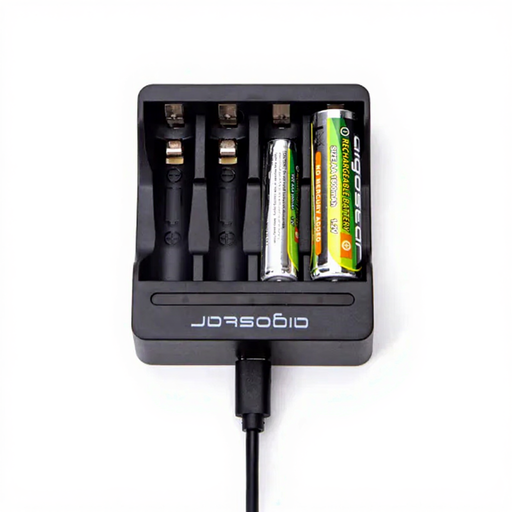
STENKOL is a four-channel charger for rechargeable AA and AAA NiMH cells, suited to situations where a simple status indicator for each cell is enough.
The eneloop range includes the BQ-CC55, for anyone who wants to monitor charging progress for each cell when charging a small set of AA/AAA batteries.
The LCD Multi Charger+ type 57681 is worth considering if you want to prepare more than four AA/AAA NiMH cells at once.
This selection is aimed at preparing individual AA or AAA cells on a shared desk, provided your recorder and chosen batteries support the size and chemistry.
 No image available
May suit the preparation of individual cells on a shared desk when you want to monitor the status of each charging slot.
Designed for rechargeable NiMH or NiCd AA/AAA cells; do not use with non-rechargeable batteries.
No. Check the exact model and its manual. For example, the Sony ICD-PX470 uses two AAA cells, allows rechargeable batteries and doesn’t charge them itself. That model information doesn’t automatically apply to other recorders.
If your batteries are compatible, choose a charger with an indicator for each slot and check the manual to find out what the lights mean. For the STENKOL, IKEA describes a steady white light as fully charged and a flashing red light as an error. Then keep full cells separate from those that still need charging.
For a consumer purchase in the Netherlands, the Dutch government says the retailer is your point of contact for a faulty product; the retailer can’t simply send you to the manufacturer. For a business purchase for a shared desk, check the applicable purchase terms separately.
Electrical equipment is subject to the applicable European safety rules. According to Dutch government information, manufacturers must affix the required CE marking and draw up an EU declaration of conformity for products that meet the rules. CE is a manufacturer’s declaration, not an independent quality test; check the documentation for the version you’re buying.
The Dutch government says that household batteries must not go in the bin and can be handed in at shops that sell batteries, among other places. According to the government, the take-back scheme for old equipment when buying a similar new item applies to equipment from private individuals, not businesses.