
Radio listener who plans ahead
You set out AA batteries during the day for your bedside radio and want to see which cells are fully charged. IKEA Netherlands describes the STENKOL as having four independent charging channels.


First, check your radio’s manual to see whether it accepts rechargeable 1.2 V AA NiMH cells and how many batteries it needs. Your radio’s manual is the definitive guide. If you charge well in advance, a simple charger with independent charging channels may be enough; stated shorter charging times apply only under the test conditions specified. Place the charger in a clear space while charging, not under bedding, as advised by Brandweer Nederland.
You set out AA batteries during the day for your bedside radio and want to see which cells are fully charged. IKEA Netherlands describes the STENKOL as having four independent charging channels.
You realise just before you want to use the radio that the batteries are flat, so you compare charging times and the conditions they are based on. VARTA and Panasonic Energy link their stated times to specific batteries and charging conditions.
You don’t yet have suitable NiMH batteries and want to know whether a complete set is more convenient than buying a charger and cells separately. IKEA Netherlands offers the STENKOL/LADDA set with four AA cells.
Start by checking the type and number of cells your radio accepts. Then compare when you’ll charge them, what’s included and how they’ll perform over time.
| What to consider | What should you check? | Who is this important for? |
|---|---|---|
| Compatibility | Check your radio’s manual to see whether rechargeable NiMH cells are allowed and how many AA cells it needs. Panasonic Energy lists a nominal voltage of 1.2 V for eneloop. | I want to avoid buying cells that my radio won’t accept. Around 29% of consumers prioritise compatibility with their radio. |
| Safe place to charge | Place the charger in a clear space and follow the instructions; Brandweer Nederland advises against charging under a pillow or duvet. | I want to get batteries ready near the bed without covering the charger. Around 24% of consumers focus mainly on when and where they charge. |
| Charging time and number of cells | Compare times for the same number of cells and check the stated capacity and power supply. IKEA says four AA cells in the STENKOL usually take 6–8 hours; VARTA bases its time for the LCD Smart Charger+ 57684 on two 1600 mAh AA cells. | I want to know whether the cells will be ready when I need the radio. Around 23% of consumers prioritise having a full charge in time. |
| What’s included | Check whether AA cells and any required power adapter are included. The STENKOL/LADDA set contains four 2450 mAh AA cells; VARTA states that the required USB-C-PD adapter is not included. | I want to know what else I need when making my first purchase. Around 12% of consumers prioritise a complete starter set. |
| Long-term use | Don’t compare only the stated capacity in mAh: the Consumentenbond notes that, in tested rechargeable batteries, higher capacity can come at the expense of long-term use. | I want to choose based on repeated use, not just one specification. Around 12% of consumers focus mainly on cost and usability over the product’s lifetime. |
Manufacturers base charging times on specific cells, capacities and quantities. So a time given for two cells doesn’t necessarily tell you how long four different AA cells will take.
Compare the test conditions with the number and type of cells your radio uses.
A standalone charger doesn’t automatically include the batteries you need. The VARTA LCD Smart Charger+ 57684 also requires a compatible USB-C-PD adapter, which isn’t included.
Before buying, check what’s in the box for the exact version you’ve chosen.
The Consumentenbond notes that, in tested rechargeable batteries, a high stated capacity can come at the expense of long-term use.
Weigh capacity against self-discharge and lifespan, where that information is available, and choose according to how often you use the radio.
The STENKOL is a straightforward AA/AAA NiMH charger with independent charging channels. IKEA also sells a STENKOL/LADDA set with AA cells.
The LCD Smart Charger+ 57684 is an AA/AAA NiMH charger with individual charging bays and a display showing charging information.
The BQ-CC55 is designed for one to four eneloop or eneloop pro cells in AA or AAA size.
The Hi-Speed Value Charger CEF14 is an AA/AAA NiMH option for those who usually charge two or four cells at a time.
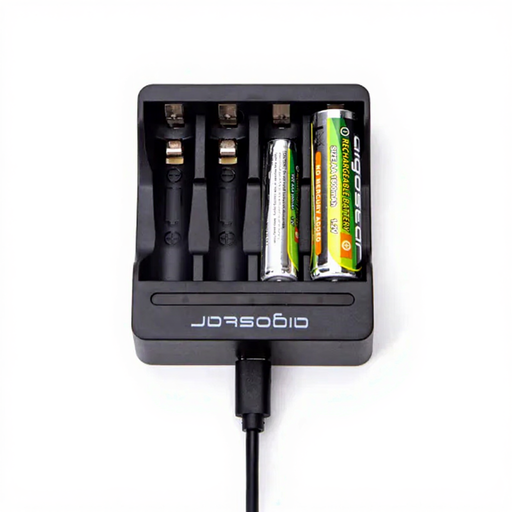
This product selection features an Aigostar charger for AA and AAA batteries. Check that the charger is suitable for your radio’s battery type and that you have the required power supply.
 No image available
An option to consider if you’re looking for an AA battery charger; check that it’s suitable for your cells before using it with your radio.
The product name specifies AA/AAA. According to the product information, it requires a DC 5 V/1 A USB power supply.
No. It must be rechargeable and compatible with the charger. The STENKOL and VARTA models discussed here are designed for AA NiMH cells; check the labels on both the battery and charger. An AA size doesn’t automatically mean a battery is rechargeable.
It depends on the radio. Panasonic Energy lists a nominal voltage of 1.2 V for eneloop, compared with around 1.5 V for alkaline batteries. Check your radio model’s manual to see whether rechargeable NiMH cells are allowed.
Place the charger in a clear space so heat can escape, and don’t charge it under a pillow or duvet, as advised by Brandweer Nederland. For the STENKOL, IKEA recommends unplugging the charger before cleaning and wiping it with a dry cloth.
Check whether AA cells are included and whether you’ll need to supply a suitable power source. VARTA states that the LCD Smart Charger+ 57684 comes with a USB-C cable, but not the required USB-C-PD adapter.
According to the Dutch government, flat batteries must not go in general waste; you can return them to shops that sell batteries, among other places. When you buy a similar new appliance, the old-for-new scheme applies to an old charger, subject to the conditions set out by the Dutch government.