What should you look for when choosing?
Start with the toy’s battery requirements, then compare charging channels, power supply and included cells.
Mains charger with individual charging channels
A good fit if: you have access to a mains socket and want to be able to charge one cell or an incomplete set of suitable cells.
Bear in mind: you’ll need a mains socket; also check whether the version you choose includes batteries.
USB charger with AA cells
A good fit if: you have a suitable USB power supply and still need rechargeable AA cells.
Bear in mind: check what type of USB power supply is needed and whether it’s included.
Charger with an individual charge-status indicator for each cell
A good fit if: you charge different numbers of cells and want to monitor the charge status of each one separately.
Bear in mind: check that the version on offer and the cells it supports suit the way you plan to use it.
Charger for two or four cells
A good fit if: you usually prepare two or four suitable cells at a time.
Bear in mind: this type of model is less suitable if you regularly want to charge one or three cells.
| What to consider |
What to check before buying |
Who should consider this? |
| Compatibility |
Check the toy’s instructions to see whether the chosen cell type is permitted, then compare this with the markings on the charger and batteries. Milieu Centraal recommends using the specified battery type. |
I want to avoid choosing an AA battery that fits in size but isn’t suitable for the toy. Around 33% of consumers prioritise compatibility between the toy, battery and charger. |
| Safe charging |
Follow the charger’s instructions and check the cable for damage. The fire service advises placing the charger in a clear space and not charging it under a pillow or duvet. |
In a small student room, I want to be able to place the charger somewhere clear and use the cable safely. Around 27% of consumers prioritise safe charging in their room. |
| Charging convenience |
Check whether the charger can charge one to four cells individually or only has slots for two or four cells; compare charging times only under the same conditions. |
I want to choose how many cells to prepare at once and know when my spare set will be ready. Around 20% of consumers prioritise charging channels and preparation time. |
| Complete set |
Check whether cells and the required USB power supply are included with the exact version. GP describes the B421 version as including four AA cells; check that the version on offer matches. |
I want to know whether I’ll need suitable batteries and a power supply as well as the charger. Around 20% of consumers prioritise what’s included in the complete set. |
Joybuy product picks
These product picks include an AA lithium battery set with a USB-C charger and a USB charger for AA and AAA cells. First check which battery chemistry the toy allows.
 No image available
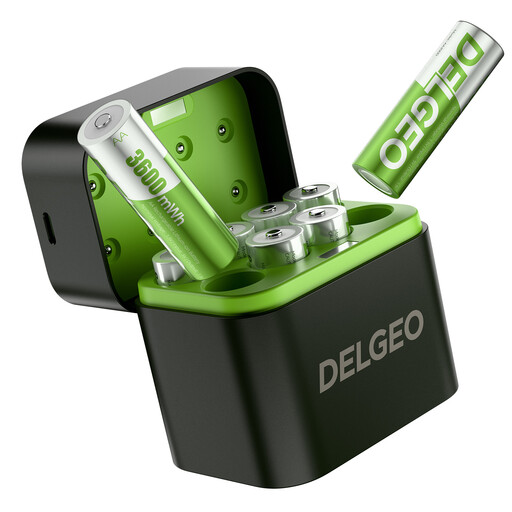
8-Pack AA Lithium Batteries with USB-C Charger
This set may be suitable if the toy’s instructions allow rechargeable AA lithium cells with a constant output of 1,5 V.
The product name lists eight AA cells and a USB-C charger.
Don’t use this combination without first checking the toy’s battery requirements.
Joybuy
 No image available
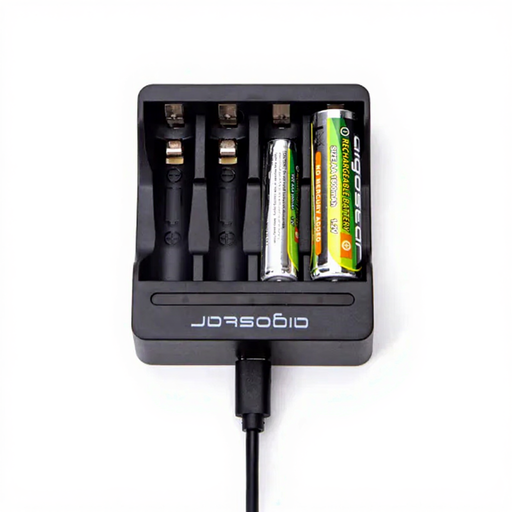
Aigostar Quick Battery Charger with Smart IC for 4 AA/AAA Black
This USB charger may be suitable if the toy allows rechargeable AA cells of a supported type.
The product information lists four independent charging channels for NiMH or NiCd cells, a USB cable, automatic shut-off and charging status lights.
Check the toy’s instructions to see whether NiMH or NiCd cells are permitted before choosing cells for the toy.
Joybuy
Frequently asked questions
Can I recharge the AA batteries currently in the toy?
Only if they’re rechargeable cells and the charger supports their type. Also check whether the toy’s instructions allow that battery type. Don’t mix rechargeable and non-rechargeable batteries, or old and new batteries, in one device; Milieu Centraal advises against this.
Why should I check the toy’s battery requirements?
The AA size doesn’t tell you what voltage or battery chemistry the toy needs. Panasonic gives a voltage of around 1,2 V for eneloop cells, compared with around 1,5 V for alkaline batteries. Without checking your toy’s instructions, you can’t be sure that a replacement is suitable.
Where should I put the charger while it’s charging?
Place the charger in a clear space so heat can escape, and don’t charge it under a pillow or duvet. The fire service also advises against using a damaged cable. Follow the charger’s instructions as well.
What if the charger develops a fault too soon?
With normal use, the product must meet the standards you’re entitled to expect. If the product is faulty, the seller is responsible for offering an appropriate solution, such as a repair, replacement or refund, subject to the applicable conditions, according to ACM ConsuWijzer. A commercial guarantee doesn’t replace this statutory right.
Where can I take used AA batteries and rechargeable batteries?
Take used batteries and rechargeable batteries to a separate collection point, such as a collection box in a shop that sells batteries. Milieu Centraal advises against putting them in household rubbish.


