
Label maker owners checking the battery type first
You want to make sure your device accepts AA NiMH cells before choosing a charger. Label makers don’t all use the same battery size.


Start by checking your label maker’s manual. An AA charger won’t be suitable if your device uses AAA batteries or a proprietary battery pack, and the manual must specify that rechargeable AA NiMH cells are supported. If it does, choose between individual charging slots, a charger for two or four cells, or extra testing and maintenance features. Also check the power supply you’ll need and make sure you have a dry, clear space for charging. For example, Brother UK lists AAA batteries for the PT-D210VP, while Brother specifies AA NiMH cells for certain other P-touch models.
You want to make sure your device accepts AA NiMH cells before choosing a charger. Label makers don’t all use the same battery size.
You want to charge the cells in a dry, clear space, and need to consider the charger’s safety features and the power adapter required.
You want to prepare a spare set and check whether cells can be charged individually or need to be charged in pairs or sets of four.
First check your label maker’s battery requirements. Then compare the number of charging slots, where you’ll charge the batteries and what you’ll need to power the charger.
| What to consider | What should you check? | Who should consider this? |
|---|---|---|
| Battery size and chemistry | Check the exact label maker model, the required battery size and whether rechargeable NiMH cells are supported. | When getting batteries ready for my label maker, I first want to know whether it accepts AA batteries and rechargeable NiMH cells. Around 36% of consumers make compatibility their top priority. |
| Safe charging on the worktop | Check what safety features the charger has. Place it somewhere dry and clear, away from spills. | When using a charger on the worktop, I want a dry, clear space where it can release heat. Around 29% of consumers prioritise a safe place to charge. |
| Number of cells per charge | Check whether you can charge one cell at a time or need to charge two or four. Only compare charging times under the same conditions. | When preparing individual cells or a spare set, I want a charging setup that suits my routine. Around 21% of consumers put this first. |
| Power supply and controls | Check whether you need a compatible adapter and whether it’s included. Also consider whether you’ll use any extra testing or maintenance programmes. | When buying a charger for occasional use, I want to know what power supply I’ll need and how much effort the extra features involve. Around 14% of consumers prioritise this convenience. |
An AA charger won’t help if your label maker uses AAA cells or a proprietary battery pack. The product page for the Brother PT-D210VP specifies AAA batteries.
Look up your exact model and follow the battery requirements in its manual.
For the VARTA LCD Smart Charger+ type 57684, VARTA specifies a compatible USB-C PD adapter, which the manufacturer says is not included.
Before buying, check the adapter specification you need and whether it’s included.
VARTA’s stated charging time is based on two 1600 mAh AA cells. Energizer notes that charging time can vary for each NiMH battery.
Only compare charging times for the same number of cells and the same capacity.
According to Panasonic, the BQ-CC55 is designed for one to four eneloop or eneloop pro AA or AAA NiMH cells, which can be charged individually.
According to VARTA, the LCD Smart Charger+ type 57684 combines individual AA and AAA NiMH slots with a display and USB-C power.
According to Energizer, the European Recharge Pro Charger is designed to charge two or four AA or AAA NiMH cells at a time.
ANSMANN positions the Powerline 4.2 Pro for users who want to charge, test or maintain one to four AA or AAA NiMH cells individually.
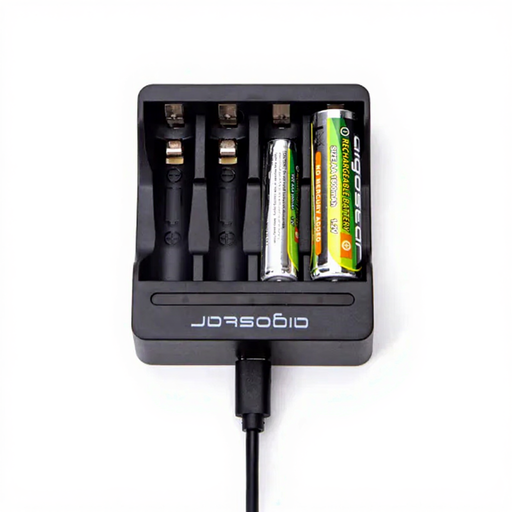
This Joybuy pick is an AA/AAA charger with individual charging channels, making it a relevant option if your label maker uses rechargeable AA NiMH cells.
 No image available
The individual charging channels are ideal if you don’t always want to charge cells in pairs. First check that your label maker supports rechargeable AA NiMH cells.
The product information lists support for AA NiMH cells, a charging status indicator and automatic shut-off when the cells are fully charged.
A USB cable is included. Check which power source you’ll need for charging.
No. Check the exact model and its manual. Brother UK’s product page specifies AAA batteries or an adapter for the PT-D210VP; Brother specifies AA NiMH cells for certain other P-touch models.
Don’t assume it does. For the models covered by the relevant FAQ, Brother says you need an external charger for AA NiMH cells. Check your model’s manual.
Place it somewhere dry and clear where it can release heat, and keep it away from spills. This safety advice comes from the Netherlands Fire Service.
If you bought it in the Netherlands, the Dutch government says you’re entitled to a product that works as it should under the statutory guarantee. If it develops a fault, contact the seller to discuss what applies in your situation.
No. The Dutch government says used batteries must not go in the bin. Follow your local guidance for returning used batteries.