
People who use one kitchen timer
If you mainly use one timer, you’ll want to know whether it accepts rechargeable AA cells and whether a charger makes sense given how much power the batteries use.


For a kitchen timer that uses very little power, an alkaline battery may make more sense than buying a separate charger and rechargeable cells, as Milieu Centraal points out. If you do want to use rechargeable AA cells, check the timer’s manual first and choose a charger that supports the specified cell type. Charge the cells in an open space, not under bedding; the Dutch Fire Service advises placing chargers where heat can escape.
If you mainly use one timer, you’ll want to know whether it accepts rechargeable AA cells and whether a charger makes sense given how much power the batteries use.
If you want to charge one or a few compatible cells in advance, look for individual charging channels. You don’t necessarily need to use every charging slot.
If you also use other devices with compatible AA or AAA NiMH cells, you can compare charging status, charging speed and the power supply required for each model.
First check which battery type the timer requires. Then consider how many cells you want to charge at once, where you’ll charge them and how you’ll use the charger.
| What to consider | What should you check? | Who is this important for? |
|---|---|---|
| Compatibility | Check the timer’s manual to see which cell type it accepts and whether the charger supports that rechargeable cell chemistry. | I want to make sure the cells work with both my timer and charger. Compatibility is the top priority for around 36% of consumers. |
| Charging location | Check the instructions for the exact model and charge the cells in an open space, not under bedding. | I want to be able to place the charger by the bed with room around it, so heat can escape and it stays clear of bedding. This is the main concern for consumers who prioritise a suitable place to charge, around 29%. |
| Small charging sessions | Check whether you can charge one cell on its own and what power supply the charger needs. | I want to prepare one or a few spare AA cells without using charging slots unnecessarily. Small charging sessions matter most to around 21% of consumers. |
| Use and purchase cost | Factor in the charger, compatible cells and any adapter you may need, and consider how often you replace batteries. | I want to know whether a separate charger is worthwhile for the way I use my timer. Around 14% of consumers focus mainly on purchase cost and use. |
AA refers to the size, not the type of battery required by the timer. The charger and cells you choose may therefore be unsuitable for your timer.
Check the timer’s manual before choosing cells or a charger.
Charging times may be based on a specific number of cells and capacities, so they won’t necessarily apply to other cells.
Compare the conditions for the stated charging time with the cells you actually want to charge.
VARTA says the LCD Smart Charger+ type 57684 requires a compatible USB-C PD adapter, which is not included. You may need to buy an adapter separately.
Before buying, check the power requirements and what’s included with the exact model.
The space by the bed isn’t automatically suitable for charging if the charger is under or touching bedding.
Charge spare batteries in an open space so the charger can release heat.
The STENKOL charger with LADDA cells is a set worth considering if you want to use AA NiMH cells.
The LCD Smart Charger+ type 57684 is aimed at people looking for individual charging slots and charging-status information.
The Hi-Speed Advanced Charger CEF27 is an AA/AAA charger for people who take the stated charging time into account.
The VC4SL is designed for people who want to charge other supported cell types as well as AA cells, or analyse their cells.
This selection includes an AA/AAA charger and a set of rechargeable AA lithium batteries with a USB-C charger. Before use, check the timer’s manual to make sure this cell type is suitable.
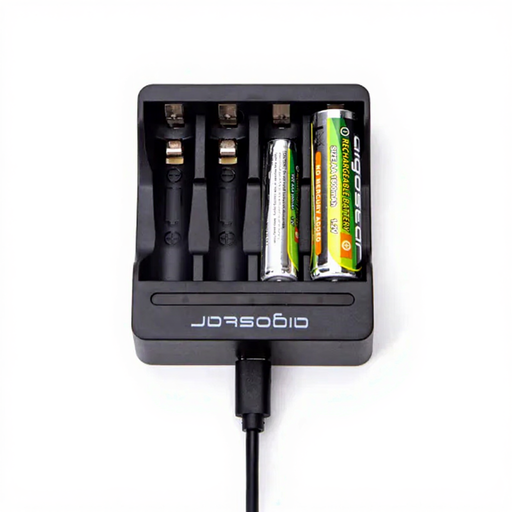 No image available
Suitable if you want to charge rechargeable NiMH or NiCd cells and prepare one cell on its own, according to the product description. It mentions four independent charging channels, LED charging status and automatic shut-off when cells are full. Do not charge non-rechargeable alkaline batteries.
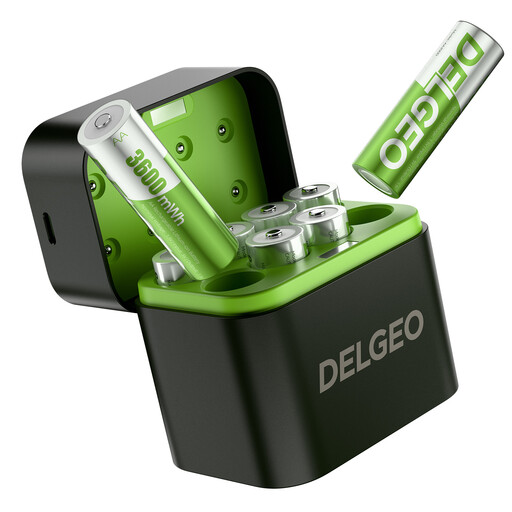 No image available
For anyone specifically looking for rechargeable AA lithium cells with the included USB-C charger. First check that your kitchen timer accepts this cell type. The product name specifies eight AA cells and a 1,5 V output.
No. Check that the cell is rechargeable and that the charger supports its chemistry. A charger that detects alkaline cells does not make non-rechargeable alkaline batteries rechargeable.
No. Place the charger in an open space so heat can escape, and don’t charge batteries under a pillow or duvet. The Dutch Fire Service advises keeping chargers clear of surrounding objects; also check the instructions for your chosen model.
Use the type specified by the timer’s manufacturer, insert the cells according to the polarity markings, and don’t mix old and new batteries, or rechargeable and non-rechargeable batteries, in one device.
In the Netherlands, contact the retailer as your first point of contact to find a solution. The Dutch government says a product must do what you can reasonably expect of it; the statutory guarantee does not have a fixed term of exactly two years for every product.
Take them to a separate collection point, such as a shop or supermarket that sells batteries, and don’t put them in the bin. This is in line with the Dutch government’s battery collection guidance.