
Clock user who wants peace of mind
First, check whether your clock’s manual allows rechargeable AA cells; the AA size alone doesn’t tell you. The IKEA manual for STENKOL also warns against putting non-rechargeable batteries in the charger.


An AA battery charger is only suitable for a hotel-room clock if the clock’s manual allows rechargeable cells. Then choose a charger that suits the number of cells you need and the power connection available. Charging-time claims apply only under the conditions specified by the manufacturer.
First, check whether your clock’s manual allows rechargeable AA cells; the AA size alone doesn’t tell you. The IKEA manual for STENKOL also warns against putting non-rechargeable batteries in the charger.
You want to be able to prepare one or two cells without using up too much luggage space. So check the number of charging slots, the power connection required and the plug type; VARTA and Panasonic provide product-specific details.
You want to prepare several cells regularly and see when a cell is ready or has triggered an error message. IKEA and Panasonic describe per-cell charging status for certain models.
Start by checking the clock’s manual, then consider the number of charging slots, the power connection available and how much time you have to prepare the cells.
| What to consider | What should you check? | Who is this important for? |
|---|---|---|
| Compatibility | Check the battery type specified in the clock’s manual and which rechargeable cells the charger accepts. The AA size alone doesn’t confirm compatibility. | I want to know whether the cells I’ve chosen are suitable for my particular clock. Around 36% of consumers put compatibility first. |
| Portability and connection | Check the dimensions, number of charging slots, required mains voltage and plug type. A suitable voltage range doesn’t automatically mean the plug will fit. | If I have limited luggage space, I want a charger that’s easy to take with me and connect. Around 29% of consumers prioritise portability and connection. |
| Preparation time | Compare charging times only for the cell type, capacity and number of cells specified. Also check whether the charging status is shown for each cell. | If I need to prepare the cells shortly before use, the time those specific cells take to charge matters most. Around 21% of consumers prioritise preparation time. |
| What you need for regular use | Check whether suitable cells are included, how many the clock needs and whether you’ll also use the charger with other compatible devices. | I want to know whether a charger supplied with cells would be practical for regular use. Around 14% of consumers focus mainly on what they need for repeated use. |
The clock and charger each have their own requirements. The IKEA manual for STENKOL prohibits charging non-rechargeable batteries.
Read the clock’s manual first, then check which cell types the charger accepts.
Charging times can depend on the number of cells and their capacity. Duracell’s fast-charging claim applies to specific AA NiMH cells; it doesn’t mean every cell will be fully charged in that time.
Compare charging times only when the cell type, capacity and number of cells match. Also check what the manufacturer means by ‘ready’.
A charger isn’t automatically a complete set. IKEA sells STENKOL as a standalone charger and also as a version with LADDA batteries.
Check what’s included in the version you choose and how many compatible cells the clock needs.
STENKOL is a charger for rechargeable NiMH cells in AA and AAA sizes.
The Mini Charger type 57656 is designed to charge two AA or AAA NiMH cells.
According to Panasonic, the eneloop BQ-CC55 is designed for one to four eneloop or eneloop pro cells in AA and AAA sizes.
The Hi-Speed Expert Charger CEF15 is an option if preparation time is an important factor in your choice.
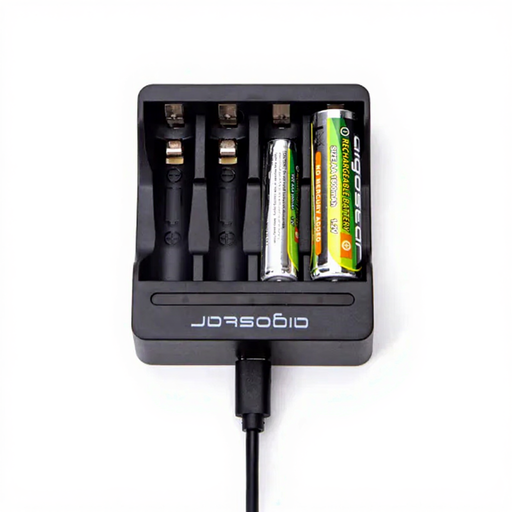
This Joybuy selection focuses on chargers for AA cells. First check whether the table clock’s manual allows rechargeable cells.
 No image available
Could be suitable if the clock’s manual allows rechargeable cells and you want to prepare several AA cells.
Bear in mind that it requires a DC 5 V/1 A USB power supply.
No. Not every AA battery is rechargeable or suitable for every clock. Check the cell type specified in the clock’s manual and the cells allowed by the charger’s manual. IKEA specifically warns against charging non-rechargeable batteries in STENKOL.
Follow the indicator for your specific charger model and insert the cells according to the positive and negative markings. According to IKEA, a flashing red light on STENKOL indicates an error, for example if a cell is non-rechargeable or damaged, or has been inserted incorrectly. Unplug the charger before cleaning it.
No, dispose of used batteries separately. Milieu Centraal lists collection bins at places including supermarkets and DIY shops; check where you can hand yours in.
An electric charger must meet the safety requirements that apply to that particular device. The Netherlands Food and Consumer Product Safety Authority classifies chargers as electrical appliances; the Dutch government outlines the CE marking obligations for manufacturers of equipment that meets the applicable requirements. The specific rules that apply also depend on the model’s design and electrical input.
Contact the seller if the charger doesn’t meet what you could reasonably expect from it. ACM ConsuWijzer states that, under the applicable conditions, the seller must provide a free remedy if a purchase breaks sooner than expected during normal use. This could include repair, replacement or a refund.