
Cautious lamp user
You want to check which rechargeable AA cells your lamp accepts before buying, and avoid putting a non-rechargeable battery in a NiMH charger.


First, check your lamp’s manual to see whether it accepts rechargeable AA cells and which chemistries are compatible. Then choose a charger designed for those cells. Individual charging channels are useful for loose NiMH cells or cells with different usage histories, while the number of cells and charging conditions determine how much time you’ll need to allow. Also check whether the version you choose includes the batteries and power supply you need.
You want to check which rechargeable AA cells your lamp accepts before buying, and avoid putting a non-rechargeable battery in a NiMH charger.
You want a full set ready before a work session, and compare charging times under conditions that suit the number and type of cells you have.
You sometimes charge individual cells with different usage histories, so you may be looking for individual charging channels or information on each cell.
First, check which cells your lamp accepts and whether the charger is designed for them. Then compare the charging time and channel layout for your set, and finally check which batteries and power supply are included with the version you’re considering.
When choosing a charger for a lamp on your home-working desk, the main reason for buying one can vary from person to person.
| What to consider | What should you check? | Who is this important for? |
|---|---|---|
| Battery type and safe charging | Check which chemistries your lamp accepts and whether the charger supports that cell chemistry. | When choosing AA batteries, I want to be sure that the lamp and charger are suitable for the same type of rechargeable cell. Around 36% of consumers give compatibility top priority. |
| Having a full set ready on time | Count the cells you need and compare the charging time for that number and the capacity of your batteries. | I want the complete set ready before use, so I plan around the charging time for my own set. Around 28% of consumers give charging on time top priority. |
| Managing individual cells | Compare the number of charging channels with the number of slots; if needed, look for a status display or test function for each cell. | When charging individual cells or cells with different usage histories, I want to know how the charger handles each one. Around 18% of consumers give managing individual cells top priority. |
| Power supply and accessories | Check whether batteries, a cable and a suitable adapter are included with the version you’re buying. | I want to know in advance whether I’ll need batteries or a suitable power supply in addition to the charger. Around 18% of consumers give the necessary accessories top priority. |
AA refers to the size, not the chemistry or whether a cell can be recharged. The IKEA STENKOL manual warns against charging non-rechargeable or damaged batteries.
Check both your lamp’s battery requirements and the cell chemistries supported by the charger.
An unsuitable or damaged cell may become unusable; only use cells that are compatible with your lamp and charger.
Charging times apply to specific numbers of cells and capacities. IKEA gives a charging time of 3–4 hours for one or two AA cells and 6–8 hours for four in the STENKOL. VARTA’s one-hour estimate for the Eco Charger Pro is based on two 1600 mAh AA cells.
Plan your charging around the estimate that matches the number and capacity of your cells.
GP specifies four slots and two charging channels for the B421; IKEA lists four individual channels for the STENKOL.
Compare both the slots and channels if you charge individual cells or cells with different usage histories.
VARTA says the LCD Smart Charger+ requires a specific Power Delivery power supply, which is not included. What’s in the box may also vary between versions.
Check the power supply specifications and the contents of the exact version you want to buy.
Depending on the version, you may also need a suitable adapter or rechargeable AA cells.
The STENKOL is a straightforward mains charger for one to four AA or AAA NiMH cells.
The Eco Charger Pro Recycled offers USB-C power and individual charging for one to four AA or AAA NiMH cells.
The ReCyko Everyday Charger B421 combines USB power with a storage case.
The Powerline 4.2 Pro is designed for individual charging and testing of AA and AAA NiMH cells.
The BQ-CC55 is an AA and AAA charger with individual charging control for eneloop and eneloop pro cells.
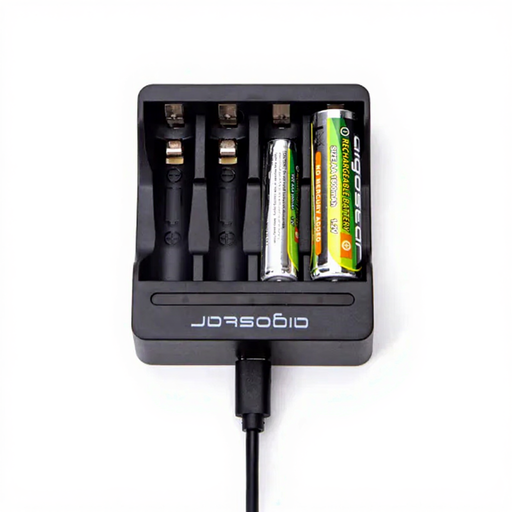
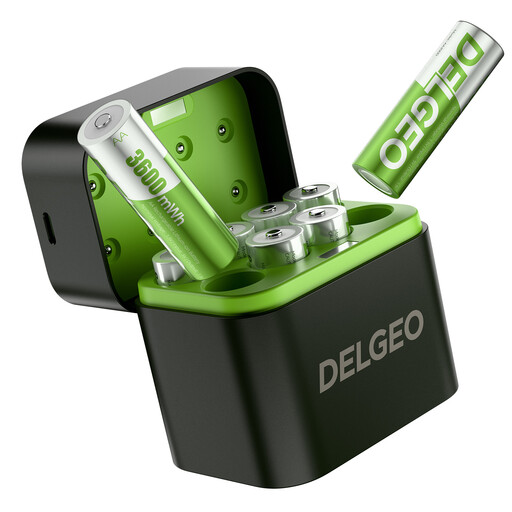
This selection includes a USB charger for AA and AAA cells and a rechargeable AA lithium battery set with a USB-C charger. Only choose cells approved in your lamp’s manual.
 No image available
A good fit if you want to prepare rechargeable AA NiMH cells; check that your lamp supports this chemistry.
Only choose this charger for cell types supported by the product information and your lamp’s manual.
 No image available
This set is suitable only if your lamp accepts rechargeable 1.5 V lithium AA cells.
The product name lists eight AA cells, a USB-C charger and a 1.5 V output.
No, don’t put non-rechargeable batteries in a NiMH charger. The IKEA STENKOL manual says to charge only suitable rechargeable NiMH cells; always check the manual for the model you choose.
The stated time depends on the number of cells and the test conditions. IKEA gives a charging time of 3–4 hours for one or two AA cells and 6–8 hours for four in the STENKOL; VARTA’s one-hour estimate for the Eco Charger Pro is based on two 1600 mAh AA cells. Compare the estimate for the number and capacity of cells you have.
According to IKEA, a flashing red light indicates an error. Check that the cells are positioned correctly and that their polarity is right, then consult the manual. IKEA lists non-rechargeable or damaged cells among the possible causes.
No, it depends on the model and version. GP describes a B421 version with four AA cells, while VARTA says the LCD Smart Charger+ requires a Power Delivery adapter that is not included. Check what’s in the exact package you’re buying.
The Dutch government advises households to take batteries to designated collection points, including shops that sell batteries. For private customers, when buying a similar new appliance, the free take-back scheme for an old charger also applies to online purchases; there are other collection points too.