
Door chime owner
You want to check which battery chemistry your exact chime model accepts. Resideo advises against NiMH batteries for the Honeywell Home series it lists, so check whether this restriction applies to your model too.


First, check the instructions for your exact door chime. For the Honeywell Home series it lists, Resideo advises against NiMH batteries, as the manufacturer says they may not work reliably. If NiMH AA batteries are permitted, choose a charger based on how many cells you want to charge at once, the power supply available and how clearly it shows the charging status of each cell. A charger won’t make an unsuitable battery suitable for your chime.
You want to check which battery chemistry your exact chime model accepts. Resideo advises against NiMH batteries for the Honeywell Home series it lists, so check whether this restriction applies to your model too.
You want to charge cells individually and check their status, so colleagues can see which batteries are still charging.
You’re preparing several suitable AA cells and weighing up the number of charging slots, charging time and power available at your workplace.
First, check the chime’s battery requirements, then choose a charger that suits the number of cells you need to charge and the power available at the shared desk.
| What to consider | What to look for when buying | Who should prioritise this? |
|---|---|---|
| Suitability for your chime | Check the instructions for the permitted battery chemistry and AA size. Rechargeable NiMH cells aren’t suitable for every chime. | I want to avoid choosing batteries and a charger that aren’t suitable for my chime. Around 36% of consumers give chime compatibility top priority. |
| Charging status when shared | Look for an indicator for each slot and separate charging channels if users insert cells at different times. | At a shared desk, I want to be able to check whether each cell is still charging, so colleagues don’t have to guess. Around 29% of consumers prioritise a clear charging status. |
| Number of cells and power supply | Count how many AA cells you want to charge at once and check whether a mains socket or the required USB-C-PD power supply is available. | If I’m preparing a stock of batteries for several suitable devices, the number of slots matters more than having a compact charger. Around 21% of consumers prioritise capacity and a suitable power supply. |
| What you need besides the charger | Check whether a required power adapter and suitable rechargeable AA cells are included. | I want to know what I’ll need to use the charger, especially if I have to buy an adapter separately. Around 14% of consumers focus on the complete purchase. |
Some doorbells use AA batteries, but Resideo advises against NiMH batteries for the Honeywell Home series it lists. The size alone doesn’t tell you which battery chemistry your chime accepts.
Check the required size and permitted battery chemistry for your exact chime model.
The stated time may depend on the number of cells, their capacity and the intended charge level. For example, Duracell’s ‘ready in 4 hours’ claim applies to specific AA cells and around 90% charge.
Only compare charging times when the number of cells, capacity and meaning of ‘ready’ match.
VARTA says the LCD Multi Charger+ type 57681 requires a suitable USB-C-PD adapter, which isn’t included.
Before buying, check the required power supply specification and what’s included in the box.
You’ll also need to arrange a suitable USB-C-PD adapter for this model.
STENKOL is a mains-powered NiMH charger with four separate AA and AAA channels.
The eneloop BQ-CC55 is designed to charge and monitor up to four AA or AAA cells individually.
According to VARTA, the LCD Multi Charger+ type 57681 has up to eight separate slots for NiMH AA and AAA cells and uses USB-C-PD power.
According to Duracell, the Hi-Speed Value Charger CEF14 is designed for AA and AAA cells in sets of two or four.
This selection focuses on rechargeable AA and AAA cells for use when your door chime permits NiMH batteries.
 No image available
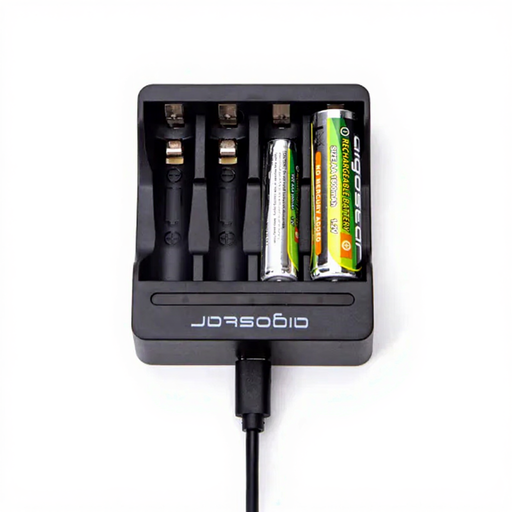
Suitable for charging cells individually at a shared desk when your chime accepts rechargeable NiMH AA cells.
Four separate channels support individual or mixed charging of AA and AAA cells.
The charger has a DC 5 V/1 A USB input and comes with a USB cable.
An LED indicator shows the charging status; the charger switches off automatically when the cells are fully charged.
No. Check the instructions for your exact chime model. Resideo advises against NiMH and NiCd batteries for the Honeywell Home series it lists, as the manufacturer says they may not work reliably because of their lower voltage. This doesn’t automatically apply to every other brand or model.
No. The IKEA STENKOL instructions prohibit charging non-rechargeable batteries. For other chargers, check the instructions to find out which battery chemistries are permitted.
It depends on the model. VARTA says the LCD Multi Charger+ type 57681 requires a suitable USB-C-PD adapter, which isn’t included. Check the power requirements and what’s in the box for the version you choose.
Check whether the charger shows the charging status for each slot and can charge cells individually. Also consider how many AA cells you want to prepare at once and whether the required power connection is available at your workplace.
According to the Dutch government, used batteries shouldn’t go in the rubbish bin; you can return them at shops that sell batteries, among other places. An old charger is an electrical appliance. The government says the take-back scheme applies to equipment from private individuals, not businesses.