
Vandaag of morgen in huis

Kwaliteit gegarandeerd

Welkomstaanbiedingen ontgrendelen: GRATIS bezorging | Tot 80% korting | Gratis 30 dagen JoyPlus-proefperiode
Download de app
An A5 notebook fits in most bags and offers more writing space than a pocket-sized book. But the size alone doesn’t tell you everything. If you focus only on the cover or colour, you could end up with a book that feels awkward after just a few weeks. That’s why, as Joybuy Product Recommendation Officer, I filter by the features you can actually check: paper weight, binding, closure, layout and intended use.
A hardcover can feel sturdy, but not every book lies flat comfortably. With a glued notebook, pages can be harder to keep open. A spiral notebook, on the other hand, is easier to flip over and can be ideal for taking notes during lectures or meetings. Just check that the spiral doesn’t take up too much room in your bag.
A higher paper weight can give you a nicer surface, but it doesn’t automatically stop ink from showing through. The pen you use, the type of ink and your writing pressure all play a part. According to the product description for the Jubiluu models, 100gsm offset paper is designed as a smooth writing surface with less show-through. That’s a product specification, not a guarantee for every pen. If you write with a fountain pen or markers, it’s wise to test a page first.
A dated planner can be awkward if you skip a week. An undated planner lets you decide when to start and how much space to give each period. Look beyond the phrase “18 months” and check the actual layout: are there monthly and weekly overviews, note-taking space and a free start page? Without that information, you could be paying for pages that don’t suit your routine.
A5 is roughly 14.8 × 21 cm. That size is large enough for lecture notes, work notes, a diary or a journal, but still practical for a rucksack or laptop bag. For quick errands and speedy to-do lists, A7 can be handier. However, an A7 notebook isn’t a replacement for an A5 planner if you’re jotting down several topics every day.
When looking at a planner, check for:
A lined notebook works well for text, lessons, meetings and journaling. Check the paper weight, for example 80gsm or 100gsm, and see whether the paper is cream, off-white or bright white. Cream-coloured paper can be easier on the eyes, while bright white can be handy for clear scans or photocopies.
Also watch out for conflicting product information. For instance, some product titles mention A5, while the description says A6. Always check the specification table and dimensions before you order. That way, you won’t end up with a compact book that’s unexpectedly too small.
A hardcover notebook generally protects its contents better in a full bag than a softcover. An elastic band keeps loose pages and the cover together. A notebook with a bookmark is handy when you’re switching between different projects. These extras add convenience, but they don’t automatically make a book suitable for heavy use.
For daily use, the following points matter:
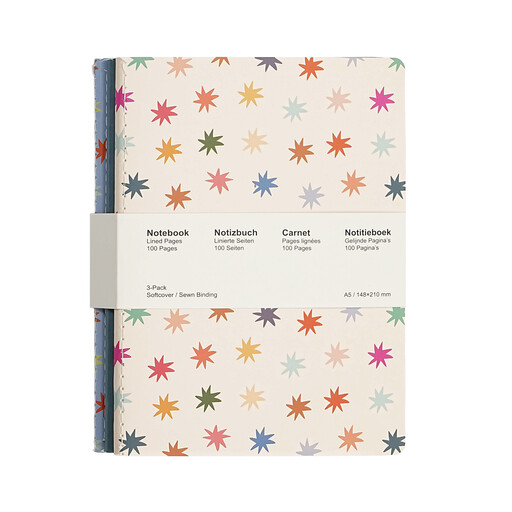
Why this fits the profile: Three lightweight A5 notebooks give you space to keep school subjects, work notes and personal ideas separate.
The product description states 80gsm lined cream offset paper and a stitched binding. Check with your own pen whether show-through is acceptable.
Set of three; 50 sheets per book; stitched binding; suitable for school, office and everyday writing.
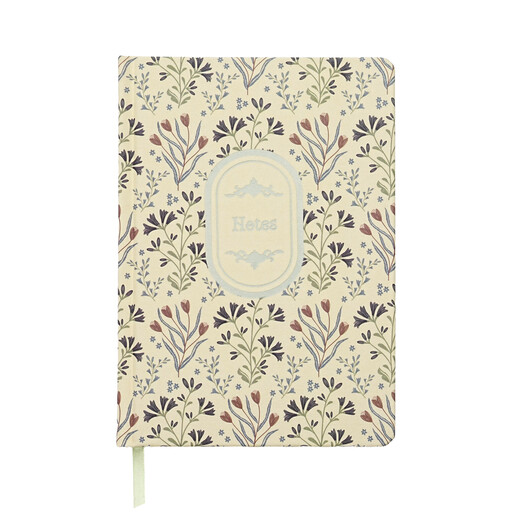
Why this fits the profile: Ideal for writers, journalers and anyone looking for a well-finished book for the office, study or as a gift notebook.
The product description mentions an A5 size, 96 sheets of 100gsm wood-free ivory paper, a hardcover, bookmark and elastic band.
192 pages; lined paper; hardcover with fabric finish; ten designs in the range.
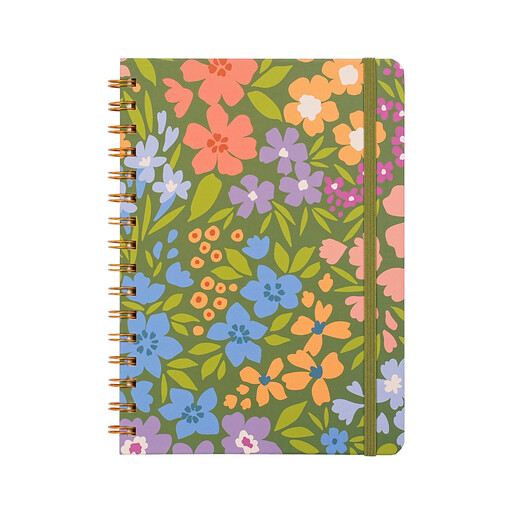
Why this fits the profile: A practical choice for students and professionals who write often and want a book that stays open easily.
The specifications mention a twin-wire spiral, 96 sheets of 100gsm lined cream offset paper and an elastic closure.
A5 size; hardcover; spiral binding; elastic band; designed for school, office, journaling and writing.
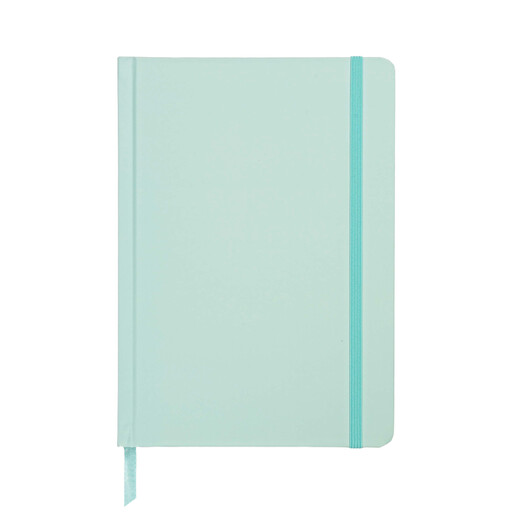
Why this fits the profile: For people who want to combine goals, work, study and daily organisation in one flexible system.
The undated monthly and weekly layout means skipped weeks won’t automatically leave you with empty, outdated pages.
224 pages; 112 sheets of 100gsm lined offset paper; hardcover; bookmark; elastic band; space for monthly, weekly and goal planning.
We’ve put together a full, up-to-date list of products that fully meet these strict selection criteria and current European safety regulations.
Yes. The size offers plenty of room for lecture notes, meetings, to-do lists and project notes. Choose a hardcover for extra protection in a bag and a spiral binding if the book often needs to lie flat.
That depends on the number of sheets, the binding and how often you write. A book with 96 sheets can fill up faster with daily use than a planner with 112 sheets. Store stationery in a dry place and protect the cover from moisture. With an elastic band, it’s best not to stretch it unnecessarily.
Not always. The value lies mainly in the flexibility: you don’t lose pages if you start later or skip a period. So compare the number of sheets, the layout and extras like a bookmark and closure band, rather than just the price or the phrase “18 months”.
