
Vandaag of morgen in huis

Kwaliteit gegarandeerd

Welkomstaanbiedingen ontgrendelen: GRATIS bezorging | Tot 80% korting | Gratis 30 dagen JoyPlus-proefperiode
Download de app
An A5 notebook is compact enough for a rucksack or laptop bag, yet still offers plenty of space for daily notes. However, the wrong choice can quickly become frustrating. A cover that curls, paper that ink bleeds through, or a binding that won't stay open comfortably can make even a budget-friendly purchase less practical.
As a Joybuy Product Recommendation Officer, I filter product information based on verifiable details. Below, you'll find out what to look for in an A5 notebook, which features suit different users, and which models are ideal for school, the office or everyday use.
A botanical print, embossed finish or soft colour may look appealing, but it tells you very little about how the notebook actually performs. Always check the paper weight, binding and number of sheets. A pretty notebook with paper that's too thin may be unsuitable for fountain pens or rollerball pens.
A product with 96 sheets typically contains 192 writable pages. With a set, the number may also refer to each individual book. So check whether the product information mentions sheets or pages. That way, you won't end up with less writing space than you expected.
A spiral notebook can lie flat on the table and is handy for lots of writing. A stitched softcover model is usually lighter and easier to carry around. A hardcover notebook protects the contents better, but can take up a little more space.
A5 has a standard size of approximately 148 × 210 mm. It's smaller than A4 and large enough for summaries, meeting notes, to-do lists and a diary. When using it in a bag, also check the thickness of the cover and the space the spiral takes up.
An A5 journal with an elastic closure stays closed more easily during travel. A built-in bookmark is practical when you frequently switch between pages, for example during lectures, project notes or creative planning.
Paper weight is expressed in grams per square metre, for example 80g or 100g offset paper. A higher weight often feels sturdier, but it's no guarantee that every pen will write without any bleed-through. If in doubt, test your favourite pen on a back page.
A lined notebook is suitable for text, lessons and work notes. For sketches or mind maps, blank paper may be a better fit. Also check the colour: cream or ivory paper can be gentler on the eyes than bright white, but that's a matter of personal preference.
A softcover notebook is light and often easy to carry. A hardcover notebook offers more support when you're not writing at a desk. With a spiral binding, it's important that the rings don't get in the way while you're writing.
When reading a product description, look out for specific details such as:
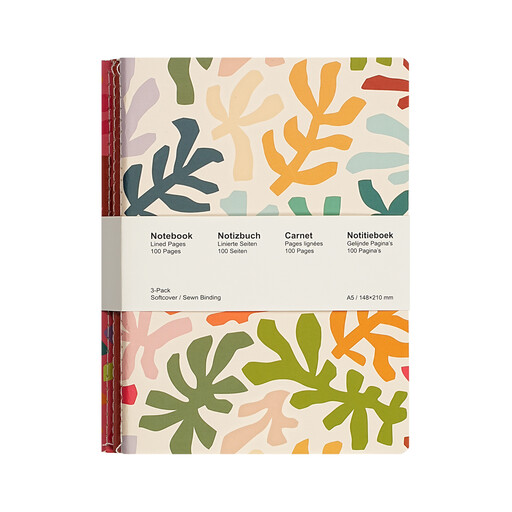
Why this fits the profile: A set of three lightweight A5 notebooks is handy for school subjects, work and personal notes without committing to one thick book straight away.
The product information clearly states three books, 50 sheets per book and 80g lined cream offset paper. So you know exactly what you're getting.
Set of 3; A5 size; stitched binding; lined pages; softcover for low weight.
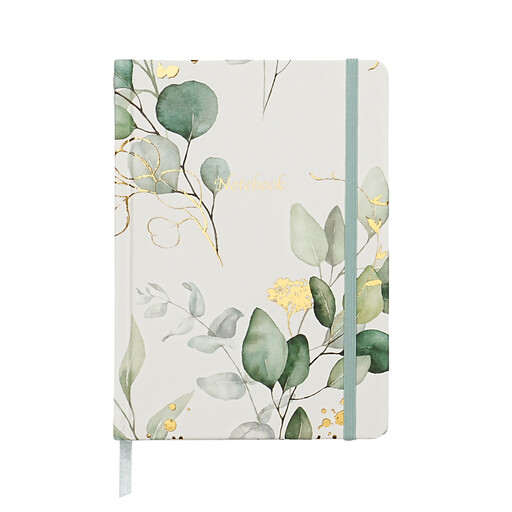
Why this fits the profile: The hardcover and accessories are ideal for daily use at the office, during study or as a well-kept A5 journal.
The specifications mention 96 sheets, 100g lined cream offset paper, a ribbon bookmark and an elastic closure band. So you don't have to rely on looks alone.
Hardcover; 100g paper; 96 sheets; elastic closure; built-in bookmark; A5 size.

Why this fits the profile: If you write a lot and regularly take your notebook with you, a sturdy cover, twin-wire spiral and elastic closure can be a real advantage.
The binding and materials are clearly described: hardcover, twin-wire spiral and 100g lined cream offset paper. That makes the choice verifiable.
Twin-wire spiral; hardcover; 96 sheets; 100g paper; elastic closure band; suitable for flat use.
We've put together a full, up-to-date list of products that fully meet these strict selection criteria and comply with current European safety regulations.
Store your notebook in a dry place and don't leave it under heavy books for long periods if the cover or binding isn't designed for it. A hardcover can be cleaned with a dry, soft cloth. Keep moisture away from the paper, elastic and ribbon. If you use a fountain pen or highly saturated ink, test a small area on a back page first.
For a diary or journal, you can use a bookmark to quickly find regular sections. For school and office use, organising by subject or project is often clearer than using one book for everything.
Yes. The size offers plenty of space for lessons, meetings and to-do lists, while still being easy to carry. Choose lined paper for text and pay attention to the cover if you often write on the go.
The lifespan depends on the paper, cover, binding and how you use it. A hardcover and spiral binding can be practical for intensive daily use. Store the notebook in a dry place and don't force the binding to keep it in good condition.
No. For a ballpoint pen or pencil, 80g paper can be sufficient. If you write with a rollerball, fineliner or fountain pen, you may prefer 100g paper. Always check the product information and test your pen if bleed-through is a concern.
A softcover is light and suitable for carrying every day. A hardcover offers more stability when writing on different surfaces. The right choice depends on your bag, where you write and how you use the notebook.
