
Vandaag of morgen in huis

Kwaliteit gegarandeerd

Welkomstaanbiedingen ontgrendelen: GRATIS bezorging | Tot 80% korting | Gratis 30 dagen JoyPlus-proefperiode
Download de app
An A5 lined notebook fits neatly in your bag, offers plenty of space for school or work notes, and is large enough for a clear layout. Yet lined notebooks vary greatly in paper quality, binding and ease of use. A pretty cover says little about how enjoyable the notebook will be to write in after a few weeks.
A floral print, textured cover or hardback may look appealing, but you should also check the paper weight, number of sheets and binding. A notebook for daily use needs to withstand regular opening, being carried around and turning pages. For a journal with an elastic closure, it's also important that the fastening is sturdy enough to keep loose papers secure.
Manufacturers sometimes list the number of pages and sometimes the number of sheets. One sheet has two sides. A notebook with 96 sheets therefore typically offers 192 writable pages, while 50 sheets equates to around 100 pages. Check this before comparing the contents with other models.
Paper of 100 g/m² is generally thicker than 70 or 80 g/m². This can be pleasant when using ballpoint pens, rollerball pens and some gel pens. According to the product descriptions from the relevant brands, the paper is designed to reduce ink bleed-through. However, the result also depends on the pen you use and the amount of ink. If you write with a fountain pen or marker, it's wise to test a few lines on the last page first.
For an A5 notebook for school, office or working from home, the following points are practical:
A lined notebook with 96 sheets is suitable for a long-term project or an A5 diary. A notebook with 50 sheets is more convenient when you want a separate book for each subject, project or topic.
A5 measures approximately 148 × 210 mm. This size offers a useful balance between writing surface and portability. A hardback cover protects the pages better in a full rucksack or laptop bag. A softback cover is lighter and bends more easily.
For short notes, shopping lists and ideas on the go, a pocket notebook A7 may be more practical. However, it offers less writing space and is less suitable for detailed lecture summaries or meeting notes.
A spiral notebook can lie flat and is therefore handy when you're writing with one hand. A stitched binding stays compact and can also open flat. Also look out for accessories:
The choice therefore depends on how you'll use it: an office notebook should be sturdy, while a school notebook should mainly be light and affordable.
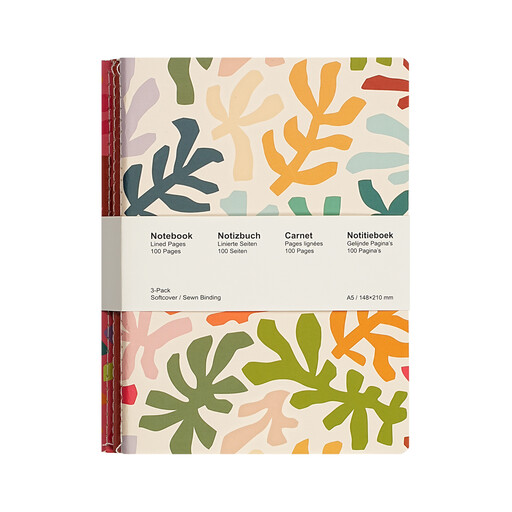
Why this fits the profile: A set of three A5 notebooks is practical for school pupils and students who want separate notebooks for different subjects, projects or personal notes.
The product description clearly states three books, each with 50 sheets of 80 g/m² lined paper. This means the contents of each book can be checked in advance.
Set of 3; softback cover; stitched binding; designed to lie flat.
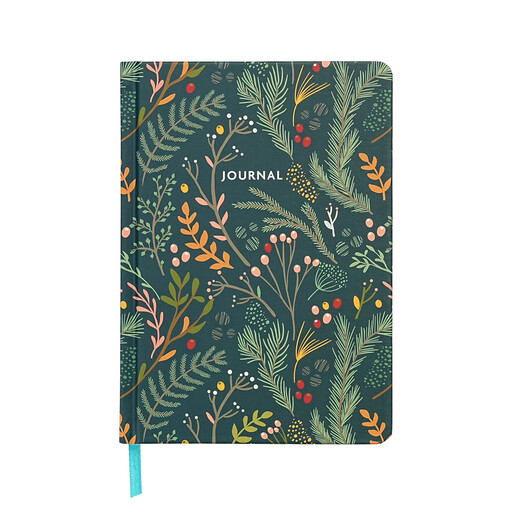
Why this fits the profile: This model suits journal enthusiasts and professionals who want a dedicated place for longer notes, planning or reflection.
The specifications mention 96 sheets of 100 g/m² paper, a hardback cover, elastic closure and a ribbon bookmark. The key usability features are therefore listed alongside the design.
100 g/m² lined paper; hardback cover; elastic closure; ribbon bookmark; A5 size.

Why this fits the profile: The combination of a hardback cover and spiral binding is suitable for daily use at school, the office or when working from home.
The product information mentions twin-wire spiral binding, 96 sheets of 100 g/m² paper and an elastic closure band. This makes it easier to match the notebook to frequent use.
Hardback cover; spiral binding; 100 g/m² cream paper; elastic closure; A5 dimensions.

Why this fits the profile: The A7 size is suitable for quick to-do lists, phone notes and ideas on the go. Four colours help you separate different topics.
The dimensions, grid paper, top-flip spiral and pack of four are all stated in the product details. This makes it clear that this is not a full-size A5 notebook.
A7 size; four books; top-flip spiral; grid paper; lightweight softback cover.
We've put together a full, up-to-date list of products that fully meet these strict selection criteria and comply with current European safety regulations.
Yes. A5 offers enough space for summaries, meeting points and daily planning, while the size usually fits in a rucksack or work bag. If you write intensively, choose a hardback cover or a binding that can lie flat.
That depends on the paper thickness, the binding and how often the notebook is carried around. A hardback cover and spiral or stitched binding can be practical for daily use. Store the notebook in a dry place and avoid putting pressure on the spiral or bending a softback cover excessively.
A set of notebooks can be handy when you want to keep several topics separate. However, do compare the total number of sheets, the paper weight and the binding per book. A three-pack with 80 g/m² paper is not automatically equivalent to one hardback notebook with 100 g/m² paper.
