
Vandaag of morgen in huis

Kwaliteit gegarandeerd

Welkomstaanbiedingen ontgrendelen: GRATIS bezorging | Tot 80% korting | Gratis 30 dagen JoyPlus-proefperiode
Download de app
An A5 hardcover lined notebook might seem straightforward to choose at first glance. Yet models vary significantly in paper, binding and practical details. A beautiful cover, for example, tells you little about how pleasant the book is to write in after daily use.
For students, school pupils, professionals and journal lovers, these three pitfalls are particularly relevant:
A5 typically measures around 148 × 210 mm. This size fits into most laptop bags, rucksacks and desk drawers. It offers more writing space than an A6 diary, yet remains portable for lectures, work or appointments.
Don’t just look at the number of pages. Manufacturers sometimes list 96 sheets or 192 pages. That usually refers to the same amount of paper: one sheet has two sides. Also check whether the pages are lined and how much space there is between the lines.
Paper weight is expressed in grams per square metre. 100gsm cream paper is thicker than standard 80gsm paper. According to the product descriptions of the Jubiluu models, the cream-coloured offset paper is designed to limit show-through and provide a smooth writing experience.
That’s no guarantee for every pen. Ink, nib thickness and pressure all play a part. If you write with a fountain pen or dark gel pen, it’s best to test the paper first on an inconspicuous spot. For everyday school and office work, 100gsm offset paper is a practical specification to include in your comparison.
A hardcover journal protects the pages better against creasing in a bag. A twin-wire binding can be convenient when you want to open the book completely flat. A traditional sewn or stitched lined notebook, on the other hand, can look neater and have fewer components.
Also consider the closure:
Watch out for conflicting product information. A model that’s called A5 in the title may still be listed as A6 in the specifications. So always check the dimensions before you order.

Why this fits the profile: A set of three A5 notebooks is practical for different subjects, projects or daily to-do lists. The soft cover keeps the weight low for use at school or on the go.
The product description mentions a stitched binding that supports writing flat. This means you don’t need to choose a heavy cover for everyday note-taking.
Set of three, A5 size, 50 sheets per book and 80gsm cream-coloured lined offset paper.
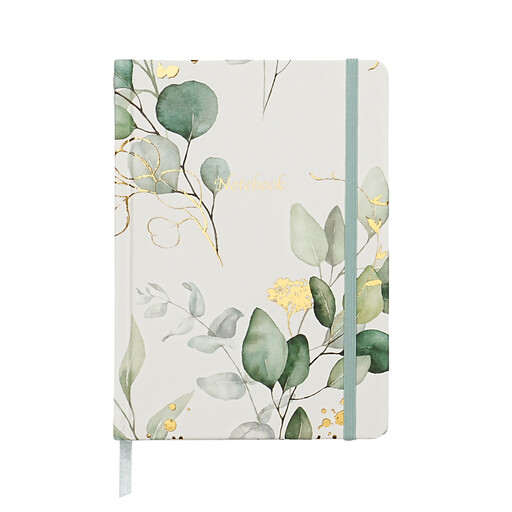
Why this fits the profile: This model combines a sturdy A5 cover with details that suit journaling, business notes and use as a gift notebook.
The specifications list 96 sheets of 100gsm cream paper, a ribbon bookmark and an elastic closure. The choice is therefore based on verifiable features, not just the cover design.
Hardcover, 148 × 210 mm, 100gsm lined offset paper, elastic closure and ribbon bookmark.

Why this fits the profile: The twin-wire spiral is ideal for those who write often, want to fold pages completely back, or need a notebook that lies flat on a desk.
The product information mentions a hardcover, twin-wire binding and elastic closure. This means attention has been paid to protection and closure, not just the pattern on the cover.
A5 size, 96 sheets, 100gsm lined cream paper, hardcover and twin-wire spiral binding.
Choose a hardcover when the notebook will often go in a bag or be used for a longer period. For separate projects or one subject per book, a set of softcover notebooks can be more affordable and lighter.
For a diary or journal, a bookmark and elastic closure are useful. You can quickly find your last page and prevent loose papers from falling out of the book. For office supplies, the size is especially important: A5 offers enough room for meeting notes without taking up too much desk space.
A floral or botanical design can work well as a gift notebook, but check the contents first. The Jubiluu A5 models with botanical covers list 96 sheets, lined paper, an elastic closure and a ribbon bookmark. Just be aware that some other variants are described as A6, despite similar product titles.
We’ve put together a full, up-to-date list of products that fully meet these strict selection criteria and comply with current European safety regulations.
Yes. The size of approximately 148 × 210 mm offers space for lectures, to-do lists, work notes and journaling. It’s larger than A6, but usually still easy to carry.
100gsm paper is thicker than 80gsm paper and can limit show-through. That doesn’t mean every fountain pen ink will behave the same way. It’s best to test your own pen, especially with broad nibs or wet ink.
The lifespan depends on how often you open it, how much you write and how you carry it. A hardcover protects the pages, while an elastic closure keeps the book shut. Store it in a dry place and wipe the cover clean with a soft, dry cloth. For models with a ribbon or elastic, remember that small parts should be kept out of the reach of young children.
