
Vandaag of morgen in huis

Kwaliteit gegarandeerd

Welkomstaanbiedingen ontgrendelen: GRATIS bezorging | Tot 80% korting | Gratis 30 dagen JoyPlus-proefperiode
Download de app
Loose papers on your desk, post piling up and files that keep going missing: an A4 wall-mounted file holder can help you stay on top of everyday clutter. However, not every file holder is right for every wall, paperwork flow or workspace. A model that looks compact, for example, may not be deep enough for full folders. And product titles do not always make the mounting requirements and load capacity clear.
This buying guide will help individuals, home workers, students, schools and business professionals compare their options.
A six-compartment wall file organiser may seem like an obvious choice, but be sure to check the dimensions of each compartment too. An A4 document measures around 21 x 29.7 cm. For a landscape A4 holder, width is especially important; for vertical document storage, each compartment must also be tall enough. Pay attention to the depth as well. A shallow compartment is suitable for loose papers, but less practical for thick files.
A metal file holder may be sturdy in itself, but the fixings also affect how securely it hangs. A hollow plasterboard wall generally needs different wall plugs from concrete or brick. Check that the screws supplied are suitable for your wall type. If necessary, use appropriate wall anchors and space multiple holders carefully across the available area.
Terms such as ‘durable’, ‘space-saving’ or ‘high-quality finish’ tell you little without measurable details. Instead, look at the material, dimensions, weight, number of compartments and included components. A powder-coated finish may help protect the metal and make it easier to clean, according to the product description. However, do not assume the holder is suitable for a damp room unless this is specified.
First, measure the space on your wall. Allow for:
A single A4 file holder may be enough for incoming post. For a home office with several paperwork flows, a six-tier office wall organiser makes more sense.
Metal is a commonly used material for mesh wall file holders. It is less prone to warping than thin plastic, but the holder’s overall weight also affects how it should be mounted. According to the product information, a powder-coated finish is easy to wipe clean and can help limit oxidation and rust. Treat this as a product specification, not a guarantee that the holder is suitable for every environment.
Check that the edges are finished smoothly too. Smooth edges are practical for everyday use in schools and shared workspaces. For cleaning, a soft, dry cloth is generally sufficient for the metal models mentioned; vigorous scrubbing could put unnecessary strain on the finish.
Check whether:
If no specific load capacity is given, do not use the holder to store heavy lever-arch files. Spread full files across several compartments and check the screws periodically.
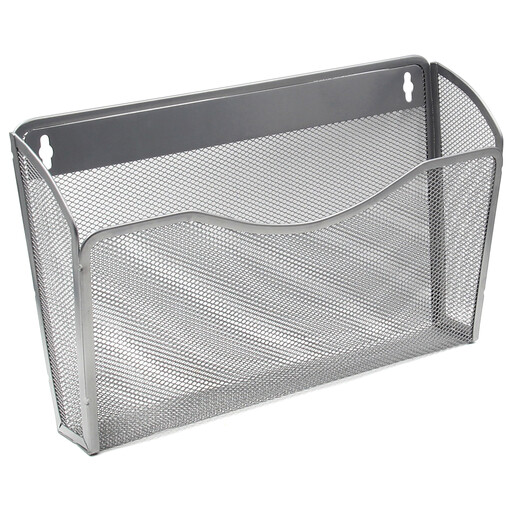
Why it suits this user type: A single holder is an easy way to organise post, current paperwork or documents in a small study area.
You won’t end up with more capacity than you need if you only want to organise one stream of paperwork. It measures 35 x 9 x 21,5 cm, and mounting hardware is listed as included.
Metal mesh design, landscape A4 format, and can be mounted on its own or alongside other holders.
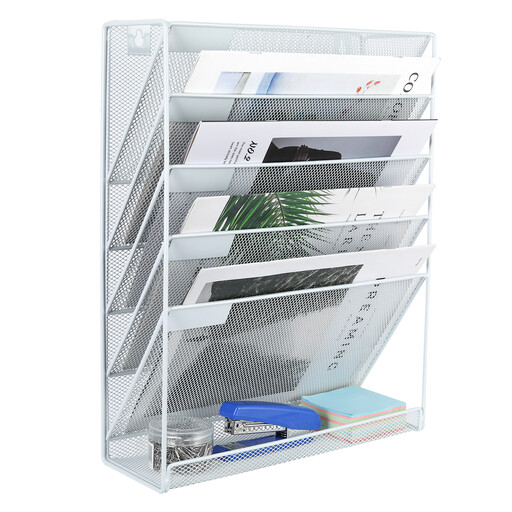
Why it suits this user type: Six categories help keep things organised in a home office, for paperwork or in a shared workspace.
The layout is clearly specified: six compartments, integrated label plates and a bottom tray for small items. That means you won’t need to improvise your own compartments.
40,5 cm high, 32,5 cm wide, weighs 1,44 kg and can also be used freestanding, according to the product description.
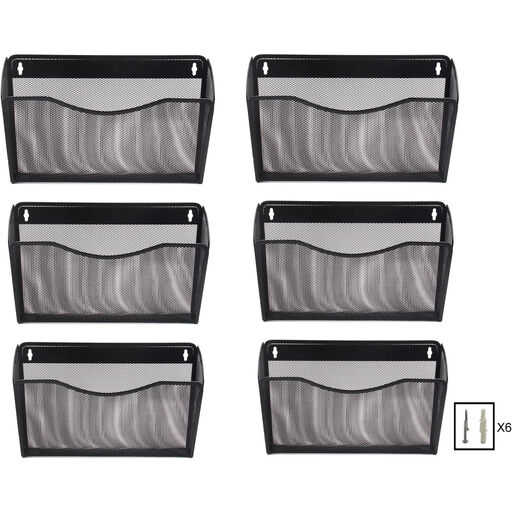
Why it suits this user type: A set of six separate holders is well suited to schools, offices or households with several regular streams of paperwork.
You’re not tied to one fixed layout: according to the product description, the six units can be mounted together or separately.
Each holder measures 35 x 9 x 21,5 cm, is designed for standard A4 documents and comes with mounting screws.
Choose a wall-mounted letter holder for incoming post and documents you want to grab quickly. A wall-mounted magazine holder or landscape A4 holder is better suited to magazines, forms and project papers. For an office with different statuses — such as ‘to process’, ‘in progress’ and ‘archive’ — a multi-tier wall organiser makes it easier to keep track of everything.
Position the holder at a height that allows everyone to reach the top and bottom compartments. Label the compartments clearly and don’t overload them beyond what the mounting and product information allow.
We’ve put together a full, up-to-date list of products that meet these strict selection criteria and the applicable European safety regulations.
First, check the mounting points and use plugs suitable for plasterboard. The screws supplied are not automatically right for every wall. If the holder is heavy or fully loaded, it’s best to fix it to a stud or use a suitable cavity wall plug.
Its lifespan depends on the load, how it is mounted, exposure to moisture and how often it is used. According to the product descriptions, the metal holders mentioned have a powder-coated finish and are designed for regular use. Check the screws from time to time and remove dust with a soft cloth.
That depends on the compartment depth and the stated format. A standard A4 wall holder is mainly designed for loose documents, post, magazines and thinner folders. A shelf or specialist storage cabinet is often more suitable for heavy lever-arch files.
